IoT in transportation gives engineering teams direct access to vehicle telemetry, sensor streams, and system states, in real time, across entire fleets. The challenge is not collecting data but structuring it so every downstream system receives consistent, usable information without adding architectural complexity. This article shows what a production-ready setup looks like and where MQTT fits in.
IoT in Transportation: Key Takeaways
- IoT in transportation replaces fragmented point-to-point integrations with a single structured data layer across vehicles, cargo sensors, and depot infrastructure.
- MQTT is a widely used protocol for transporting IoT telemetry because persistent sessions and QoS levels can improve delivery reliability even when vehicles temporarily lose cellular coverage.
- A production-ready transport IoT architecture typically includes a structured MQTT topic namespace, appropriate high-availability broker infrastructure, RBAC, and connections into TMS, ERP, and fleet analytics systems through MQTT bridges or a Kafka pipeline.
- Cedalo is an enterprise MQTT platform for transport IoT deployments, built on Eclipse Mosquitto, an open-source MQTT broker whose development is driven by Cedalo and which has reached over 600 million Docker pulls.
What Does IoT in Transportation Cover?
IoT in transportation refers to connected systems that generate, transmit, and act on operational data across vehicles, infrastructure, and logistics networks. This covers road freight, rail, urban transit, port operations, and aviation ground handling. Any environment where physical assets move and operational data needs to reach decision-making systems in real time.
The distinction from consumer IoT matters here. Transport IoT operates in conditions where network connectivity fluctuates, hardware runs in harsh environments, and data loss directly affects operational reliability. GPS tracking apps on a smartphone and a fleet telematics system managing 500 trucks operate on fundamentally different requirements.
Key Data Sources in Transportation IoT
- Vehicle-mounted sensors: engine temperature, fuel consumption, brake pressure, axle load, door status
- GPS and positioning modules: real-time location, geofence events, route deviation alerts
- Cargo sensors: internal temperature, humidity, shock detection, tamper alerts
- Infrastructure signals: dock sensors, gate status at logistics hubs, traffic control units, weigh-in-motion systems
- Driver assistance data: harsh braking events, fatigue detection signals, lane departure events
Each of these sources produces data at different rates and in different formats. A production-grade architecture structures all of it into a shared data layer before it reaches analytics, TMS, or ERP systems.
Where do IoT in Transportation and Logistics Converge?
IoT in transportation and logistics shares the same data infrastructure problem: assets move across networks, change hands, and pass through multiple systems and each transition creates a potential gap in visibility. A truck leaving a warehouse connects transportation data (vehicle state, route) with logistics data (cargo condition, order status, delivery confirmation).
A shared MQTT topic structure covers both domains. The same broker that receives engine telemetry from a vehicle also handles temperature readings from the cargo compartment and gate status updates from the destination depot. This is where IoT solutions for transportation and logistics create measurable operational value: not by connecting one system to another, but by creating one data layer that serves all systems simultaneously.
Which IoT Applications in Transportation Replace Reactive Decisions with Live Fleet Data?
The most mature IoT applications in transportation share a common characteristic: they replace reactive decision-making with data-driven action. The value is not in collecting more data but in making specific operational processes faster and more reliable.
Fleet Telematics and Predictive Maintenance
Continuous telemetry from engines, transmissions, and tires allows maintenance teams to act before failures occur rather than after. A sensor detects abnormal vibration patterns in a wheel bearing; the broker routes this event to a maintenance scheduling system; a service appointment gets created automatically.
The data model matters as much as the sensor coverage. Without a consistent topic structure and payload format across vehicle types, analytics tools receive heterogeneous data that requires constant normalization. A well-designed MQTT topic hierarchy, such as fleet/{vehicle-id}/powertrain/vibration, removes this friction by standardizing how data from different vehicle generations arrives at the same endpoint.
Real-Time Cargo Monitoring and Cold Chain Tracking
Pharmaceutical logistics, food transport, and high-value automotive parts all share one requirement: proof that cargo stayed within specified conditions throughout transit. IoT sensors in the cargo space transmit temperature and humidity data at configurable intervals.
At QoS level 1 or 2, the MQTT broker confirms message delivery even over intermittent cellular connections. This matters specifically on long-haul routes where connectivity drops and recovers repeatedly. The broker can buffer messages during outages and deliver them once the connection returns, provided session persistence, expiry settings, and broker resources are configured accordingly. This helps downstream systems maintain a more complete data record with fewer gaps.
Traffic and Route Optimization Through Connected Infrastructure
Vehicle-to-infrastructure (V2I) communication transmits signal phase and timing data, incident alerts, and dynamic speed limits directly to fleet management systems. Buses receive early green signals at intersections; logistics vehicles get rerouting instructions before they reach congestion points.
The data volumes here remain manageable, but latency requirements are strict. MQTT’s publish-subscribe model routes infrastructure events to subscribed fleet systems with low overhead and potentially low latency, without requiring each vehicle to poll a central server.
Port and Freight Hub Automation
Crane status, container position, gate access events, and truck arrival notifications all belong to the same operational picture at a port or intermodal hub. Connecting these signals to TMS and ERP systems through direct integrations creates brittle point-to-point dependencies that break whenever a system changes.
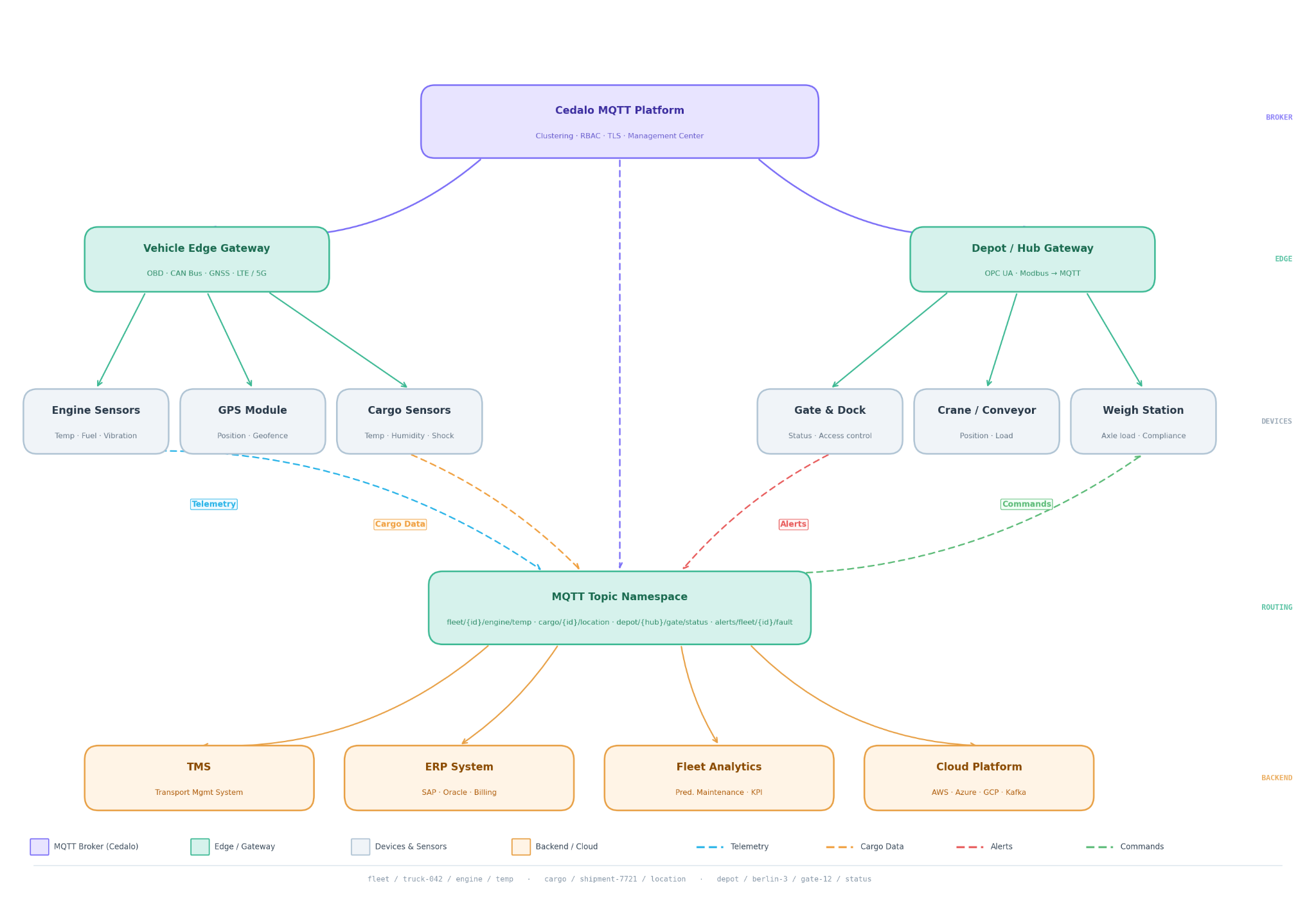
A broker-centered IoT architecture for transportation routes all hub signals through one structured MQTT layer. The IoT integration model keeps downstream systems decoupled: when a TMS updates, the broker connection remains stable because the interface is standardized, not custom-coded per system.
What Architecture Do IoT Solutions for Transportation Require?
Production-grade IoT solutions for transportation need an architecture that stays stable when network conditions vary, device counts grow, and backend systems change. A broker-centered setup with a structured topic namespace covers all three requirements without adding specialized middleware for each integration.
How MQTT Handles Vehicle Connectivity Under Unreliable Network Conditions
MQTT’s architecture fits mobile transport scenarios better than HTTP or AMQP for three concrete reasons:
- Persistent sessions: The broker retains subscriptions and queued messages when a vehicle loses connectivity. On reconnect, the client receives buffered messages without re-subscribing.
- Last Will and Testament (LWT): When a vehicle connection drops unexpectedly, the broker can publish a predefined LWT message to a status topic. Fleet management systems can detect that the vehicle went offline without relying solely on application-level timeout logic.
- QoS levels: QoS 1 guarantees at-least-once delivery; QoS 2 guarantees exactly-once delivery. Cargo condition data, where duplicates at billing or compliance systems cause direct errors, travels at QoS 2. High-frequency GPS pings, where occasional loss is acceptable, travel at QoS 0.
Structuring MQTT Topics for Transportation Fleets
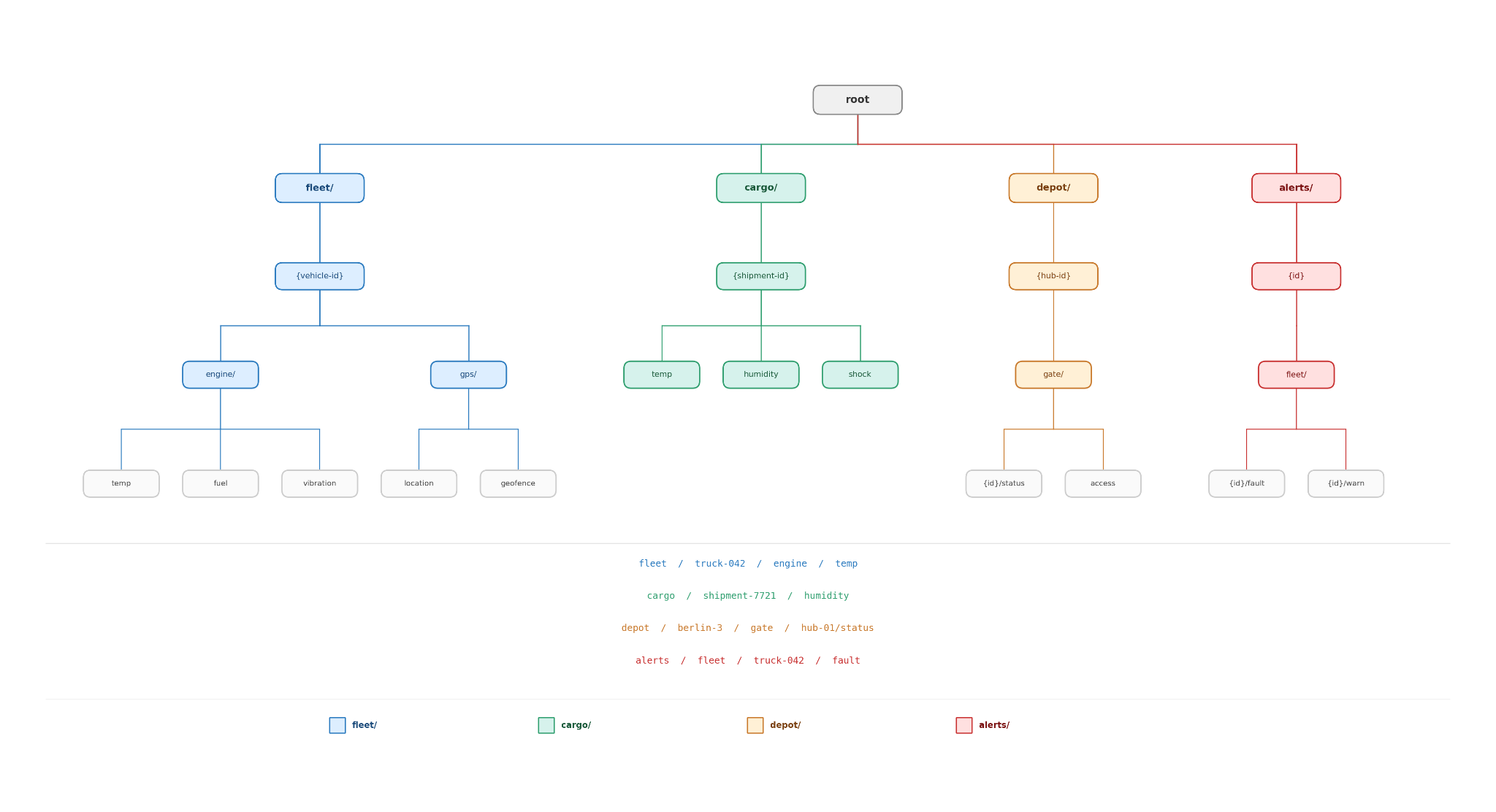
Topic design is not a configuration detail, it determines how every downstream system consumes data and how monitoring tools interpret the overall state of the fleet. A flat or ad hoc topic structure creates ambiguity that grows exponentially as fleet size increases.
A hierarchical topic namespace for a transport operation looks like this:
| Level | Example Topic | Purpose |
|---|---|---|
| Fleet telemetry | fleet/truck-042/engine/temp | Vehicle health monitoring |
| Cargo | cargo/shipment-7721/location | Real-time shipment tracking |
| Infrastructure | depot/berlin-3/gate-12/status | Hub operational status |
| Alerts | alerts/fleet/truck-042/fault | Critical event routing |
| Commands | cmd/fleet/truck-042/speed-limit | Remote configuration |
Edge Processing vs. Cloud Aggregation in Transport IoT
Not all data needs to reach the cloud. Decisions requiring sub-second response times (a brake pressure threshold breach, a temperature alert on a pharmaceutical shipment) happen at the edge. The edge gateway evaluates sensor data locally and publishes an alert to the broker, which routes it to the cab display and the fleet operator dashboard simultaneously.
Data that feeds historical analysis, AI model training, or cross-fleet benchmarking flows to the cloud. The edge-to-cloud architecture determines which processing happens where, based on latency, bandwidth, and data retention requirements. The MQTT broker sits at the center of both flows, routing messages to local subscribers and cloud bridges from a single configuration.
How Do You Build a Production-Ready IoT Setup for Transportation?
Moving from a working prototype to a production-ready deployment requires addressing five architectural requirements that prototypes typically skip.
| Step | Requirement |
|---|---|
| Step 1 | Define your data sources and topic namespace. Map every sensor type, vehicle category, and infrastructure asset to a topic hierarchy before writing a single line of integration code. Changing the namespace later breaks all downstream subscriptions. |
| Step 2 | Deploy a clustered MQTT broker with high-availability failover. A single-broker setup creates a single point of failure. Clustering distributes load and keeps vehicle connections active when a broker node fails. |
| Step 3 | Configure role-based access control per vehicle group and system. RBAC at the topic level prevents a logistics application from publishing to vehicle command topics and prevents a vehicle from reading cargo billing data. |
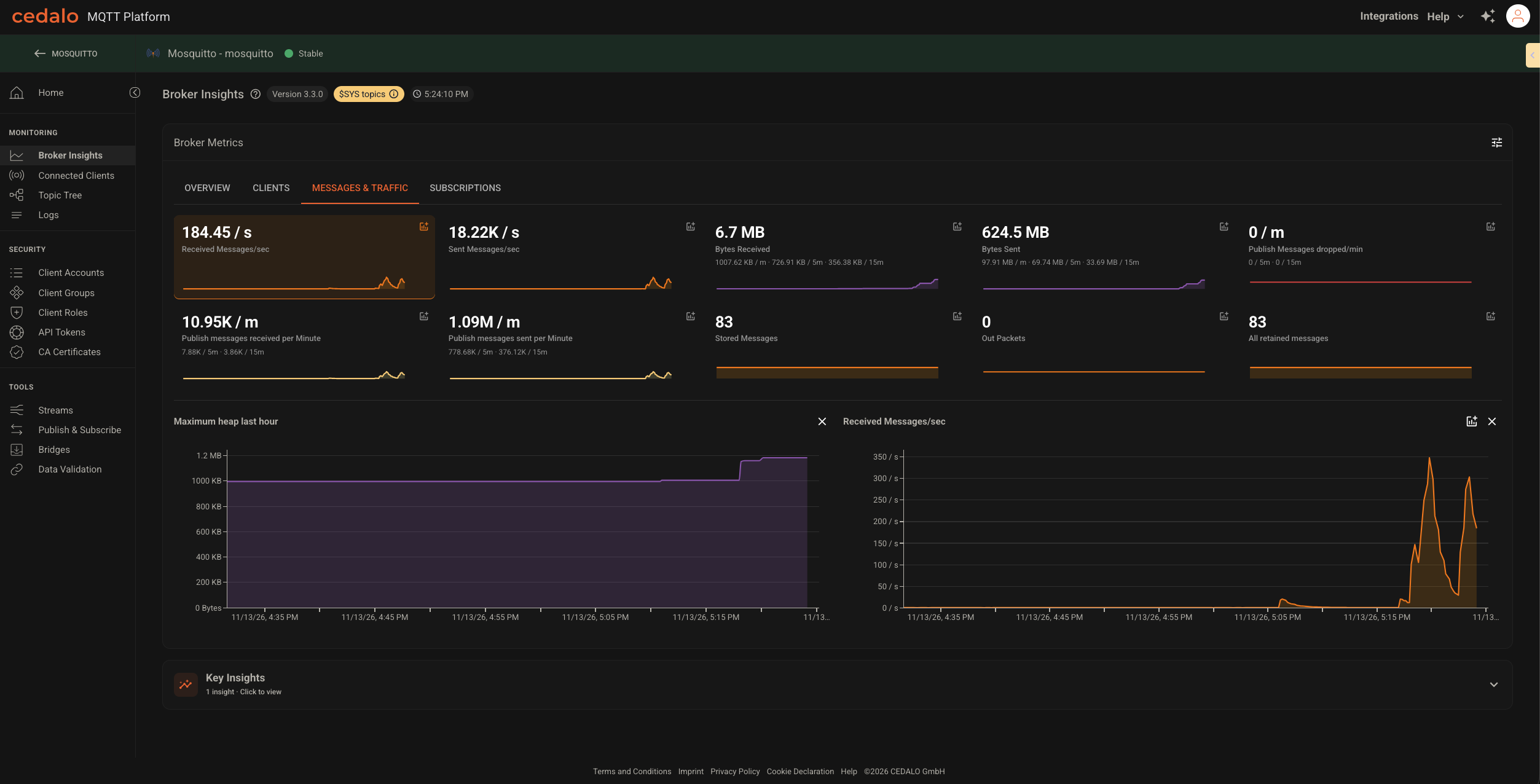
| Step 4 | Set up centralized monitoring for broker health and message flow. Message throughput, client connection counts, and error rates belong in a central dashboard. Anomalies in message flow surface connectivity issues before they affect operations. |
| Step 5 | Connect backend systems via MQTT bridge or Kafka. TMS, ERP, and fleet analytics platforms consume MQTT data through bridges or a Kafka pipeline. Direct MQTT-to-Kafka integration can reduce or, in some cases, eliminate the need for custom middleware. |
Why a Single Platform Replaces Multiple Point-to-Point Tools
Most transport IoT setups accumulate tools: one for monitoring, one for broker configuration, one for user management, and one for debugging. Each tool adds an integration dependency and a separate learning curve for the operations team.
The Cedalo Management Center consolidates broker configuration, real-time monitoring, client visibility, topic inspection, and multi-broker management in one interface. Teams that previously maintained separate observability stacks for their MQTT infrastructure gain a single operational view across brokers, across sites, and across vehicle groups.
What Makes Cedalo the Right MQTT Foundation for Transportation IoT Projects?
Cedalo contributes to and drives the development of Eclipse Mosquitto, an open-source MQTT broker with over 600 million Docker pulls. The Cedalo MQTT Platform extends Mosquitto with enterprise features that IoT deployments often need early in production rollouts.
| Capability | Open-Source Mosquitto | Cedalo Platform |
|---|---|---|
| Clustering / High Availability | ✗ | ✓ |
| Centralized Monitoring Dashboard | ✗ | ✓ |
| RBAC + Audit Trail | Limited | ✓ |
| Kafka integration | Manual | Via bridge |
| Multi-Broker Management | ✗ | ✓ |
| Enterprise Support & SLAs | ✗ | ✓ |
Teams that already run Mosquitto in their transport infrastructure move to the Cedalo Platform without replacing their broker. The platform adds clustering, security governance, and observability on top of the same proven broker core that their teams already know.
For transport operations that span multiple depots, regional hubs, or country borders, the multi-broker management capability matters concretely: one interface controls all broker instances, applies consistent security policies, and surfaces metrics from the entire deployment in a single view.
The MQTT Foundation That Keeps Fleet Data Flowing at Any Scale
A transport IoT setup that collects data is not the same as one that acts on it. The difference lies in the infrastructure: a structured topic namespace, a broker that stays online under load, and backend integrations that deliver data where decisions happen. Teams that build this foundation reach production faster and scale without reworking their architecture.
Your advantages with Cedalo:
- Clustered broker architecture with automatic failover improves availability and helps maintain service continuity when individual nodes go down.
- The Management Center covers broker health, topic activity, and client status without additional observability tools.
- Built on Eclipse Mosquitto (600M+ downloads), with the clustering, security, and integrations that production transport environments require.
- Native bridges to Kafka, AWS, Azure, and GCP connect fleet data to streaming and cloud backends. TMS and ERP systems consume that data through those bridges or a Kafka pipeline.
Start Your Transport IoT Project on a Solid Foundation
Reduce data gaps between vehicles, depots, and backends. One MQTT platform helps connect your fleet with a production-ready foundation.
IoT in Transportation: Frequently Asked Questions
What regulations apply to IoT deployments in transportation?
Transport IoT deployments in Europe fall under GDPR when processing driver or location data, industry-specific standards for cold chain documentation, and sector regulations such as the EU’s Smart Tachograph requirements for commercial vehicles. Depending on the data processed and the regulatory context, cross-border freight operations typically require appropriate controls for data governance, traceability, and secure transmission.
How does IoT in transportation handle connectivity in low-coverage areas like tunnels or remote routes?
Edge gateways buffer messages locally when cellular coverage drops and retransmit them once the connection recovers. MQTT’s persistent sessions and QoS mechanisms can reduce the risk of message loss during outages, especially when session handling, expiry settings, and reconnect behavior are configured correctly, making the architecture suitable for long-haul routes with unreliable infrastructure.
What is the typical migration path from legacy fleet telematics to a full IoT architecture?
Most teams start by connecting existing telematics hardware to an MQTT broker via gateway adapters, without replacing devices. The data layer gets structured incrementally. First telemetry, then cargo monitoring, then backend integrations. This approach avoids big-bang replacements and lets operations validate each layer before expanding.
How does IoT in transportation contribute to CO₂ reduction and sustainability targets?
Continuous engine and route data identify idling patterns, suboptimal load distribution, and inefficient routes that fleet managers previously estimated manually. Real-time feedback to drivers and automated route adjustments measurably reduce fuel consumption, giving logistics operators verifiable data for ESG reporting and emissions compliance.
How does Cedalo support transport IoT deployments that span multiple countries or fleet operators?
Cedalo’s multi-broker management consolidates broker instances across regions into one controlled environment, with consistent RBAC policies and topic structures applied across all locations. This prevents configuration drift between national fleets and gives central operations teams a single monitoring view regardless of where vehicles or depots are located.
How does Cedalo compare to cloud-native IoT platforms like AWS IoT Core for transportation use cases?
Cedalo runs on-premises, in the cloud, or in hybrid setups, giving transport operators full control over data residency and avoiding vendor lock-in. Unlike managed cloud services, Cedalo’s clustering and broker configuration stay under the operator’s control, which matters for fleets subject to strict data sovereignty requirements or operating in regions with limited cloud connectivity.