The Internet of Things (IoT) connects physical assets, sensors, machines, gateways, and embedded devices, to software that can act on the data they produce. On its own, a connected device only generates signals. The value appears when those signals reach the systems that monitor, analyze, and control operations. That step is IoT integration.
IoT integration is successful when devices, data pipelines, and existing IT systems function as a single connected environment. Many teams know their technical goals but run into difficulties when protocols, data models, and system behaviors are incompatible. A clear integration approach helps create a configuration that works reliably in production and supports real operational outcomes.
IoT integration: key takeaways
- IoT integration creates a unified data layer that connects devices, edge systems, and enterprise applications without isolated data silos.
- Scalable IoT integration relies on clear namespaces, stable routing, protocol bridging, and coordinated governance across OT and IT teams.
- The real IoT integration challenges cluster around three themes: device heterogeneity, scalability, and reliability.
- Cedalo provides a reliable MQTT backbone, built on Eclipse Mosquitto, that strengthens IoT integration across industrial and enterprise environments.
What is IoT integration?
IoT integration connects devices, platforms, and enterprise systems through a unified data and communication structure. It creates a setup where device signals reach the intended applications in a consistent format, and all systems operate on the same data foundation. This removes isolated data pockets and creates a continuous flow across OT, edge, and IT.
How does IoT integration connect technical layers?
A useful way to picture IoT integration is as a stack of layers, where each layer adds structure and context to the data as it moves from the machine toward the business.
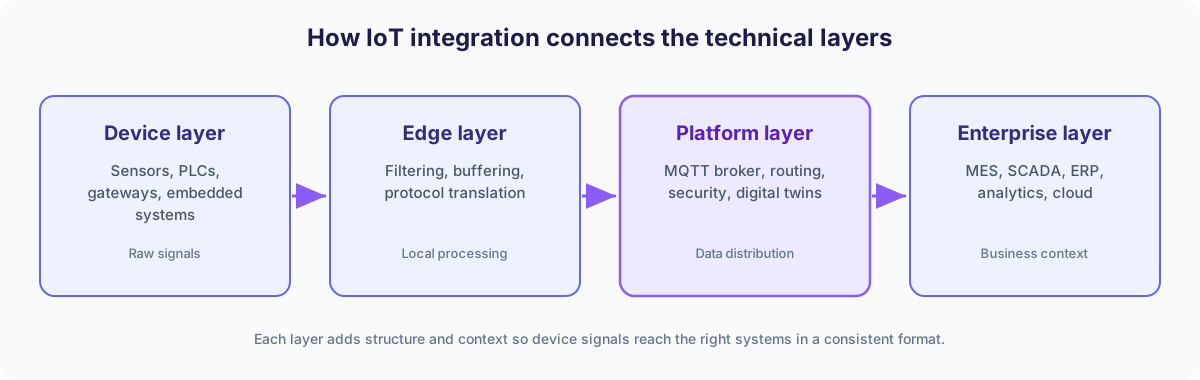
- Devices and sensors: Raw signals from machines, PLCs, gateways, or embedded systems.
- Edge layer: Local processing, filtering, buffering, and protocol translation.
- IoT platforms: Routing, device management, security functions, digital twins, and automation logic.
- Enterprise systems: MES, SCADA, ERP, CRM, analytics, data lakes, or cloud platforms.
Core functions that define IoT integration
- Protocol bridging: MQTT, OPC UA, Modbus, REST APIs, and proprietary protocols often coexist. IoT integration translates them into a format downstream systems can use consistently.
- Data normalization: Devices speak different “dialects.” IoT integration aligns payloads, units, timestamps, and structures into a unified model that fits operational and analytical workflows.
- Event routing and stream handling: Machine states, thresholds, telemetry, and commands must reach dashboards, apps, or automation rules reliably. Predictable routing creates trust across teams.
- Secure identity and access control: Devices need verifiable identities with controlled access paths. IoT integration provides this without exposing the wider environment.
- Bidirectional communication: Beyond reading data, IoT integration handles controlled write-back actions such as configuration updates, command messages, and workflow triggers.
Which architectural models shape a scalable IoT integration setup?
A scalable IoT integration setup depends on architectures that keep data flow predictable, support mixed device environments, and avoid tight coupling across systems. In practice, three commonly used models appear again and again.
#1 Hub-based IoT integration for structured device onboarding
A hub pattern gives organizations a controlled entry point for new devices. Identity checks, certificates, and segmentation are handled in one place, which works well in settings where each device must be validated before reaching IT systems.
Typical characteristics:
- central identity and certificate handling
- defined access points for devices
- clear segmentation between networks
This pattern becomes restrictive when several systems need the same signals or when data volume rises, which is where a broker-centered approach takes over for a smoother transition to continuous, many-to-many data exchange.
#2 Broker-centered IoT integration for continuous data exchange
Powered by the publish/subscribe pattern through protocols such as MQTT, broker-centered designs form the high-speed backbone of modern IoT integration. Publishers and subscribers stay independent, which helps teams expand their environment without breaking existing workflows.
Strengths include:
- independent communication paths for OT assets, IT platforms, and cloud systems
- clustering options for high availability and, depending on the broker architecture, load distribution
- shared topic structures across teams and applications
- real-time delivery with minimal network overhead, scaling across thousands of devices
This model fits mixed environments where machines, sensors, and enterprise systems rely on the same real-time data stream. It is also the natural foundation for a Unified Namespace (UNS): a single, structured, broker-backed hierarchy that every system can read from and write to. An enterprise broker such as Pro Mosquitto provides the clustering, security, and monitoring that this central role demands.
#3 Event-driven IoT integration for real-time system behavior
Event-driven designs route incoming values into functions, streaming platforms, or workflow engines that act immediately on device signals. This supports use cases where system output must react within seconds, such as automated routing or production checks.
Typical destinations:
- serverless functions
- streaming platforms such as Kafka or Pulsar
- workflow engines for routing and validation
Build a reliable IoT integration foundation
Cedalo provides a stable MQTT backbone that keeps IoT data consistent and supports mixed OT/IT setups across multiple sites.
What are the main IoT integration challenges in real projects?
IoT integration usually struggles for three connected reasons: the heterogeneity of the devices involved, the scalability pressure that builds as deployments grow, and the reliability required once real operations depend on the data. These issues appear early whenever identity, structure, and routing are not governed consistently.
Device heterogeneity
Different device generations introduce incompatible protocols, inconsistent payloads, timestamp variations, and unclear lifecycle states. Shifting field names, varying units, or duplicate messages distort analytics and break event logic. Without normalization and a shared data model, payload drift and version conflicts spread quickly downstream.
Scalability
Large deployments add numerous connections, growing topic structures, and complex security requirements, while many ERP, MES, and CMMS systems cannot absorb high-frequency, event-driven data. Teams have to adjust streaming, buffering, and delivery formats to avoid overload, and they need unified governance so that OT, IT, and cloud teams do not apply conflicting naming rules, routing logic, or certificate policies. Without shared conventions, scaling becomes inconsistent and hard to correct.
Reliability
Once operations depend on IoT data, delivery has to be predictable. Drift in payloads, metadata, and timestamps degrades KPIs over time, and point-to-point interfaces multiply the number of places a change can break something. A broker-first design with consistent identities, fixed data contracts, and stable routing keeps data trustworthy across analytics, automation, and operational systems.
Security considerations in IoT integration
Security challenges in IoT environments arise from the gap between OT device limitations and IT security expectations. Many field devices cannot run modern security agents or support frequent updates, while IT requires hardened endpoints, segmented networks, and short certificate rotation cycles.
Zero-trust models demand mutual authentication and strict access boundaries, conditions many industrial devices cannot natively fulfill.
A shared security framework must define:
- how device and gateway identities are issued and maintained,
- which certificate routines and expiration cycles apply across OT and IT,
- how exceptions are handled for constrained devices,
- and how segmentation and authentication are enforced without disrupting operations.
At the broker level, much of this is enforced through fine-grained access control. Mosquitto’s dynamic security plugin, for example, lets you manage clients, roles, and per-topic permissions at runtime, so identities and access paths can evolve with the deployment instead of requiring broker restarts. When both sides follow consistent rules, security scales predictably across sites.
Identity, routing, and structure as core requirements for IoT integration
A stable integration setup needs:
- unique identities for devices, gateways, and consuming systems
- namespace rules that keep topics and endpoints predictable, ideally organized as a Unified Namespace
- routing logic that avoids bottlenecks
- conventions for payloads, metadata, and lifecycle states
These rules prevent uncontrolled growth and keep data usable across analytics, automation, and operational systems.
How does an IoT integration strategy guide decisions?
A strong IoT integration strategy defines the rules that keep data flow predictable as systems scale. It clarifies which signals matter, where processing occurs, and how OT and IT coordinate changes.
Core elements include:
- determining which signals stay at the edge vs. flow into IT or cloud systems
- defining device and gateway identities
- establishing shared conventions for routing, APIs, and payload structures
- setting lifecycle rules for onboarding, updates, and retirement
By aligning these fundamentals early, teams avoid redesigns, reduce friction, and maintain consistent behavior across devices, gateways, and enterprise systems.
How do teams shape the IoT data model before connecting devices?
The IoT data model puts the strategy into a concrete, scalable structure. It gives each asset a clear place in the namespace and ensures data stays consistent across environments.
Important components are:
- stable device and gateway IDs
- grouping rules for lines, zones, or logical domains
- topic or API structures that scale without renaming
- metadata, payload, and timestamp standards
- lifecycle definitions aligned with the overall strategy
Defining the model before devices go live prevents uncontrolled growth, keeps data traceable, and ensures downstream systems can rely on consistent structures.
How to align IoT integration patterns in established IT environments?
Most enterprises follow recurring patterns when connecting IoT data to existing systems. SCADA and MES consume operational states and alarms via MQTT, REST, or adapters. ERP and planning tools rely on enriched or aggregated values, while analytics platforms and data lakes ingest structured, timestamp-clean data via streaming or batch connectors.
These patterns keep each system focused on the data volume and format it can reliably handle.
Enterprise system connectivity across SCADA, MES, ERP, CMMS, and analytics tools
Different enterprise systems require different structure and timing:
- SCADA & MES → tightly timed operational data
- ERP & CMMS → enriched or aggregated data for planning and maintenance
- Analytics → consistent telemetry for monitoring and modeling
A stable integration design assigns each system the appropriate data type and delivery frequency.
Clean handoff across OT and IT boundaries
A clean OT/IT handoff defines which signals stay in the OT domain, which move into enterprise systems, and which require long-term storage. It ensures consistent identity mapping so devices, lines, and locations remain traceable. Clear boundaries reduce load on IT systems and maintain stable operations.
Managing interfaces when multiple systems need the same IoT data
When multiple systems rely on the same IoT signals, point-to-point interfaces cause drift and high maintenance. A broker-first approach distributes a single structured data stream to all consumers:
- consistent payloads and naming
- fewer interfaces to maintain
- predictable delivery across OT and IT
This model scales cleanly as new systems, sites, or use cases are added.
Build IoT integrations that fit your existing systems without rework
Cedalo provides a reliable MQTT backbone for clean data flow, stable scaling, and predictable behavior across OT and IT environments.
Which components form a robust IoT integration platform?
A strong IoT integration platform combines several building blocks that keep data flow stable, predictable, and ready for scaling.
| Component | Purpose |
|---|---|
| MQTT broker layer | Handles continuous device communication, topic routing, and high-volume telemetry. |
| Gateway and edge layer | Normalizes payloads, buffers data, and bridges protocols in constrained environments. |
| Device and identity management | Assigns identities, certificates, and access rights for devices and gateways. |
| API and integration layer | Delivers structured data into MES, ERP, analytics platforms, and cloud services. |
| Monitoring and observability | Tracks message behavior, throughput, client states, and system load. |
Generic cloud IoT suites often limit control over routing and namespaces. Industrial-grade platforms provide deterministic behavior across multiple sites.
MQTT broker capabilities in large IoT deployments
A strong MQTT broker acts as the core data layer. Clustered instances handle high message volume, support thousands of clients, and route telemetry reliably across locations. The Cedalo Management Center adds central control, monitoring, and access management across all of those brokers from one interface.
Middleware functions for mapping, routing, and orchestration
Middleware standardizes incoming data by bridging protocols, normalizing payloads, aligning timestamps, and routing messages. In event-driven environments, it forwards signals to streaming or automation tools.
Integration of IoT data into enterprise and manufacturing systems
A consistent data path helps SCADA, MES, ERP, CMMS, and analytics tools work with the same trusted information instead of isolated feeds.
Data push vs. pull in IoT-to-IT integrations
- Push: for event-driven, low-latency updates
- Pull: for fixed intervals or limited-throughput systems
A combined model is common
The broker acts as the real-time source, while data lakes or ERP systems pull curated datasets at set intervals.
Identity mapping and long-term data governance
Consistent identities help IT and OT maintain traceability across device generations, lines, and locations.
Governance includes:
- stable device IDs
- aligned timestamps
- lifecycle rules for adding or retiring assets
- long-term retention standards
These practices help teams avoid repeated restructuring as deployments grow.
Strengthen IoT integration outcomes with a reliable MQTT backbone
IoT integration stays manageable when data flow, identities, and routing follow one consistent structure. A broker-centered setup keeps OT, edge, and IT aligned and prevents rework as deployments grow. Cedalo provides the stable MQTT foundation to run this setup across lines, buildings, and sites.
Your advantages with Cedalo:
- Reliable MQTT communication for industrial environments
- Scalable clusters for growing deployments
- mTLS, RBAC, and audit trails for secure IoT operations
- Clean routing for SCADA, MES, ERP, and analytics
Build a stable IoT integration foundation across all your systems
Get a high-performance MQTT platform that keeps device data consistent, supports multi-site scaling, and aligns OT and IT without custom interfaces.
IoT integration: frequently asked questions
How does IoT integration support multi-site industrial environments?
IoT integration creates a unified data layer across plants, lines, and remote facilities. Shared topic structures, stable routing, and consistent identities help teams compare performance, roll out updates predictably, and keep analytics aligned across locations.
How can teams maintain IoT data quality over long operating cycles?
Long-running deployments face drift in payloads, metadata, timestamps, and device behavior. Continuous validation, fixed data contracts, and automated schema checks keep structures stable and prevent analytics from degrading over time.
How does IoT integration reduce dependency on point-to-point interfaces?
A broker-first setup distributes the same structured data to multiple systems without duplicating integration logic. This removes custom code, shortens rollout time, and avoids conflicts between MES, ERP, and analytics platforms.
How can IoT integration support event-driven workflows without overloading existing systems?
A layered design routes high-frequency events into streaming or automation tools, while providing filtered or aggregated datasets to ERP or reporting systems. This keeps low-latency use cases responsive without pushing unnecessary load into legacy applications.
How does Cedalo help teams manage MQTT at scale?
Cedalo provides clustering, predictable failover behavior, and observability features that keep MQTT traffic stable even under rising load. This supports multi-line or multi-site deployments where message volume, client counts, and routing complexity grow over time.
How does Cedalo simplify IoT integration for mixed OT/IT environments?
Cedalo gives teams one controlled MQTT layer for machines, gateways, cloud apps, and enterprise tools. Unified security, topic governance, and central broker management remove friction between OT and IT teams and help standardize data flow across the entire stack.