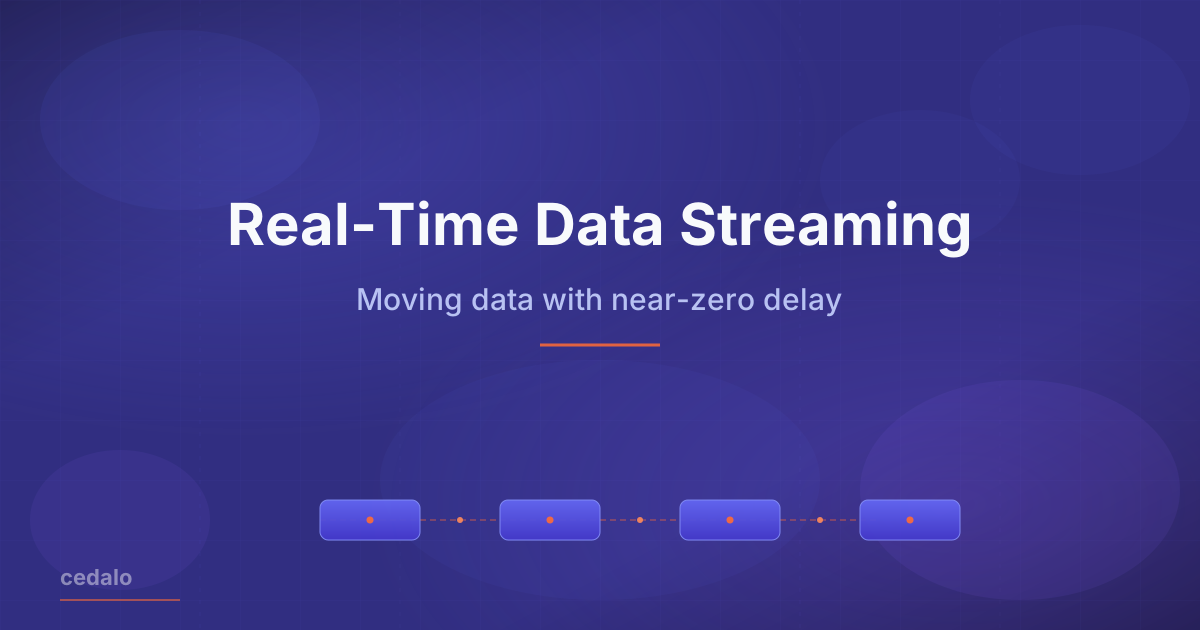
Real-time data streaming delivers continuous information with minimal delay and addresses a recurring challenge: data arrives rapidly, yet traditional pipelines react too slowly. Many engineering teams explore this approach to understand how real-time pipelines function and where they create measurable value.
Real-Time Data Streaming: Key takeaways
- Real-time data streaming moves events continuously through a low-latency pipeline, keeping systems aware of changes as they occur.
- Real-time streaming architectures remain stable under fluctuating load when brokers, processors, and storage layers incorporate buffering, back pressure, scalable resource allocation and failover mechanisms.
- Real-time streaming suits high-frequency telemetry, machine data, automation, and environments where timing directly affects reliability.
- Pro Mosquitto provides a production-grade Mosquitto broker with clustering, monitoring, and secure connectivity for real-time streaming pipelines.
How does a real-time streaming data pipeline work?
Real-time data streaming pipelines move events the moment they occur. Each message flows through a small set of components organized around the broker, which keeps latency low and system behavior predictable. This structure supports high-frequency telemetry, machine data, and event-driven applications across industrial and digital environments.
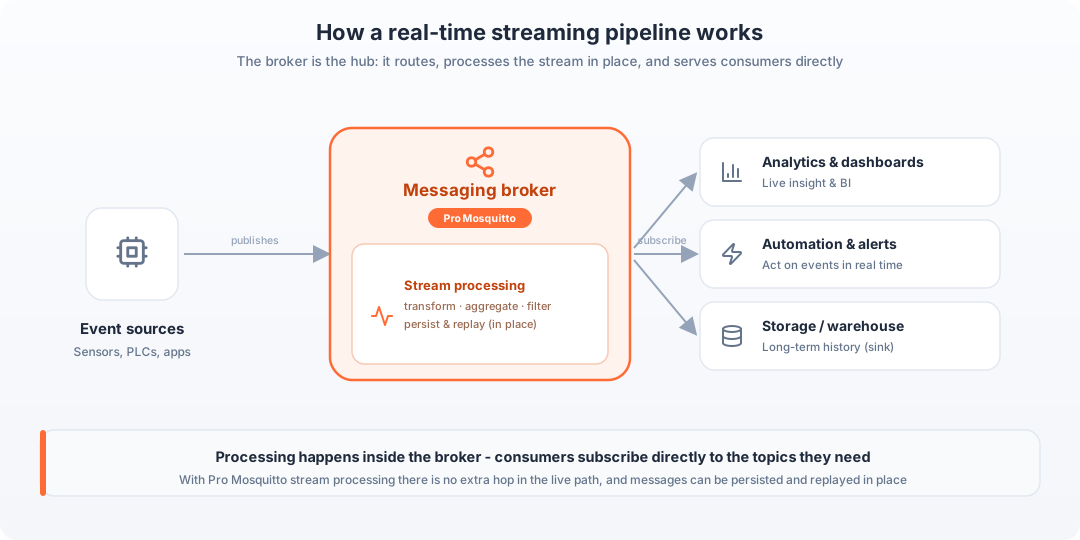
Figure 1: The broker is the hub of a real-time streaming pipeline - it routes and processes events in place while consumers subscribe directly to the topics they need.
Core flow in a real-time streaming pipeline
A typical real-time streaming data setup centers on the broker:
- Event sources publish continuous signals (sensors, Programmable Logic Controllers (PLCs), gateways, apps) to broker topics.
- The messaging broker routes every message by topic - and, with broker-side stream processing, can transform, aggregate, filter, and even persist or replay the stream in place.
- Consumers subscribe directly to the topics they need: live analytics and dashboards, automation and alerts, or storage and warehouse sinks for long-term history.
Because the broker decouples producers from consumers, load on one subscriber never propagates back to the field devices that keep publishing - and processing close to the broker removes an extra network hop from the live path.
Why does real-time streaming architecture stay stable under fluctuating loads?
Real-time stream processing remains stable under fluctuating loads when brokers, processors, and storage layers apply buffering, backpressure, scalable resource allocation, and fault-tolerant paths. These mechanisms keep data flowing even when event volumes shift unexpectedly.
Key concepts in real-time streaming data
| Term | Meaning |
|---|---|
| Topic | Routing channel for publishers and subscribers inside the broker. |
| Back pressure | Mechanism for handling bursts when consumers process slower than producers. |
| Consumer group | Set of consumers that share the load of a stream. |
| Event timestamp | Marker used for ordering, analytics, and stateful processing. |
Real-time streaming vs. batch processing
Real-time data streaming pushes events through a continuous pipeline, while batch processing groups data into scheduled intervals. Both approaches solve different problems. The key question is how timing, workload, and system constraints shape the right choice.
Where does real-time streaming deliver practical advantages?
Real-time streaming data works well when systems must react without delay. Typical drivers include:
- High-frequency sensor readings
- Machine states that change unpredictably
- Event-driven automation or control loops
- Operational monitoring with tight reaction windows
This model limits blind spots because information moves immediately instead of waiting for a batch cycle.
Where does batch processing remain sufficient?
Batch workflows continue to serve scenarios with stable workloads and loose timing requirements. Daily reports, aggregated KPIs, or periodic data transfers fall into this category. Storage engines, data warehouses, and legacy systems often rely on these cycles because they reduce load and simplify planning.
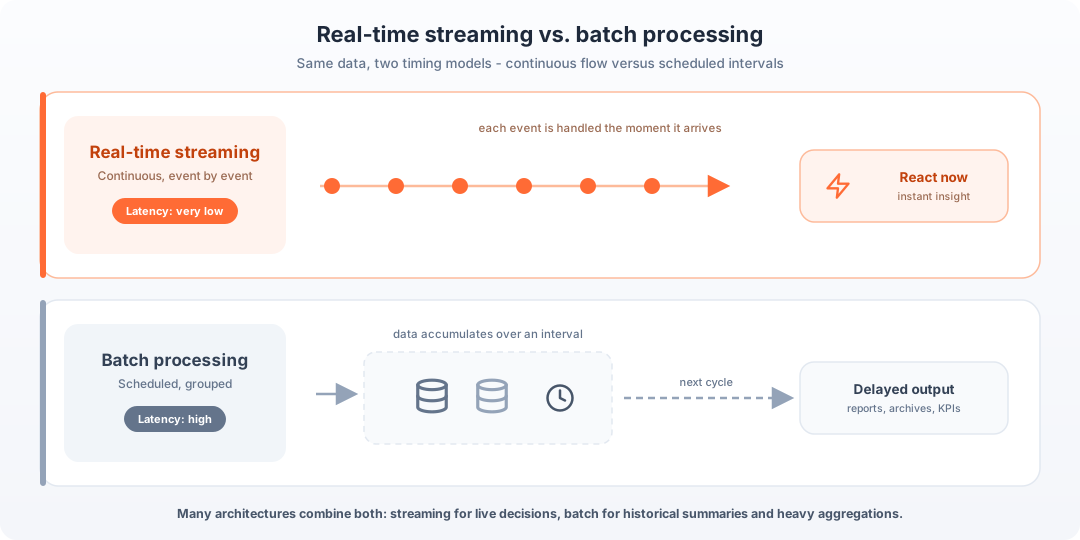
Figure 2: Real-time streaming processes each event the moment it arrives, while batch processing groups data into scheduled intervals.
Why does a real-time data streaming architecture stay stable under fluctuating loads?
Real-time stream processing keeps each component active instead of waiting for fixed intervals. Brokers push events immediately to subscribers. Processors adjust to fluctuating volumes. Storage layers capture history without slowing down the live path. This architecture suits systems with variable loads and time-critical tasks.
A practical comparison between real-time streaming and batch processing
| Aspect | Real-time streaming data | Batch processing |
|---|---|---|
| Timing | Continuous; events flow instantly | Scheduled; data waits for the next cycle |
| Latency | Very low | High |
| Processing model | Event-by-event | Grouped data sets |
| Best suited for | Monitoring, automation, alerts, telemetry | Reporting, archiving, large aggregations |
| Operational impact | Requires robust, scalable pipelines | Lower system pressure and simpler workflows |
Many architectures combine both. A real-time streaming pipeline manages operational decisions, while batch jobs handle historical summaries or cost-intensive transformations. This mix prevents overload in production systems and supports long-term analytics.
Run real-time streaming workloads at scale with the Cedalo MQTT Platform
Set up fast and reliable streaming pipelines with a production-grade Mosquitto broker.
What are key technologies for real-time data streaming?
Real-time data streaming relies on technologies that move, route and interpret events with minimal delay. Several components form the backbone of modern streaming setups, each solving a distinct part of the workload. The tools below represent the core building blocks used across industrial, cloud, and large-scale digital systems.
MQTT brokers for machine data and telemetry
MQTT brokers distribute real-time messages from sensors, PLCs, machines, and edge gateways. Their lightweight design fits IIoT environments where connections fluctuate, bandwidth is limited or devices publish data at high frequency.
Key traits include:
- Topic-based routing
- Low-overhead transport
- Strong support for edge connectivity
- Clear separation between publishers and subscribers
This makes MQTT a strong choice for OT/IT communication, continuous machine telemetry, and modern IT/OT convergence.
Event streaming platforms for high-volume data
Pro Mosquitto includes a native Kafka Bridge that routes MQTT topics directly into Kafka topics without an intermediate adapter - relevant for teams combining OT telemetry with high-volume Kafka pipelines.
Common uses include:
- High-throughput event pipelines
- Real-time analytics
- Log aggregation
- Distributed microservice communication
Stream processing engines for logic in motion
Stream processors apply transformations while data is in motion. Depending on the workload, they handle:
- Filtering and aggregation
- Rule-based decisions
- Window operations
- Pattern detection
These engines operate continuously and support stateful logic, which keeps live analytics and automation responsive.
For MQTT-centric pipelines, Pro Mosquitto includes built-in stream processing that runs inside the broker. Using SQL-like select queries, it transforms JSON payloads, applies time-window aggregations, filters messages, and can persist and replay streams - so many telemetry workloads need no separate processing hop.
Cloud services for managed streaming operations
Cloud vendors provide managed brokers, messaging layers, data ingestion services, and serverless processors. They reduce operational overhead and simplify scaling, while integrating with analytics and storage services. These services suit teams that run hybrid architectures or prefer cloud-managed reliability.
Reference architectures for real-time streaming data
Real-time data streaming fits into several well-established architecture patterns. The right model depends on where data originates, how quickly systems must react and how workloads scale across edge, on-prem, and cloud environments. These patterns reflect what engineering teams use to build stable, low-latency pipelines:
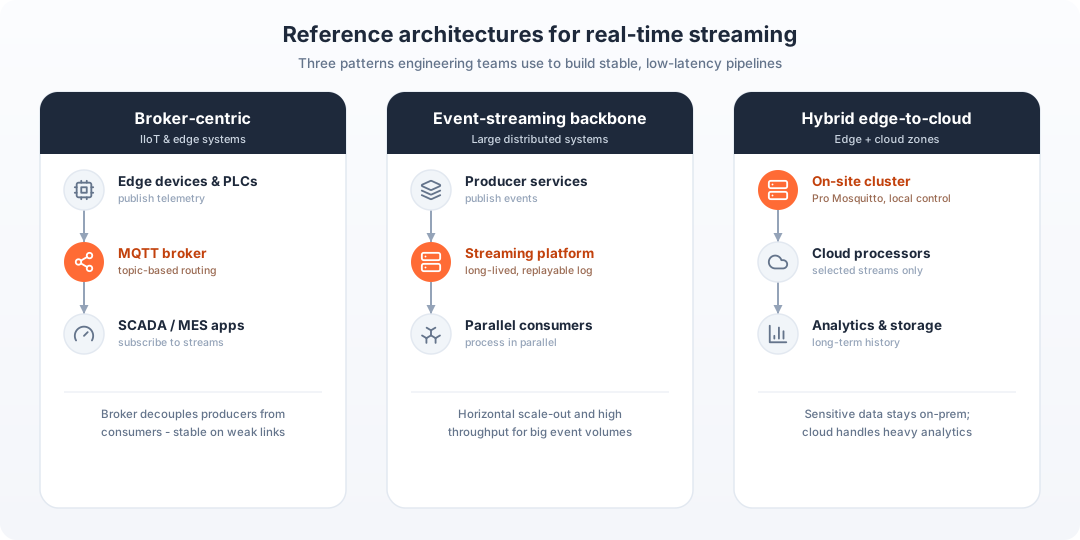
Figure 3: Three common reference architectures for real-time streaming - broker-centric, event-streaming backbone, and hybrid edge-to-cloud.
Broker-centric architecture for IIoT and edge systems
This pattern places an MQTT broker at the center of the data flow. Devices publish telemetry, machine states or command responses to topics, while consuming systems subscribe to the streams they need.
Typical characteristics:
- Stable connectivity across constrained networks
- Clear separation between device layer and processing layer
- Predictable real-time behavior, even under uneven workloads
- Clean integration with gateways, PLCs, Supervisory Control and Data Acquisition (SCADA) and Manufacturing Execution Systems (MES)
This approach suits environments with fluctuating edge conditions because the broker decouples producers from consumers - load on the consuming side does not propagate back to field devices.
Event-streaming backbone for large distributed systems
In cloud-native and data-heavy environments, an event-streaming platform functions as a central nervous system. Applications publish events, and consumer services process them in parallel.
Key traits include:
- Horizontal scale-out
- Long-lived logs for replay and troubleshooting
- High throughput for large event volumes
- Decoupled communication between microservices
Teams often route device data from MQTT into this layer to combine operational telemetry with business events, logs, or transaction streams.
Hybrid edge-to-cloud architecture
Many operational systems operate across multiple zones: factory floor, on-prem systems, and cloud analytics. A hybrid setup routes local data through an on-site Pro Mosquitto cluster, then forwards selected streams to cloud processors or storage layers.
Why this pattern works:
- Local control loops remain responsive
- Sensitive data stays on-prem
- Cloud capacity handles heavy analytics
- Streaming workloads adapt to bandwidth limits and outages
This structure supports IT/OT convergence, real-time monitoring and long-term analytics in one cohesive flow.
Unified data layer for structured access to real-time streams
Some teams implement a structured topic hierarchy or a unified data layer to make real-time streaming data discoverable across the entire organization. Applications subscribe to well-defined topics, reducing ambiguity, and preserving consistency across use cases.
Build real-time streaming architectures with the Cedalo MQTT Platform
Create stable pipelines for IIoT, edge, and cloud workloads with a production-grade Mosquitto broker. Test clustering, security and monitoring in your own setup.
What are the advantages and compromises of real-time data streaming?
Real-time data streaming reduces the delay between an event and the action that follows. This improves system awareness, responsiveness and operational stability across industrial and digital environments.
Where does real-time streaming create benefits?
Real-time streaming data strengthens workloads that depend on timing and continuous visibility:
- Instant insight into machine states, and sensor changes
- Faster reactions through automation and live analytics
- More stable operations without batch-driven blind spots
- Consistent data flow for accurate monitoring and diagnostics
Compromises in real-time data streaming that engineering teams must evaluate
Real-time pipelines introduce architectural responsibilities:
- Scaling components to handle bursts
- Continuous monitoring of throughput and latency
- Higher update frequency for storage and compute
- More operational know-how to maintain reliable flows
System-level comparison
| Aspect | Real-time streaming | Conventional data flows |
|---|---|---|
| Timing | Continuous, event-driven | Scheduled or triggered |
| Awareness | Near-immediate | Delayed |
| Failure visibility | Quickly exposed | Often detected late |
| Processing mode | Live transformations | Retrospective |
Real-time streaming use cases for industrial and digital products
Real-time data streaming supports environments where system awareness and rapid reactions are essential. These use cases highlight where continuous event flows create the strongest impact:
Industrial monitoring and machine telemetry
- Live visibility into equipment states
- Early detection of temperature, vibration, or pressure shifts
- Automated actions in SCADA systems, MES, and edge control loops
Mobility, logistics, and smart city operations
- Tracking of fleets and autonomous systems
- Reacting to traffic or environmental anomalies
- Stabilizing data flows between gateways and cloud systems
Security and fraud detection
- Identifying unusual event patterns
- Triggering alerts as events occur
- Correlating signals across distributed systems
Telemetry for connected devices and digital products
- Real-time product analytics
- Monitoring rollout performance and device behavior
- Supporting feature flags and operational insights
Best practices for reliable real-time stream processing
Real-time data streaming performs best when pipelines remain predictable, traceable, and easy to operate under fluctuating load. These practices help teams maintain stability from edge to cloud:
Clear topic and schema design in real-time streaming data
A consistent structure reduces ambiguity and prevents downstream breaks.
Recommended patterns:
- Use clear naming conventions for topics
- Keep message payloads small and structured
- Version schemas to avoid compatibility issues
- Separate telemetry, commands, and status updates into dedicated paths
Handling load variations and back pressure
Real-time pipelines often face uneven traffic. To keep flows stable:
- Size brokers and processors with headroom for bursts
- Apply back pressure rules when consumers slow down
- Distribute load across consumer groups using MQTT 5 shared subscriptions (
$share/group/topicsyntax) - not available in MQTT 3.1.1 - Log throughput and queue depth to detect emerging issues early
Monitoring the health of real-time streaming components
Low latency requires continuous insight into system behavior.
Useful metrics include:
- End-to-end latency
- Consumer lag
- Connection stability
- Message drop rates
- Processor execution time
These indicators provide a direct view of pipeline performance.
Governance and access control in real-time streaming data
Consistent governance keeps streaming environments safe and manageable:
- Apply role-based access control
- Use TLS/mTLS for device and system authentication
- Maintain audit trails for configuration and access events
- Validate all data entering the pipeline
This prevents unstable or untrusted inputs from reaching critical systems.
Security, compliance, and high availability in real-time streaming
Real-time data streaming needs secure and resilient pipelines. The controls below protect live event flows and keep systems stable under changing conditions.
Security measures required in real-time streaming data pipelines
- TLS/mTLS for encrypted communication
- Role-based access control
- Strong authentication for devices and users
- Audit trails for configuration and access changes
Compliance demands for real-time streaming environments
- Documented message flows
- Controlled access to operational data
- Clear separation of duties
- Continuous monitoring for traceability
High availability patterns for stable real-time streaming
- Clustering to avoid single failure points (Pro Mosquitto feature - not available in open-source Mosquitto)
- Redundant brokers
- Automatic failover paths
- Health checks to detect issues early
4 practical steps for teams evaluating real-time streaming
Real-time data streaming becomes easier to assess when teams break the decision into clear, technical steps. These four steps help determine whether a real-time pipeline fits current systems and future workloads:
#1 Clarifying requirements for real-time streaming data
Start by mapping the conditions that shape your architecture:
- Event frequency and volume
- Required reaction time
- OT/IT network boundaries
- Data retention and replay needs
- Security and access control requirements
A clear requirements profile shows whether continuous streaming provides measurable value.
#2 Building a small proof of concept
A focused test environment reveals how real-time streaming behaves under your conditions.
Useful steps include:
- Define a small set of topics
- Publish representative events from one device or service
- Add a lightweight processor for filtering or aggregation
- Observe latency, throughput and resource usage
- Document how downstream systems react to live data
This creates a realistic foundation for evaluating larger deployments.
#3 Selecting tools for real-time stream processing
Choose tools that match your environment:
- MQTT brokers for device-to-cloud and OT/IT communication
- Event-streaming platforms for large-scale analytics
- Stream processors for logic in motion
- Storage systems for historical access
The combination depends on where data originates and how quickly systems must respond.
#4 Preparing the organization for real-time operations
Real-time pipelines require predictable operations:
- Establish monitoring routines
- Define ownership for schema and topic management
- Set access rules and onboarding steps for new publishers
- Train teams on debugging live flows
These practices keep streaming systems reliable as they scale.
How real-time data streaming improves system performance and decision-making
Real-time data streaming reduces delays, increases transparency, and supports precise, event-driven decisions. Systems react sooner, issues surface earlier, and automation becomes more reliable. This creates a measurable improvement in operational stability from the edge to the cloud.
Your advantages with Cedalo:
- Enterprise-grade Mosquitto with clustering, monitoring, and strong security
- Stable pipelines for OT/IT communication and edge-to-cloud data flows
- Intuitive management for brokers, topics and system health
- Scalable foundation for IIoT, AI, and predictive maintenance workloads
Get started with the Cedalo MQTT Platform
Set up stable, low-latency streaming pipelines on a production-grade Mosquitto core. Test clustering, security, and monitoring in minutes.
Real-Time Data Streaming - Frequently Asked Questions
What is the difference between real-time data streaming and real-time messaging?
Real-time messaging focuses on delivering individual messages quickly, while real-time data streaming manages continuous event flows across a full pipeline. Streaming adds processing, routing, and system-wide coordination that support analytics, automation, and large-scale telemetry.
How do I size a real-time streaming pipeline for unpredictable workloads?
Start by modeling peak event bursts, not just average traffic. Combine this with tests that simulate upstream and downstream delays to understand how brokers, processors, and storage layers behave under stress.
How does real-time data streaming support digital twins or simulation models?
Digital twins depend on timely and accurate data to mirror machine states or system behavior. A real-time stream supplies continuous updates that keep models in sync, improving forecasting, diagnostics, and operational decision-making.
What role does Cedalo play in industrial real-time streaming architectures?
Cedalo provides an enterprise-grade Mosquitto foundation with clustering, monitoring, and secure connectivity for OT and IT systems. This creates a stable environment for high-frequency machine telemetry and edge-to-cloud streaming flows.
How does Cedalo help integrate real-time streaming with existing SCADA or MES systems?
Pro Mosquitto forwards machine data via structured topics that existing systems can subscribe to without major changes. This supports clean integration, reduces configuration effort, and ensures that legacy systems can respond to live event streams.
Can real-time data streaming improve incident detection across distributed systems?
Yes. By pushing events as they occur, anomalies appear sooner and correlation across multiple locations becomes more precise. This shortens detection time and reduces the risk of cascading failures.
How do security teams validate the integrity of real-time streaming data?
Security teams typically combine TLS/mTLS for transport encryption, MQTT-level authentication (username/password, ACLs), and audit trails that capture configuration and access changes. Pro Mosquitto includes a built-in audit trail for compliance and forensic tracing. These controls make it easier to trace anomalies back to their source and maintain trust in the live event flow.