DataOps is DevOps applied to data. It borrows the automation, testing, and monitoring that software teams use for code and applies it to data pipelines, so problems get caught early instead of surfacing days later in a dashboard. The goal is to deliver new data products faster while keeping quality and compliance intact. For industrial organizations juggling OT and IT data, that discipline closes the gap between fast-moving engineering teams and strict regulatory requirements like the EU Data Act.
DataOps: key takeaways
- DataOps applies automated testing, monitoring, and version control to data pipelines, cutting the manual work that causes delays and errors in traditional data engineering.
- One practical DataOps workflow moves through five stages: ingest, transform, test, deploy, and monitor, with automated quality gates between the stages.
- The EU Data Act and the Data Governance Act establish specific data access, sharing, and governance requirements that mature DataOps practices can help support.
- Cedalo MQTT Platform gives industrial teams a high-availability data layer with security and governance features that can connect OT and IT systems and support DataOps pipelines.
What does DataOps actually mean?
DataOps means applying the automation, testing, and collaboration principles of DevOps directly to data pipelines. It treats data flows the way software teams treat code, with version control, automated quality checks, and continuous delivery, so new data products reach production faster and with fewer errors.
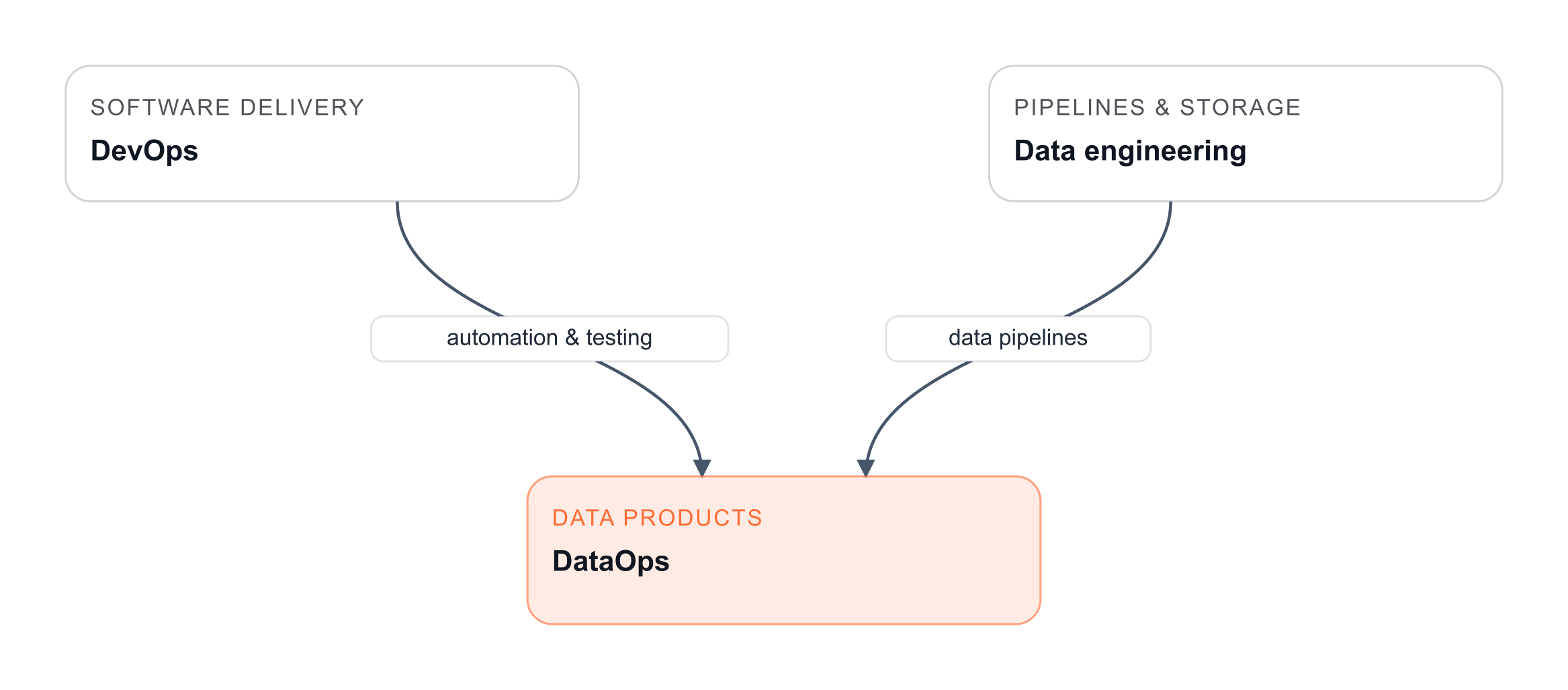
Figure 1: DataOps borrows the automation, testing, and continuous-delivery discipline of DevOps and applies it to the data products and pipelines that traditional data engineering builds.
How does DataOps differ from DevOps?
DevOps primarily delivers software. DataOps delivers data products and pipelines, which changes what “quality” includes. Schema validation, data lineage tracking, and freshness checks complement the unit tests and build pipelines used for application code. A data pipeline that fails silently is harder to catch than a broken build, which is why DataOps puts extra weight on continuous testing and monitoring rather than one-time releases.
What is the DataOps methodology built on?
This DataOps framework focuses on four principles:
- Automate repeatable tasks,
- monitor data quality continuously,
- test pipelines before they reach production,
- and keep data and platform teams working from the same backlog instead of separate silos.
Two terms come up constantly once you apply the methodology in practice. A data quality gate is an automated checkpoint that stops a pipeline from moving forward when incoming data fails a validation rule. Pipeline orchestration is the coordination layer that sequences ingestion, transformation, and testing tasks so they run in the right order without manual triggering.
How does a DataOps workflow actually run?
A DataOps workflow runs through five connected stages. Data is ingested from source systems, transformed into a usable structure, tested against quality rules, deployed to production, and continuously monitored for drift or failure. Automation links each stage, so a failed test blocks deployment instead of letting bad data reach downstream users.

Figure 2: A DataOps workflow chains five stages, ingest, transform, test, deploy, and monitor, with automated quality gates between them so a failed test blocks deployment instead of shipping bad data.
| Phase | Goal | Typical tooling |
|---|---|---|
| Ingest | Pull data from OT/IT sources without disrupting operations | MQTT brokers, connectors, APIs |
| Transform | Normalize formats and structures | ETL/ELT tools, stream processors |
| Test | Catch schema drift and bad values before production | Data quality frameworks, automated test suites |
| Deploy | Push validated pipelines live | CI/CD pipelines, version control |
| Monitor | Track pipeline health and data freshness | Observability dashboards, alerting |
Some of this work can happen in the streaming layer itself instead of in separate tools. Pro Mosquitto, for example, can run stream processing to transform and route messages, and data validation to enforce schema and value rules at the broker, which acts as a data quality gate right at ingestion.
Which checkpoints prevent errors before they reach production?
- Define schema rules for every incoming data source before the first record arrives.
- Run automated validation on every batch or stream before it moves downstream.
- Block deployment automatically when a test fails, instead of relying on manual review.
- Log every rejected record with a reason, so engineers can fix the source instead of guessing.
What capabilities support enterprise DataOps?
A DataOps platform for enterprise use typically combines automated testing, real-time observability, governance controls, and the ability to scale from a single pipeline to hundreds without a full rebuild. If these capabilities are not covered by the platform or connected tools, engineering teams may face more manual work and a higher risk of errors.
| Capability | Why it matters | Risk if missing |
|---|---|---|
| Automated testing | Catches bad data before it reaches dashboards or downstream systems | Silent data corruption |
| Observability | Shows pipeline health and data freshness in real time | Failures go unnoticed for days |
| Governance | Tracks who accessed or changed data and why | Potential compliance and governance gaps |
| Elastic scalability | Supports new data sources without re-architecting | Bottlenecks as data volume grows |
How do you evaluate a DataOps platform for regulated environments?
Check for role-based access control, encrypted data in transit and at rest, and audit trails that log every pipeline change. In regulated industries, ask whether the platform can prove who touched a dataset and when, not only whether the pipeline ran successfully. On the observability side, exporters that feed metrics into tools such as Prometheus or a time-series database like InfluxDB can provide granular monitoring that may support technical and compliance audits.
Why do industrial organizations need DataOps for OT/IT integration?
Industrial organizations need DataOps because OT and IT systems generate data in incompatible formats, on different schedules, and with different reliability requirements. DataOps applies the same automated testing and monitoring principles to machine data that it applies to business data, helping to close the gap between the production floor and analytics teams while reducing manual reconciliation.
A unified namespace can give DataOps pipelines a consistent, structured access layer for machine data instead of requiring direct access to many disconnected systems, which can help make an industrial DataOps practice sustainable.
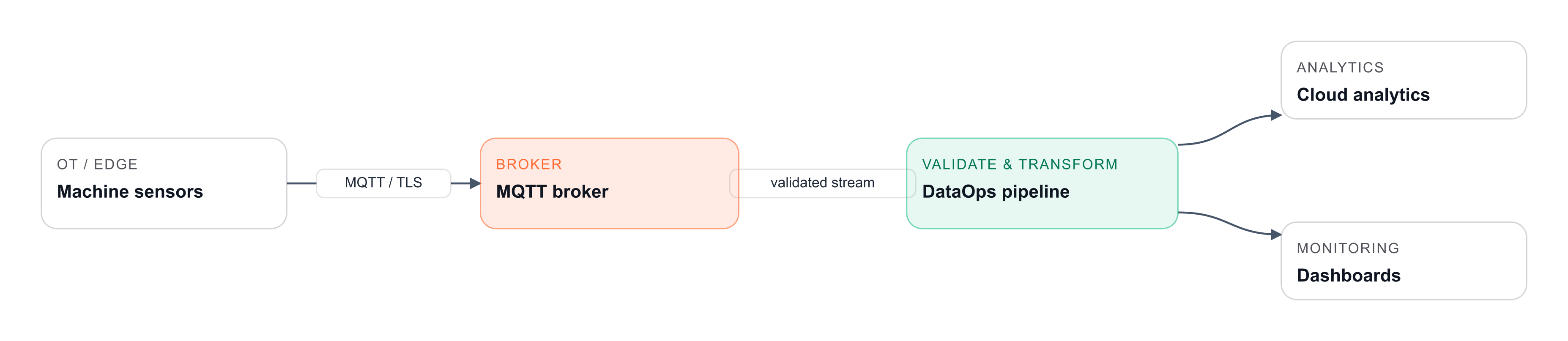
Figure 3: In an industrial setting, machine sensors publish to an MQTT broker layer that feeds a DataOps pipeline, which validates the data before it reaches cloud analytics and dashboards.
How does DataOps apply to IIoT and Industry 4.0 data pipelines?
- Standardize machine data at the source using a consistent topic structure, so pipelines don’t need to reconcile formats after the fact.
- Route sensor data through a broker capable of clustering and failover to reduce the risk that a single broker failure stalls the whole pipeline. Teams deciding between streaming backbones can compare the two approaches directly in this MQTT vs. Kafka guide, or start from Kafka fundamentals if the streaming layer is new territory for the team.
- Apply automated quality checks at the edge to reduce the chance that corrupted sensor readings reach downstream systems.
- Feed validated data into monitoring dashboards, tying pipeline observability directly to production KPIs instead of a separate reporting process.
What do the EU Data Governance Act and Data Act mean for DataOps?
The EU Data Governance Act and the Data Act establish rules for specific forms of data access, sharing, and governance, while the Data Act gives users more control over data generated by connected devices. For DataOps teams, this means pipelines may need to support traceability and auditability as part of their operation, depending on the applicable requirements.
| Regulatory requirement | Consequence for DataOps practice |
|---|---|
| Traceability and documentation | Pipelines should record relevant source, transformation, and destination information where required |
| Access transparency | Appropriate access controls should be built into the pipeline rather than added as an afterthought |
| User control over IoT-generated data | Machine data pipelines may need consent where legally required and access logic built in from ingestion |
| Interoperability obligations | Data formats and APIs may need to support applicable interoperability requirements and standards |
The Data Act has applied across the EU since September 2025 and gives businesses and consumers more control over data generated by connected devices, including industrial machinery. It builds on the Data Governance Act, applicable since September 2023, which set the earlier framework for trustworthy data sharing.
Which DataOps solutions support these workflows in practice?
DataOps solutions typically fall into three categories: pipeline orchestration tools that schedule and sequence tasks, observability platforms that track data quality and freshness, and the streaming or messaging layer that moves data between systems in the first place.
For industrial pipelines, that streaming layer may include an MQTT broker, Kafka, or both working together. Teams combining the two can look at how an MQTT-Kafka integration bridges the gap between device-level messaging and large-scale event streaming. Running stream processing at the broker helps close that gap further by filtering, aggregating, and reshaping messages before they reach Kafka, so downstream systems receive cleaner, lower-volume data.
What does a DataOps engineer actually do?
A DataOps engineer builds and maintains the automated pipelines, tests, and monitoring that keep data flowing reliably from source systems to the teams that use it. The role sits between data engineering and platform operations, with a strong focus on automation and observability rather than one-off analysis.
- Building and maintaining automated data pipelines and their test suites
- Setting up monitoring and alerting for data quality and pipeline health
- Managing version control and deployment for pipeline code and configurations
- Working with data governance teams to keep lineage and access controls current
Turn DataOps from a buzzword into a working pipeline practice
A working DataOps practice can mean fewer pipeline failures, faster delivery of new data products, and auditability that supports regulatory requirements while reducing manual work. The methodology combines automated testing, continuous monitoring, and governance controls across every pipeline stage, from ingestion to deployment.
For industrial organizations, that same discipline extends naturally into OT/IT integration, where a stable streaming layer determines whether machine data reaches analytics teams in a usable form. Getting there starts with treating data pipelines the way software teams treat code.
Your benefits with Cedalo:
- You get a high-availability MQTT broker with security and governance features that can feed validated, structured data into DataOps pipelines.
- You can reduce OT/IT integration work with a unified namespace alongside the gateways or connectors required for individual machines.
- You gain audit trails and role-based access control that can support traceability, access governance, and applicable documentation requirements.
- You can scale from a single production line to a multi-site rollout while limiting the need for major architectural changes.
See how Pro Mosquitto fits your DataOps streaming layer
Pro Mosquitto gives industrial teams a reliable streaming layer with clustering, high availability, security, and audit trails that can anchor your DataOps pipelines.
DataOps: frequently asked questions
What is the difference between DataOps and data engineering?
Data engineering builds the pipelines and systems that move and store data. DataOps adds the automation, testing, and monitoring layer on top, so those pipelines run reliably and errors get caught before they reach production.
How long does it take to implement DataOps in an existing organization?
Teams can start with one pipeline, adding automated tests and monitoring before expanding further. Implementation time varies by scope, systems, and governance requirements; a pilot may take weeks, while a broader rollout can take months.
Does DataOps require replacing existing data tools?
DataOps builds on existing databases, streaming platforms, and BI tools by adding testing, orchestration, and monitoring layers on top. This approach keeps implementation lower risk and faster to roll out than a full platform migration.
What skills does a DataOps engineer need?
Core skills include SQL and Python, experience with workflow orchestration tools such as Airflow, and familiarity with CI/CD and observability stacks. In industrial settings, knowledge of messaging protocols such as MQTT strengthens the bridge between OT and IT data.
How does Cedalo support DataOps in industrial data pipelines?
Cedalo MQTT Platform provides a high-availability streaming layer that DataOps pipelines can use to move machine data reliably. Clustering, monitoring, and role-based access control can reduce manual work and support stable, well-governed industrial data pipelines.
Can DataOps work with legacy OT systems that don’t use modern protocols?
Yes, many legacy OT systems can connect through a gateway or adapter that translates their native protocol into MQTT or another supported format. Once that bridge exists, standard DataOps testing and monitoring practices can be adapted to the specific characteristics of the OT data source.