A smart factory links machines, sensors, and IT systems through a shared data layer, turning production data into automated decisions in real time. Built on protocols like MQTT and organized as a Unified Namespace, this layer connects OT and IT continuously. That connection enables AI, predictive maintenance, and compliance-supporting monitoring at scale.
Smart Factory: Key takeaways
- A smart factory is a manufacturing environment where machines, sensors, and IT systems exchange data continuously through a shared communication layer, enabling automated decisions instead of manual monitoring.
- MQTT and a Unified Namespace can form the communication backbone of many smart factory architectures, connecting OT devices with cloud, ERP, and MES systems in real time.
- Depending on sector, size, AI use cases, and data flows, smart factories operating in the EU may need to account for NIS2 cybersecurity obligations, AI Act requirements for relevant AI systems, and Data Act rules on industrial data access.
- Built on Eclipse Mosquitto, the Cedalo MQTT Platform adds the enterprise layer a smart factory needs: Pro Mosquitto for clustering and security, and the Management Center for centralized, compliance-ready monitoring.
What is a smart factory?
A smart factory is a production environment where machines, sensors, and enterprise systems share data through one connected architecture instead of isolated control systems. Every process, from a single sensor reading to an ERP order, becomes part of the same real-time data flow. That shared flow lets the factory adjust automatically instead of waiting for manual intervention.
Three traits define a smart factory in practice:
- Continuous data exchange between shop floor devices and IT systems, without manual data transfer or batch uploads.
- Closed-loop automation, where the system reacts to data changes on its own, for example adjusting machine parameters based on sensor input.
- Real-time visibility across production lines, plants, and sometimes entire supply chains.
Industry 4.0 describes the broader strategic shift toward digital, connected manufacturing. A smart factory is the operational result of that shift on the shop floor. Every smart factory needs one foundational piece first: a data layer that machines, PLCs, and IT systems can all read from and write to.

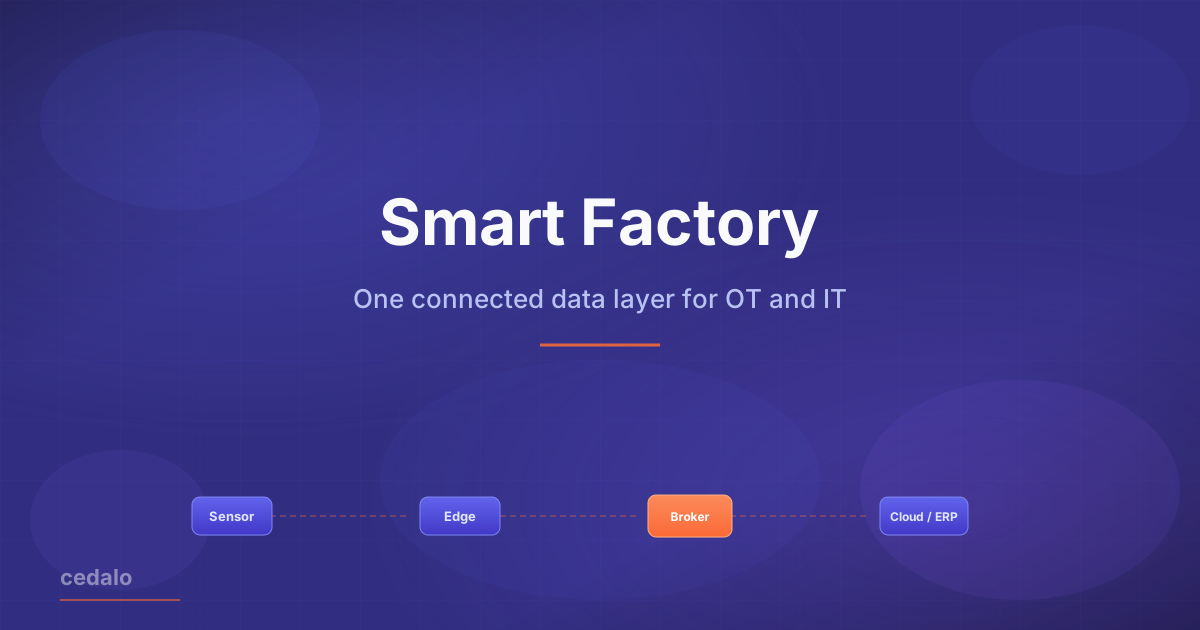
Figure 1: The smart factory data flow. Sensors capture machine data, edge nodes pre-process it locally, the MQTT broker routes every message once, and cloud and ERP systems subscribe to what they need. One connected data layer replaces a patchwork of point-to-point links.
Which technologies power a smart factory?
A smart factory runs on four technology layers working together: a lightweight messaging protocol that connects machines, a unified data structure that organizes that data, edge and cloud computing that process it, and sensors that capture it in the first place.
Communication architecture: MQTT and Unified Namespace
MQTT works on a publish/subscribe model, which keeps message overhead low enough for constrained devices and unstable network connections. That efficiency is why MQTT has become a widely used protocol for industrial data exchange, especially compared with heavier alternatives like HTTP.
A Unified Namespace organizes that MQTT data into one consistent topic hierarchy, so every system in the factory reads from the same structure instead of building custom point-to-point connections. Sparkplug B adds a standardized topic namespace, payload format, and session state model on top of MQTT, which can make devices from different vendors easier to integrate. For teams building this layer from scratch, a complete overview of the MQTT protocol covers the technical foundations in more depth.
Edge computing and AI in production
Edge computing processes data close to the machine, which matters for decisions that can’t wait for a round trip to the cloud, like stopping a line before a defect spreads. Cloud systems handle the heavier workloads: training predictive maintenance models, aggregating data across plants, and running analytics that don’t need millisecond response times.
Streaming platforms often sit between the two. Comparing MQTT against Kafka helps clarify which protocol fits which job: MQTT for lightweight device communication, Kafka for high-throughput event streaming and long-term data retention.
Smart factory sensors and data capture
Smart factory sensors capture the raw data everything else depends on: vibration and temperature for predictive maintenance, energy consumption for efficiency tracking, and machine status for real-time monitoring. Existing SCADA systems often already collect a large share of this data and can feed it into the MQTT layer through a SCADA integration guide rather than requiring a full sensor replacement.
Data quality at this stage determines whether AI models further up the stack produce reliable predictions or false alarms.
| Sensor type | Captures | Typical use case |
|---|---|---|
| Vibration | Mechanical wear patterns | Predictive maintenance |
| Temperature | Thermal load on equipment | Overheating prevention |
| Energy | Power draw per machine or line | Efficiency optimization |
| Machine status | Run/stop/fault states | Downtime tracking, OEE |
How do you build a compliance-ready smart factory?
Depending on sector, size, AI use cases, and data flows, three EU regulations can shape how a smart factory is architected today, not just how it is documented afterward.
NIS2: cybersecurity requirements for industrial operators
NIS2 may apply to medium-sized and large operators in covered critical and important sectors, including certain areas of manufacturing. It requires documented risk management measures, incident reporting processes, and security controls across the supply chain, including the industrial data infrastructure connecting machines to IT systems.
AI Act: requirements for AI-driven production systems
The AI Act classifies AI systems by risk level. Predictive maintenance or automated quality control systems used as safety components, or affecting health, safety, or regulated products, may fall into higher-risk categories, which brings documentation, human oversight, and transparency obligations.
Data Act: data access and sharing in industrial IoT
The Data Act governs who can access and use data generated by connected industrial devices and under what conditions that data can be shared with third parties, including service providers and platform vendors.
| Regulation | Scope | Core requirement or obligation |
|---|---|---|
| NIS2 | Manufacturing and other critical-sector operators | Risk management, incident reporting, supply chain security |
| AI Act | AI systems in quality control, maintenance, safety-critical decisions | Risk classification, documentation, human oversight |
| Data Act | Connected industrial devices and their data | Data access rights, usage rights, sharing conditions, portability |
What maturity stages lead to a scalable smart factory?
Most smart factory initiatives move through four maturity stages, and most stall between the second and third.
| Stage | What it looks like | Typical blocker | Next step |
|---|---|---|---|
| Connected | Machines send data to a central system | Data silos between OT and IT | Introduce MQTT and a Unified Namespace |
| Visible | Dashboards show real-time status across lines | No standardized data structure | Apply Sparkplug B to standardize topics |
| Predictive | Models forecast failures and quality issues | Data quality or volume insufficient for AI | Extend sensor coverage, connect edge and cloud analytics |
| Autonomous | Systems trigger corrective actions without manual review | Governance and compliance gaps for automated decisions | Build AI Act-aligned oversight and audit trails where required |
The jump from “Visible” to “Predictive” is where most projects run out of momentum, usually because the underlying data layer wasn’t built to handle the volume and consistency AI models need.
From test run to scalable smart factory operations
Moving from an initial test run to full-scale operation depends on architecture decisions made before the rollout, not fixes applied after it. Point solutions that work for one line rarely scale across a plant, let alone multiple sites, because each one adds its own data format and connection logic.
An enterprise-ready MQTT infrastructure like Pro Mosquitto avoids that trap by giving every new line or plant the same connection standard from day one. Clustering and high availability then keep that infrastructure running without a single point of failure as the number of connected devices grows.
Scale your smart factory without adding point solutions
Get one MQTT infrastructure that scales from a single line to your entire plant, with clustering and high availability built in.
Smart factory solutions: platform vs. smart factory as a service
Choosing between a self-managed platform and a smart factory as a service model comes down to three questions: how much internal MQTT and infrastructure expertise you have, how strict your compliance requirements are, and how fast you need to scale.
A platform approach gives you full control over deployment, whether on-premises, in a specific cloud region for data residency, or directly in Azure. An as-a-service model shifts operational overhead to the provider, which speeds up the initial connection but requires closer attention to where data is processed and stored.
Turn your smart factory data into a compliant, scalable backbone
A working smart factory depends on one connected data layer, not a patchwork of point solutions. MQTT and a Unified Namespace give machines, edge systems, and cloud applications a common language, while NIS2, the AI Act, and the Data Act define the guardrails to design around from day one.
The maturity model shows that most factories stall between the Connected and Predictive stages, usually because data quality or governance wasn’t planned early enough. Moving past that stage means picking an architecture built for enterprise scale and compliance, not just an initial test run.
Your benefits with Cedalo:
- You connect OT and IT on Eclipse Mosquitto’s proven open-source core, with Pro Mosquitto adding the enterprise clustering and high availability that open-source Mosquitto does not include.
- You get built-in security and audit trails that support NIS2 and AI Act documentation requirements.
- You avoid vendor lock-in with native integrations into Kafka, AWS, Azure and GCP.
- You manage every broker instance from one Management Center instead of juggling separate monitoring tools.
Support compliance directly in your smart factory architecture
Get enterprise MQTT with built-in security, audit trails, and clustering, so NIS2 and AI Act documentation is easier to prepare when you need it.
Smart Factory: Frequently Asked Questions
How much does a smart factory improve production efficiency?
Manufacturers can achieve significant reductions in unplanned downtime when real-time monitoring is combined with predictive maintenance, since technicians can detect failures before they cause a stop. Efficiency gains scale further as predictive maintenance and automated quality checks replace manual inspection routines.
What are the biggest security risks in a smart factory?
Connecting OT devices to IT networks expands the attack surface, especially where legacy machines lack built-in authentication. Weak access control and unencrypted data in transit are the two most common entry points attackers exploit in industrial environments.
How long does it take to implement a smart factory?
Connecting a single production line can take weeks to months once the data layer and protocols are defined. Scaling that setup across a full plant usually takes several months, depending on how many legacy systems need gateway integration.
What skills does a team need to operate a smart factory?
Teams need OT engineers who understand production processes alongside IT staff familiar with networking, data pipelines, and security. Cross-functional collaboration between these two groups matters more than any single specialist skill set.
How does the Cedalo Management Center support real-time monitoring across a smart factory?
The Cedalo Management Center gives you a single interface to monitor broker connections, message flows, and system health across every production line. It flags anomalies as they happen instead of requiring manual log checks after an incident.
Why is the Cedalo MQTT Platform suited for multi-site smart factory rollouts?
Multi-broker management lets you control every site’s MQTT infrastructure from one platform instead of maintaining separate setups per location. Each site runs its own Pro Mosquitto cluster for local high availability and high performance, and MQTT bridges keep sites operating independently even if the link to headquarters drops.