MQTT-SN (MQTT for Sensor Networks) is a lightweight messaging protocol for devices that lack a full TCP/IP stack, such as battery-powered sensors and low-power controllers. It adapts the publish/subscribe model of MQTT to constrained transports like UDP, cutting message overhead and power draw for large sensor deployments.
MQTT-SN: key takeaways
- MQTT-SN is a lightweight adaptation of MQTT for constrained devices that use datagram-based or non-TCP/IP networks instead of a persistent TCP connection.
- The protocol separates three roles: client, gateway, and broker, where a gateway translates MQTT-SN messages into standard MQTT for an existing broker.
- The MQTT-SN 1.2 specification defines mechanisms such as predefined topic IDs, which can reduce message size, as well as Will messages; further development takes place within OASIS.
- The Cedalo MQTT Platform runs a Mosquitto-based broker behind MQTT-SN gateways, providing clustering, monitoring, TLS-secured connections, and role-based access control for hybrid MQTT and MQTT-SN sensor networks.
What is MQTT-SN?
MQTT-SN is a separate specification that adapts MQTT’s publish/subscribe logic for constrained devices and networks. Version 1.2 was originally published by IBM, while further development toward version 2.0 takes place within OASIS. MQTT-SN clients typically reach an MQTT broker through a gateway, which translates their traffic into standard MQTT. That makes MQTT-SN a companion protocol designed for constrained environments and gateway-based integration rather than direct broker use.
How does MQTT-SN differ from MQTT?
MQTT-SN adapts MQTT for constrained devices and networks, using a compact message format over transports such as UDP/IP or non-TCP/IP networks. Classic MQTT runs over TCP and normally uses topic names in PUBLISH messages, although MQTT 5 also supports topic aliases. MQTT-SN can replace topic names with short numeric topic IDs and does not require a continuously active TCP connection, which can reduce message overhead and radio activity.
| Aspect | MQTT | MQTT-SN |
|---|---|---|
| Transport or underlying network | TCP | Datagram-based or non-TCP/IP networks, including UDP/IP, Zigbee, and Bluetooth Low Energy |
| Topic representation | Topic names; MQTT 5 also supports topic aliases | Topic IDs, predefined topic IDs, or short topic names |
| Session model | TCP connection with optional persistent session state | MQTT-SN session with support for sleeping clients over various underlying networks |
You will often encounter MQTT-SN in deployments with battery-powered nodes, where every byte and every radio wake-up cycle can affect device lifetime.
How is MQTT-SN protocol architecture structured?
MQTT-SN distinguishes among MQTT-SN clients, gateways, and forwarders. In a common deployment, a gateway connects the MQTT-SN network to an MQTT broker, which handles routing and subscriptions. The client normally communicates with the broker through the gateway, which translates MQTT-SN messages into standard MQTT; the broker may also be integrated with the gateway.
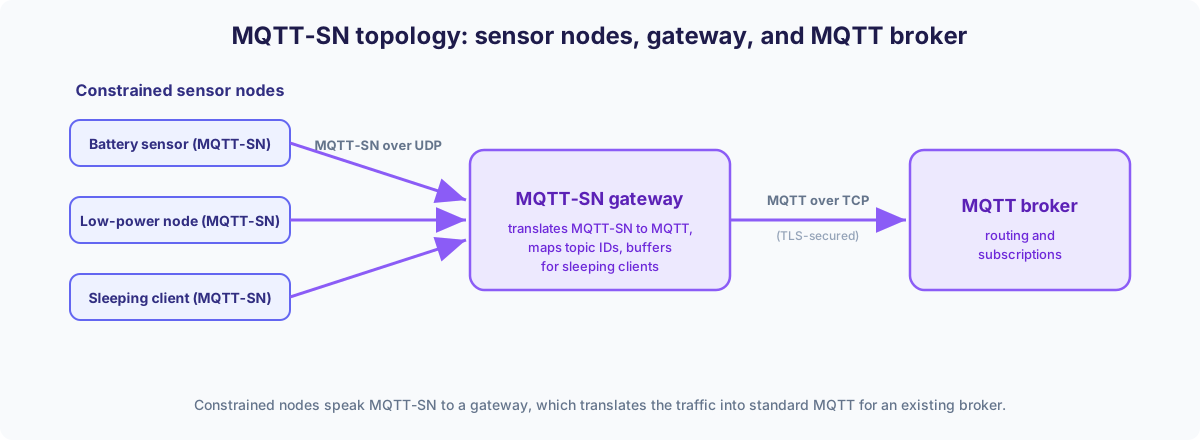
Client, gateway and broker in practice
The client can publish using numeric topic IDs instead of full topic strings. Normal topic IDs are mapped through registration with the gateway and may need to be registered again if the mapping is lost; predefined topic IDs and short topic names do not require registration. The gateway can maintain mappings and support sleeping clients by buffering eligible messages until they wake. The broker receives the translated traffic as standard MQTT according to the gateway’s translation model.
Why MQTT-SN runs on UDP instead of TCP
MQTT-SN often runs over UDP/IP because it avoids TCP connection setup and keep-alive overhead, which can reduce energy use on constrained devices. Depending on the traffic pattern and radio technology, TCP handshakes and keep-alive traffic may add significant overhead in long-lived deployments. Because UDP does not provide built-in delivery guarantees, MQTT-SN uses protocol-level acknowledgments and retransmissions for message flows and QoS levels that require them.
What role does the MQTT-SN gateway play?
An MQTT-SN gateway acts as a point of contact between sensor devices and the MQTT infrastructure. MQTT-SN deployments can use multiple active or standby gateways, so devices on a segment do not have to depend on one gateway instance. Deployment planning should cover gateway placement, discovery, redundancy, failover behavior, and broker design.
Aggregating vs. transparent gateway
An aggregating gateway manages many MQTT-SN clients through a single MQTT connection to the broker, which reduces the number of broker-side connections you need to monitor. A transparent gateway instead opens a separate MQTT connection for each MQTT-SN client, which gives you finer-grained visibility per device at the cost of more broker connections. Your choice depends on how many devices you run and how closely you need to track individual client state.
Gateway integration in four steps:
- Deploy the gateway close to the sensor network, ideally on the same local segment as the constrained devices.
- Configure the gateway’s UDP listener and confirm it can reach your broker over TCP.
- Enable TLS or a VPN tunnel between the gateway and the broker if the traffic crosses an untrusted network.
- Test topic registration with a small batch of devices before rolling out the full deployment.
What is an MQTT bridge and when do you need one?
An MQTT bridge connects two separate broker domains, letting messages flow between independent MQTT networks without merging them into one flat topic space. You typically need a bridge when a plant runs several isolated sensor networks, each with its own gateway and broker, and you want selected data to reach a central system without forwarding every local topic.
In hybrid architectures, an MQTT bridge at the edge can forward only the topics relevant to central monitoring while keeping high-frequency local traffic on the shop floor.
Which MQTT-SN broker options are available?
A compatible MQTT broker can serve MQTT-SN clients once a gateway translates the traffic into a supported MQTT version. The broker must still handle the resulting message volume, connection model, and reliability requirements. Both open-source and commercial brokers can provide advanced functions, while enterprise offerings commonly bundle clustering, support, user management, and observability in an integrated product.
Open source vs. enterprise brokers for MQTT-SN
Open-source brokers can be suitable for both test and production deployments, depending on their features, architecture, and operational support. Sensor networks with high-availability or audit requirements may need clustering, role-based access control, and centralized monitoring. These capabilities are available in some open-source projects and enterprise editions, with differences in integration, support, and operation.
Pro Mosquitto adds these enterprise features on top of Eclipse Mosquitto, and the Cedalo MQTT Platform manages the deployment, so existing configurations, client libraries, and operational know-how are generally reusable, subject to compatibility and configuration review.
Add enterprise reliability to your Mosquitto broker
Clustering, role-based access control, and centralized monitoring on top of the open-source broker your team already uses, typically without rebuilding the surrounding application.
What does the MQTT-SN specification define?
The MQTT-SN 1.2 specification defines message types, topic ID mechanisms, and Will message behavior intended to support interoperability across implementations; further development toward version 2.0 takes place within OASIS. A normal topic ID is a short numeric identifier mapped through registration with the gateway, replacing the full topic string in subsequent messages while the mapping remains valid.
For topics known in advance, the specification also allows predefined topic IDs, which skip registration and let a device publish after connecting. It further defines Will messages that a gateway can send on a client’s behalf after an unexpected disconnect, making such failures detectable when the feature is configured and monitored.
How do you deploy MQTT-SN securely in industrial environments?
You secure an MQTT-SN deployment primarily at the gateway, since UDP itself carries no built-in encryption or authentication. The gateway is the point where you enforce access control, encrypt traffic toward the broker, and isolate the sensor network from other parts of your infrastructure. The same principles that apply to MQTT security in general, access control, encryption, and monitoring, apply here too, just enforced one hop earlier in the chain.
Access control and encryption at the gateway
Restrict which devices can register with the gateway through device authentication, filtering, or network segmentation. An exposed UDP listener can receive traffic from any reachable device, but message acceptance depends on the gateway’s validation and access controls. Protect the gateway-to-broker connection with TLS, and secure the client-to-gateway hop according to the capabilities and risks of the underlying network.
Compliance in hybrid MQTT and MQTT-SN architectures
Auditors evaluating ISO 27001 or SOC 2 examine the systems and controls within the defined scope, which may include the full data path. Gateway logging and access control should therefore address the applicable risks and control objectives for that scope. Role-based access control and audit trails can support traceability, but they do not establish compliance on their own.
When does MQTT-SN make sense in a hybrid architecture?
MQTT-SN and MQTT can coexist in a hybrid architecture, where MQTT-SN handles constrained edge devices and standard MQTT carries data across the rest of the infrastructure after it passes through a gateway. You do not need to choose one protocol for an entire site. Instead, you can match the protocol to each segment’s device constraints. If your architecture uses Sparkplug MQTT, MQTT-SN traffic can be integrated only if the devices, gateway, or another component preserves or generates the required Sparkplug topics, payloads, and state behavior.
| Criterion | Favors MQTT-SN | Favors MQTT |
|---|---|---|
| Device power source | Battery, multi-year lifetime | Mains-powered |
| Network stack | No full TCP/IP stack | Full TCP/IP available |
| Device and network scale | Suitable at many scales, especially when device constraints dominate | Suitable at many scales, depending on broker and network design |
| Topology | Gateway-based, but not limited to a single star topology | Direct or bridged broker connections |
Make your sensor network ready for scale
MQTT-SN gives you a way to connect constrained sensor networks without abandoning the MQTT ecosystem you already run. The protocol’s gateway architecture keeps your broker, your topic structure, and your existing tooling intact while extending reach to battery-powered devices.
Getting this right depends on gateway placement, encryption at the right points, and a broker that scales with the number of devices you add. Compliance and uptime requirements apply to the full path, from sensor to broker, not just the parts running classic MQTT.
Your benefits with Cedalo:
- You connect MQTT-SN gateways to a broker built on Eclipse Mosquitto, a technology many engineering teams already use.
- You get broker clustering and high-availability features that can reduce the impact of broker failures; gateway redundancy and failover must be designed separately.
- You control access with role-based permissions and TLS encryption across the full path from gateway to broker.
- You monitor connections and troubleshoot gateway-to-broker traffic through one central management interface.
Talk to an engineer about your MQTT-SN setup
Book a demo and walk through your gateway architecture, device count, and compliance requirements with an engineer experienced in hybrid MQTT and MQTT-SN deployments.
MQTT-SN: frequently asked questions
Does MQTT-SN require a continuously active TCP connection?
No. MQTT-SN can run over UDP/IP and other underlying networks without requiring a continuously active TCP connection. It defines sessions and a sleeping-client mode in which eligible messages can be buffered until a device wakes. MQTT can also retain session state and queue eligible messages for disconnected clients when configured accordingly.
Can MQTT-SN and MQTT devices publish to the same topics?
Yes, once a gateway translates MQTT-SN messages into standard MQTT, both device types can publish to and subscribe to the same broker topics, subject to the gateway’s topic mapping and access controls. The broker receives the translated traffic as standard MQTT, although the connection model can differ, particularly with aggregating gateways.
What happens if an MQTT-SN gateway goes offline?
Clients currently using that gateway lose their path to the broker until service resumes, unless another configured gateway is available and failover succeeds. Production deployments can use multiple active or standby gateways, but automatic failover depends on the implementation and configuration.
How does Cedalo support hybrid MQTT-SN and MQTT deployments?
The Cedalo MQTT Platform can sit behind your MQTT-SN gateways as a Mosquitto-based broker platform. Existing gateway configurations and topic structures can often be retained, subject to compatibility and configuration review. You can add clustering, monitoring, and access control as your device count grows.
Does every MQTT broker support MQTT-SN out of the box?
No, a broker receives MQTT-SN traffic only after a gateway translates it into standard MQTT. The broker itself does not need native MQTT-SN support, but it must support the MQTT version, authentication method, client identifiers, and connection behavior used by the gateway.
Does adding MQTT-SN devices affect broker performance for existing MQTT clients?
Yes, adding MQTT-SN devices can affect broker performance because the translated message traffic still reaches the broker. The gateway handles protocol translation, but broker load continues to depend on message volume, payload size, QoS, subscriptions, persistence, and the number and type of MQTT connections.
What skills does my team need to run an MQTT-SN deployment?
Your team needs standard MQTT broker administration skills plus gateway configuration knowledge, since the gateway is the new component in the chain. UDP network troubleshooting becomes more relevant than it typically is in a pure TCP-based MQTT setup.