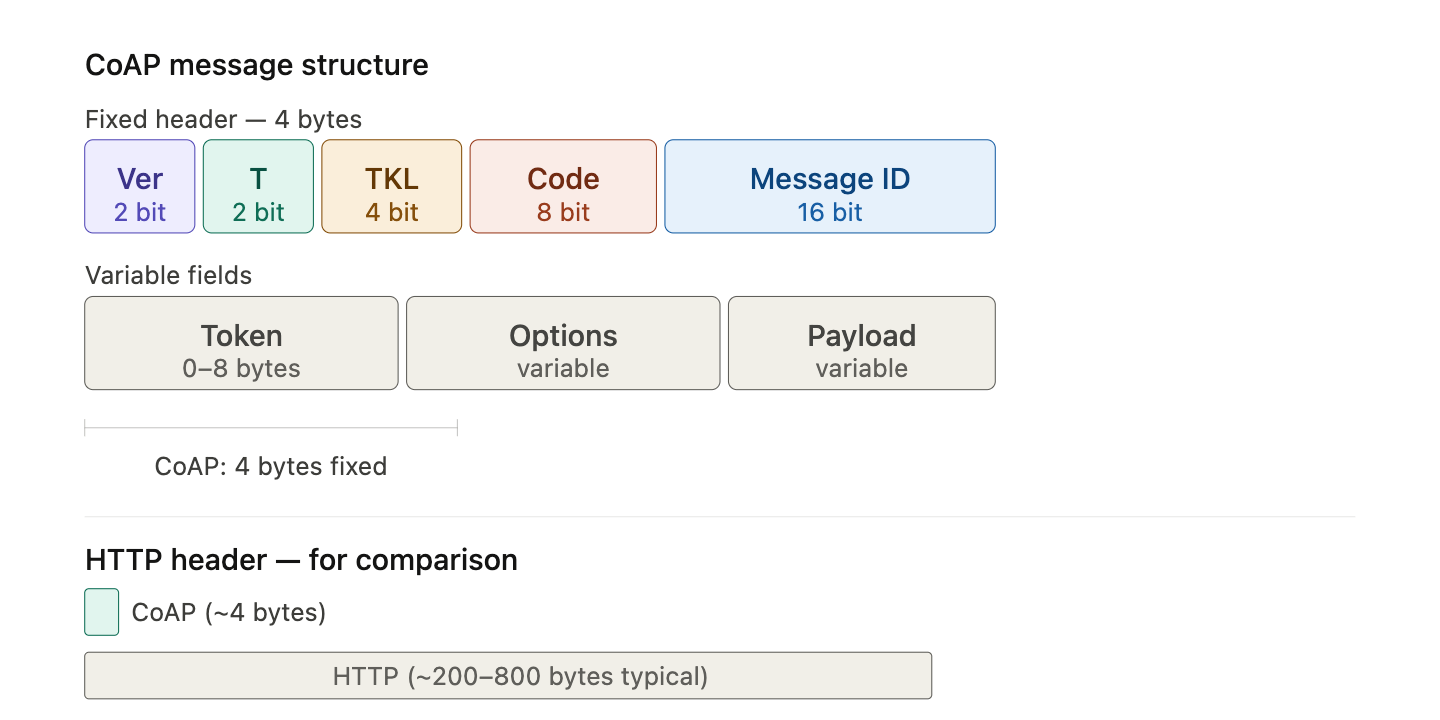
CoAP (Constrained Application Protocol) compresses the HTTP request/response model into a 4-byte fixed header that runs over UDP. Standardized in RFC 7252, it targets microcontrollers, low-power sensors, and constrained networks where TCP connections are too expensive to maintain. If you work with resource-limited devices in IoT environments, CoAP solves a specific problem that HTTP and MQTT are not designed for.
CoAP: key takeaways
- CoAP is a lightweight IoT protocol (RFC 7252) for constrained devices and networks, running over UDP with a 4-byte fixed header. RFC 8323 extends CoAP to TCP, TLS, and WebSockets.
- CoAP follows a RESTful request/response model and extends to server-push behavior through the Observe extension (RFC 7641) without requiring a message broker.
- In production IoT architectures, CoAP handles constrained device communication at the edge; a CoAP-to-MQTT gateway bridges it to scalable backend systems, cloud platforms, and enterprise applications.
- The Cedalo MQTT Platform provides the enterprise broker layer for CoAP architectures, with clustering, high availability, role-based access control, and integrations for Kafka, Azure Event Hub, Google Pub/Sub, databases, and monitoring systems.
What is the CoAP protocol and how does it work?
CoAP is an application-layer protocol developed by the IETF CoRE (Constrained RESTful Environments) Working Group and published as RFC 7252 in 2014. Its core objective: bring HTTP-style semantics to device communication without the resource overhead that makes HTTP impractical on microcontrollers.
CoAP supports four standard request methods (GET, POST, PUT, DELETE) and maps them to resources identified by URIs, just like HTTP. The response codes follow a similar numbering scheme (2.xx success, 4.xx client error, 5.xx server error). Anyone familiar with REST APIs recognizes the structure immediately.
How does the CoAP protocol work?
The protocol runs over UDP instead of TCP, which removes connection setup overhead and persistent state management. Reliability over UDP works through the message exchange model: each request carries a Token that the receiver echoes back in the response, allowing multiple concurrent exchanges over a single UDP socket without confusion.
A 16-bit Message-ID handles deduplication. If a CON message triggers a retransmission, the receiver recognizes the duplicate and discards it without processing it twice.
CoAP message types: CON, NON, ACK, and RST explained
CoAP defines four message types that control how reliability works over UDP:
| Message type | Name | Function |
|---|---|---|
| CON | Confirmable | Requires an ACK from the receiver; retransmitted until acknowledged |
| NON | Non-confirmable | Fire-and-forget; no acknowledgment required |
| ACK | Acknowledgment | Confirms receipt of a CON message |
| RST | Reset | Signals that a message cannot be processed |
CON messages handle critical data where delivery confirmation matters. NON messages suit high-frequency telemetry where occasional packet loss is acceptable and retransmission overhead would outweigh the benefit. The receiver matches requests and responses using a Message-ID (for deduplication) and a Token (for request/response correlation), which allows multiple concurrent exchanges over a single UDP socket.
How does the CoAP Observe extension work?
RFC 7641 defines the CoAP Observe extension, which adds server-push behavior to the otherwise request/response-based protocol. A client registers interest in a resource by sending a GET request with an Observe option. The server then sends notifications whenever the resource state changes, without the client polling repeatedly.
This resembles a publish/subscribe pattern, but it operates without a broker. The server maintains a list of registered observers and pushes updates directly. The practical limit: CoAP Observe works well for one-to-few communication. It does not scale to large device fleets or complex fanout scenarios the way an MQTT broker does. There is no persistent session management, no QoS negotiation beyond CON/NON, and no native way to distribute updates across multiple backend systems simultaneously.
Where does CoAP fit in real IoT architectures?
CoAP targets environments where devices operate on batteries, communicate over lossy radio networks, and run firmware on microcontrollers, think smart meters, environmental sensors, building automation nodes, or Smart Grid endpoints. The protocol runs natively on 6LoWPAN, Thread, Zigbee IP, and similar IEEE 802.15.4-based networks.
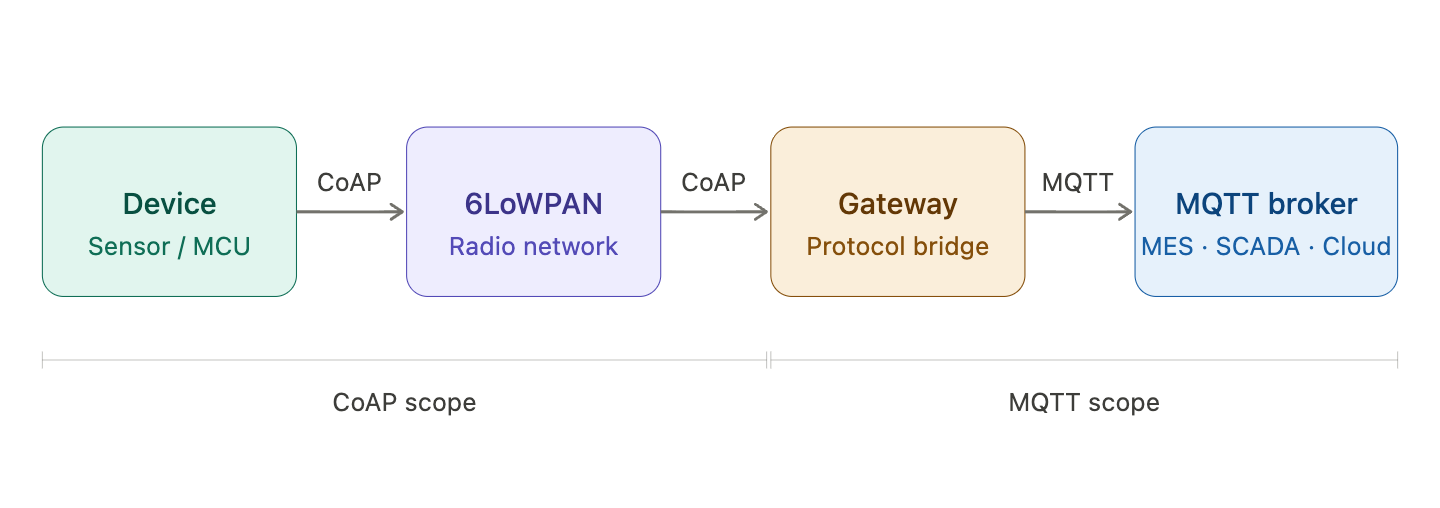
The device communicates in CoAP because maintaining TCP connections would be unnecessarily expensive for its hardware and network profile. A gateway translates CoAP messages into MQTT payloads and forwards them to a broker that handles routing, fanout, and downstream system integration. CoAP handles the constrained last-mile; MQTT handles the scalable data distribution layer.
CoAP and LwM2M: device management in constrained networks
OMA LwM2M (Lightweight Machine to Machine) is a standardized device management protocol for IoT fleets, built directly on CoAP as its transport layer. It covers the full device lifecycle from initial provisioning to remote firmware updates, making it the standard choice for telecom operators and platforms managing large numbers of constrained devices.
LwM2M covers four operational interfaces:
- Bootstrap: initial provisioning of device credentials and server addresses
- Registration: device announces itself to the management server
- Device management and service enablement: remote configuration, firmware updates, parameter changes
- Information reporting: periodic or event-driven telemetry delivery
CoAP provides the application-layer messaging model for all four interfaces. LwM2M uses CoAP bindings to carry these exchanges efficiently across constrained networks.
CoAP vs. MQTT vs. HTTP: which protocol fits which scenario?
No single protocol covers every layer of an IoT architecture. The decision depends on hardware constraints, network characteristics, and what the data needs to do after it leaves the device.
| Aspect | CoAP | MQTT | HTTP |
|---|---|---|---|
| Transport | UDP | TCP | TCP |
| Header overhead | ~4 bytes | ~2 bytes minimum | ~100 to 800 bytes |
| Communication model | Request/Response | Publish/Subscribe | Request/Response |
| Broker required | No | Yes | No |
| QoS levels | CON / NON | 0, 1, 2 | Non-native |
| Multicast | Native | No | No |
| Session persistence | No | Yes | No |
| Security | DTLS | TLS | TLS |
| Typical hardware | MCU, <10 KB RAM | Gateway, embedded Linux | Server, gateway |
Use CoAP when:
- Devices run on microcontrollers with severely limited RAM and no TCP stack
- The network is a low-power radio standard (6LoWPAN, Thread, Zigbee IP)
- You need native multicast for group addressing in a local network segment
- Device management follows LwM2M
Use MQTT when:
- Multiple backend systems consume the same device data
- Devices operate over TCP-capable connections (cellular, Ethernet, Wi-Fi)
- You need persistent sessions, fanout to many subscribers, or the three MQTT QoS levels
- The architecture requires a central broker for routing, security, and monitoring
Use HTTP when:
- Devices report data occasionally and REST API integration with enterprise systems matters
- Firmware updates, configuration retrieval, or large file transfers are the primary use case
- Browser-based access or standard web tooling is a requirement
In practice, most IoT architectures combine all three: CoAP at the constrained device layer, MQTT for data distribution across the platform, and HTTP for management interfaces and enterprise API integration.
What are the limitations of CoAP in IIoT environments?
CoAP’s strengths come with architectural trade-offs that matter at production scale.
- UDP reliability overhead: CON messages add retransmission logic on top of UDP. On lossy networks with high message frequency, this overhead can approach TCP-level cost for reliability-critical data streams. For large payloads, UDP fragmentation at the IP layer creates additional complexity.
- DTLS costs on constrained hardware: DTLS (Datagram TLS) secures CoAP over UDP, but the handshake and session state require CPU cycles and RAM that very small microcontrollers may not provide. Some deployments use object security (OSCORE, RFC 8613) as a lighter alternative, but this adds implementation complexity.
- No native fanout: A CoAP server distributes data to registered Observe clients directly. There is no broker to route a single message to dozens of different consumers (dashboards, historians, analytics pipelines, and alerting systems) simultaneously. Architectures that require this pattern need MQTT or a comparable messaging layer.
- No clustering or high availability: CoAP defines no server-side clustering, load balancing, or failover mechanisms. For IoT deployments where uptime is a hard requirement, the gateway and broker layers carry the availability responsibility.
These limitations do not make CoAP a poor choice, they define its scope. CoAP solves the constrained device communication problem exceptionally well. Scaling beyond that scope requires complementary protocols.
How to integrate CoAP into an IoT architecture step by step
- Evaluate device constraints. Confirm that the target hardware cannot sustain a TCP stack or that the radio network uses a CoAP-native standard like 6LoWPAN or Thread. If devices run embedded Linux or have reliable cellular connectivity, MQTT may fit better at the device layer.
- Select a CoAP library matching your hardware and language:
- Eclipse Californium (Java): mature, widely used in gateway and server implementations
- libcoap (C): runs on bare-metal MCUs, POSIX systems, and embedded Linux
- aiocoap (Python): async Python library, good for prototyping and gateway services
- CoAP.NET: .NET implementation for Windows-based gateway environments
- Define your resource model. Map device data to CoAP URIs (coap://device.local/sensors/temperature). Use GET for reading, PUT/POST for writing, and register Observe for push-based updates where appropriate. Keep resource paths shallow and consistent across device types.
- Set up a CoAP-to-MQTT gateway. Deploy a gateway that translates CoAP requests or observations into MQTT publish messages. The gateway receives data from CoAP resources, normalizes payloads, and forwards structured data to the MQTT broker. This is the architectural handoff between the constrained device layer and the scalable messaging layer.
- Secure the communication path. Apply DTLS between the device and the gateway for transport security. Between the gateway and the MQTT broker, use TLS with certificate-based authentication. Define access control at the MQTT broker level to prevent unauthorized topic access.
CoAP libraries and tools you can use today
| Library | Language | Platform | License |
|---|---|---|---|
| Eclipse Californium | Java | Gateway, server | EPL 2.0 |
| libcoap | C | MCU, embedded Linux | BSD / GPL |
| aiocoap | Python | Gateway, prototyping | MIT |
| CoAP.NET | C# / .NET | Windows gateway | MIT |
CoAP and MQTT: how both protocols work together in industrial IoT
CoAP and MQTT operate at different architectural layers and address different problems. CoAP handles the constrained device communication problem: small hardware, lossy radio networks, low-power operation. MQTT handles scalable data distribution: fanout to many consumers, persistent sessions, three-tier QoS, and centralized broker management.
The standard integration pattern connects these layers through a CoAP-to-MQTT gateway
- CoAP device sends data over 6LoWPAN or Thread
- CoAP-to-MQTT bridge translates payloads and maps URIs to MQTT topics
- Enterprise MQTT broker routes data with access control and session persistence
- Downstream systems (MES, SCADA, analytics, cloud) consume structured data
At the broker level, the architecture gains what CoAP cannot provide natively: simultaneous fanout to all subscribed consumers, session persistence across reconnects, three-tier QoS, and centralized topic-based access control. These functions belong to the broker layer by design. CoAP does not replicate them, it hands off to them.
The MQTT broker becomes the critical junction in this architecture. Its availability, security configuration, and operational visibility directly affect every system that consumes device data downstream.
Your MQTT broker choice decides the success of your CoAP architecture
CoAP solves the device communication problem. What happens at the broker layer determines whether that data reaches the right systems, reliably, securely, and at scale. A broker that lacks clustering, access control, or operational visibility becomes the bottleneck in an architecture that was designed to be lean.
Your advantages with Cedalo:
- Once a CoAP-to-MQTT gateway translates the device data, it reaches MES, SCADA, analytics, and cloud systems through a single, centrally managed MQTT backbone, eliminating data silos across OT and IT.
- Clustering and automatic load balancing keep your architecture running reliably even under peak load or partial failures.
- Role-based access control, TLS encryption, and audit trails support industrial compliance requirements and security governance, depending on the deployment, configuration, and organizational processes in place.
- The Cedalo Management Center provides real-time monitoring, multi-broker control, and structured troubleshooting across all sites from one interface.
Start building your CoAP-to-MQTT architecture with Cedalo
Connect CoAP devices reliably to your enterprise systems, with clustering, security, monitoring, and native integrations for Kafka, AWS, Azure, and GCP.
CoAP: frequently asked questions
Is CoAP suitable for battery-powered IoT devices?
CoAP is well suited to battery-powered hardware. Its 4-byte fixed header, UDP transport, and Non-confirmable message mode can help minimize transmission time and CPU cycles. In low-power deployments such as Zigbee IP and other constrained networks, this can contribute to long battery life, but actual device lifetime depends on the radio technology, transmission interval, payload size, and overall device behavior.
What is the difference between CoAP and REST?
CoAP follows the same principles as REST (URIs, stateless interactions, GET/POST/PUT/DELETE) but runs over UDP instead of TCP. This makes it deployable on microcontrollers where a full TCP stack is too resource-intensive, while keeping the familiar request/response model that REST developers already know.
Does CoAP support encryption and secure communication?
CoAP commonly uses DTLS (Datagram TLS) for transport security, providing encryption and authentication over UDP. Depending on the deployment, authentication can use pre-shared keys, raw public keys, or certificates. For devices where DTLS overhead is prohibitive, OSCORE (RFC 8613) offers object-level security directly at the CoAP application layer as an alternative.
Can CoAP and MQTT run in the same IoT architecture?
The practical question is not whether CoAP and MQTT can coexist, but where to place the protocol boundary. Teams that run CoAP all the way to the cloud typically hit fanout and session management limits as device counts grow. Teams that switch to MQTT too early, before the gateway, face TCP stack requirements that many microcontrollers cannot meet. The gateway is the right boundary: CoAP up to the gateway, MQTT from the gateway onward.
How is CoAP used in IoT projects?
CoAP in IoT fits projects where hardware constraints dictate the protocol choice: microcontrollers with limited RAM, battery-powered operation, and radio standards like 6LoWPAN or Thread. It integrates with OMA LwM2M for device management, supports native multicast, and runs on bare-metal firmware without an RTOS.
How does Cedalo support CoAP-to-MQTT architectures?
Cedalo provides the enterprise MQTT broker layer that CoAP architectures need at the platform tier. The Cedalo MQTT Platform adds clustering, high availability, role-based access control, and native integrations for Kafka, AWS, Azure, and GCP, so CoAP device data flows reliably into existing enterprise systems without custom connector development.
How does Cedalo help teams migrate from open-source Mosquitto to an enterprise MQTT setup?
Cedalo is closely associated with Eclipse Mosquitto and offers an enterprise platform built around Pro Mosquitto and the Cedalo Management Center. For teams already running Mosquitto in production, migration can be straightforward, but the exact effort depends on the existing deployment, integrations, security setup, and operational requirements. Teams can gain clustering, centralized management, and enterprise support without necessarily redesigning their topic structure or client configurations.