Reliable enterprise data exchange fails when message delivery remains unconfirmed or routing logic lacks granular control. The AMQP protocol provides a strictly standardized, binary wire-level framework that supports transactional messaging and sophisticated message distribution across distributed industrial systems.
AMQP: key takeaways
- AMQP is a standardized, binary messaging protocol for reliable, transactional, and asynchronous data transfer across distributed enterprise and industrial systems.
- An AMQP broker manages exchanges, queues, and bindings, ensuring persistent storage, acknowledgments, and granular routing logic.
- AMQP 0-9-1 (broker-centric) and AMQP 1.0 (ISO standardized, interoperable) address different requirements in on-premises and cloud architectures.
- Hybrid MQTT-AMQP architectures with the Cedalo MQTT Platform combine edge efficiency with enterprise-grade transactional reliability.
What is AMQP?
AMQP (Advanced Message Queuing Protocol) is an open-standard, binary application layer protocol designed for high-performance, asynchronous messaging between distributed systems. It establishes a strictly defined framework that ensures an AMQP message moves reliably from a producer to a consumer, regardless of the underlying platforms or programming languages.
Unlike text-based alternatives, AMQP operates on a wire-level specification to enable transactional messaging, sophisticated routing, and configurable delivery guarantees within complex enterprise environments.
How does the AMQP messaging model work?
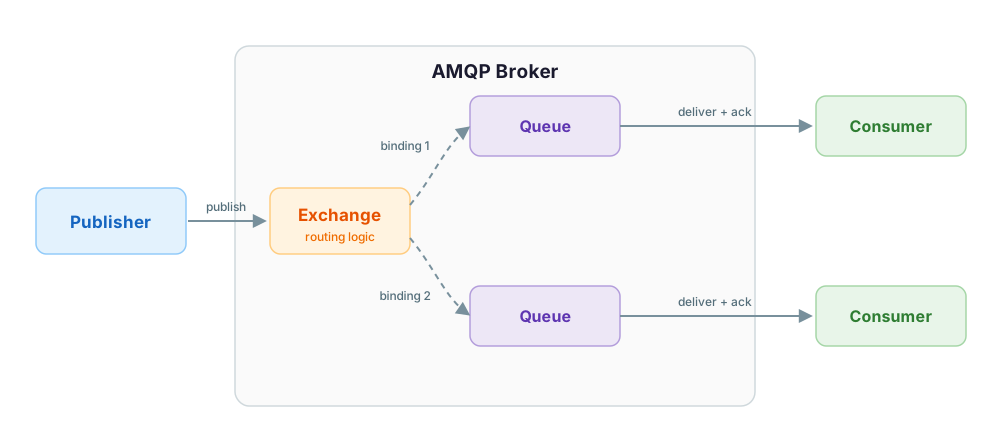
The functionality of the AMQP protocol relies on a modular architecture that separates the act of receiving a message from its ultimate distribution. This decoupling allows for sophisticated load balancing and high system resilience.
- Exchanges: These components act as the entry point for data, receiving messages and determining their destination based on routing keys.
- Queues: These buffers store the data safely until a connected application processes the information.
- Bindings: These rules link exchanges to queues, defining the exact path an AMQP message follows through the system.
Why do industrial systems require an AMQP broker?
An AMQP broker serves as the central orchestration point for the entire messaging network. It manages the persistent storage of messages, handles client authentication, and enforces delivery guarantees. In enterprise environments, this central coordinator prevents data loss during network outages by holding information until receivers confirm successful processing.
What are the different AMQP exchange types?
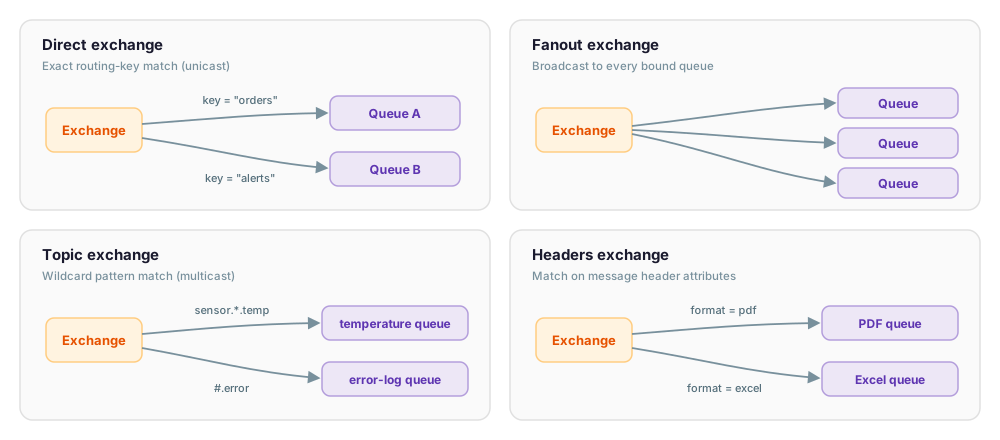
The versatility of the AMQP protocol stems from its ability to route data through different exchange types. Each type follows a specific algorithm to decide which queue receives an AMQP message. This flexibility allows engineers to tailor the data flow to the exact requirements of their industrial applications.
Direct exchange: precise unicast routing
A direct exchange delivers messages to queues based on an exact match of the routing key. This is the simplest routing mechanism within an AMQP broker. It is ideal for tasks where a specific worker must process a specific command, such as triggering a defined machine action.
Fanout exchange: high-efficiency broadcasting
The fanout exchange ignores routing keys and pushes every incoming AMQP message to all bound queues. This method is highly efficient for broadcasting global updates or configuration changes across an entire factory floor. It ensures that every connected subsystem receives the information simultaneously without additional filtering logic.
Topic exchange: multicast pattern matching
Topic exchanges route messages based on wildcard matches between the routing key and the binding pattern. This allows for complex filtering logic where a consumer can subscribe to specific categories of data, such as all “error” logs from “Region A”.
Headers exchange: attribute-based routing
Unlike other types, the headers exchange uses multiple message header attributes instead of a single routing key. This allows for even more granular control, as the AMQP broker can evaluate several criteria before directing the data to a queue.
What is the typical AMQP message lifecycle?
The lifecycle of an AMQP message begins at the producer and follows a strictly defined path through the broker infrastructure. This process ensures that data remains traceable and secure from the moment of creation to the point of consumption.
Step-by-step path of data through the broker
- Production: The application creates a payload and attaches a routing key.
- Ingestion: The producer transmits the data to a specific exchange on the AMQP broker.
- Routing: The exchange evaluates the routing key against its existing bindings.
- Queuing: The message moves into one or more queues based on the routing results.
- Consumption: The broker pushes the message to a subscribed consumer or waits for a pull request.
- Acknowledgment: The consumer sends a signal back to the broker once the data is processed, triggering the removal of the message from the queue.
How do message properties influence routing performance?
Every AMQP message contains a header section that holds metadata such as content type, priority, and expiration. Engineers use these properties to implement complex logic, such as dead-lettering for failed tasks or prioritizing urgent control signals over routine telemetry. Proper header configuration minimizes the processing load on the exchange, as the broker can route data without inspecting the actual payload.
How does the AMQP protocol manage reliability and flow control?
Reliability remains the primary reason engineers select the AMQP protocol over simpler alternatives. High-stakes industrial environments cannot afford silent data loss or system crashes due to message congestion. The protocol implements specific mechanisms to prevent these failures: delivery acknowledgments and credit-based flow control.
Guaranteeing message integrity with acknowledgments
The AMQP broker tracks every AMQP message until it receives a formal confirmation from the consumer. If a network connection drops before the consumer sends this signal, the broker restores the message to the queue for another attempt. This handshake mechanism protects critical production data, ensuring that no instruction or sensor reading disappears during transit.
Preventing system overload through flow control
Flow control prevents a fast producer from overwhelming a slow consumer. In AMQP 1.0, the protocol uses a credit-based flow control system where the consumer defines its available processing capacity to the broker. In AMQP 0-9-1 implementations, flow control is typically handled via QoS and prefetch mechanisms.
- Credit allocation: The consumer grants credits to the broker, representing its available buffer space.
- Controlled delivery: The broker only pushes an AMQP message if the consumer has remaining credits.
- Dynamic throttling: Once credits run out, the broker pauses transmission until the consumer finishes its current tasks and requests more data.
Technical safeguards for enterprise stability
| Mechanism | Protective function |
|---|---|
| Publisher confirms | Protects the path from the producer to the AMQP broker. |
| Consumer acknowledgments | Protects the path from the broker to the receiving application. |
| Dead-letter exchanges | Routes unprocessable messages to a separate area for later debugging. |
| Message persistence | Saves data to a physical disk to survive broker restarts or power failures. |
Which AMQP version should you choose?
Selecting the right version is a critical decision. Although they share a name, AMQP 0-9-1 and AMQP 1.0 are functionally distinct.
AMQP 0-9-1: broker-centric logic
Most popular AMQP broker implementations are built on version 0-9-1. It defines both data movement and internal broker behavior, including exchanges and bindings. If your project requires complex, battle-tested server-side routing logic, 0-9-1 is the standard choice.
AMQP 1.0: global interoperability
AMQP 1.0 focuses solely on the transport layer as a peer-to-peer communication standard. It does not dictate internal broker routing, making it the preferred ISO standard for cloud providers like Azure Service Bus. Use this version to ensure different messaging platforms can communicate without translation layers.
Technical comparison of AMQP versions
| Feature | AMQP 0-9-1 | AMQP 1.0 |
|---|---|---|
| Philosophy | Command-oriented (RPC style) | Transport-oriented (peer-to-peer) |
| Broker requirements | Explicit (exchanges/queues defined) | Flexible (internal logic is opaque) |
| Interoperability | Higher within specific ecosystems | Universal across different vendors |
| Standardization | De facto industry standard | ISO/IEC 19464 standard |
How do AMQP and MQTT differ in industrial environments?
Choosing between the AMQP protocol and MQTT depends on whether your IIoT architecture prioritizes complex enterprise routing or resource-efficient edge communication. While both support asynchronous data transfer, they serve distinct strategic roles in the factory-to-cloud pipeline.
Benchmarking throughput and overhead
MQTT is designed for extreme efficiency, using a minimal header to reduce network load, perfect for battery-powered sensors and massive device fleets. Conversely, the AMQP protocol utilizes a larger header to carry metadata for transactions and granular routing. When evaluating AMQP vs. MQTT, engineers must balance the need for the deep metadata of an AMQP message against the low-latency, high-frequency requirements of modern industrial telemetry.
When to prioritize an AMQP broker?
The decision to deploy an AMQP broker over an MQTT solution typically occurs when integrating enterprise-level applications or B2B workflows. If your system requires distributing data to multiple specific queues based on diverse attributes, AMQP’s architectural depth is superior for those central IT hubs.
Hybrid edge-to-cloud architectures with Cedalo
Modern facilities often avoid a “one-or-the-other” choice. Instead, they use the Cedalo MQTT Platform at the edge to collect raw machine data with maximum efficiency and minimal overhead. This data is then integrated into an AMQP protocol environment for deep enterprise processing.
By using Cedalo as the high-performance ingestion layer, you ensure that your edge devices remain responsive while your central AMQP broker handles the complex transactional logic required for ERP and cloud systems.
Build a scalable hybrid architecture
Optimize your data flow by combining the Cedalo MQTT Platform with your AMQP protocol infrastructure. Achieve maximum edge efficiency and enterprise-grade reliability without increasing system complexity.
What is the security architecture for enterprise messaging?
In regulated industries, a breach in the AMQP protocol stream could mean more than just data loss, it could disrupt physical production lines. To prevent unauthorized access or data tampering, a professional AMQP broker deployment relies on a multi-layered security model.
Authentication and encryption: SASL and TLS
The first line of defense is the Simple Authentication and Security Layer (SASL). This framework allows the broker to support various authentication mechanisms, from basic username/password to complex Kerberos or external LDAP integrations, without changing the core protocol.
To protect the AMQP message during transit, Transport Layer Security (TLS) encryption is mandatory. This ensures that even if a packet is intercepted between the producer and the broker, the payload remains unreadable.
Granular control: role-based access control (RBAC)
In multi-tenant industrial environments, not every application should have access to every queue. Role-Based Access Control (RBAC) allows administrators to define precise permissions at the exchange and queue levels.
- Producers: May only have “write” access to specific exchanges.
- Consumers: Are restricted to “read” access from designated queues.
- Admins: Manage infrastructure without necessarily viewing sensitive message payloads.
Strategic deployment of an AMQP broker
Deploying an AMQP broker for production requires an architecture designed for zero downtime. For industrial enterprises, this means moving beyond basic setups toward high-availability (HA) clustering.
Ensuring high availability
A single node is a point of failure. Professional AMQP protocol deployments use clustering to synchronize multiple nodes:
- Queue mirroring: Replicated or quorum-based queue mechanisms (depending on the broker implementation) replicate messages across nodes to prevent data loss during hardware failure.
- Load balancing: Distributes connections to prevent bottlenecks during traffic peaks.
Key evaluation criteria
When selecting a messaging platform, focus on these performance pillars:
- Hybrid support: Does it bridge legacy AMQP protocol needs with modern, lightweight standards?
- Resource footprint: Can it run efficiently on-premises and at the edge?
- Scalability: Does it handle growing data volumes without exponential management costs?
Storage requirements
Reliability depends on hardware. High-speed persistent storage (like NVMe SSDs) is essential to persist data instantly, ensuring messages survive reboots without sacrificing throughput.
AMQP: frequently asked questions
What is the primary use case for AMQP 1.0 in modern cloud computing?
AMQP 1.0 is the standard for cross-platform interoperability, enabling different messaging vendors and cloud services to communicate without a shared broker architecture. It is essential for bridging diverse programming languages and cloud-native services like Azure Service Bus or Amazon MQ in distributed systems.
How does the AMQP protocol handle message persistence during hardware failures?
By declaring queues as durable and marking messages as persistent, AMQP implementations can ensure that messages are written to non-volatile storage before acknowledgment, allowing recovery after broker restarts. This mechanism allows the broker to recover the exact queue state from disk after a crash, guaranteeing that no critical data is lost.
Can an AMQP broker support multi-tenancy in industrial private clouds?
Many AMQP broker implementations, such as RabbitMQ, use Virtual Hosts (vhosts) to provide logical isolation for different departments or clients on a single physical instance. This ensures that security policies, message queues, and connection limits remain segregated, which is vital for secure industrial service provider environments.
Why is an AMQP message more suitable for financial transactions than telemetry data?
An AMQP message supports complex headers and atomic transactions, ensuring multiple operations succeed or fail as a single unit. This supports reliable and transactional message processing required for financial systems. However, exactly-once delivery semantics depend on the overall system architecture, including idempotent consumers and transaction management.
How does Cedalo integrate the AMQP protocol into its high-performance MQTT environment?
The Cedalo MQTT Platform serves as the high-speed MQTT ingestion layer at the edge and forwards data through its native bridges (Kafka, databases, HTTP, cloud services) into the enterprise stack, where an AMQP broker consumes it. This setup allows you to leverage Cedalo’s low latency at the machine edge while piping data into central AMQP brokers for ERP and PLM integration.