MQTT security problems rarely originate from the protocol itself. They arise when brokers run with weak identity, missing authorization, and little visibility into who publishes and subscribes to which data.
In industrial and IIoT environments, this turns MQTT into an unintended bridge between OT and IT. Availability, safety, and compliance then depend on whether security was designed into the architecture from the start.
MQTT Security: Key takeaways
- MQTT security depends on TLS encryption, strong client identity, and strict topic level authorization, not on the protocol alone.
- A large share of MQTT security incidents trace back to exposed brokers, shared credentials, and missing access control rather than advanced attacks.
- Operational visibility through logging, monitoring, and controlled change management is essential to keep MQTT secure in production.
- Enterprise features such as RBAC, audit trails, and centralized management simplify secure MQTT operations across multiple sites.
What does MQTT security include?
MQTT security covers more than encrypted connections between clients and brokers. A secure deployment combines transport protection, strong identity, strict authorization, and continuous operational governance.
The MQTT specification enables these capabilities, but it does not enforce them. Production security depends on how teams configure and operate the broker, not on the MQTT protocol alone.
The four pillars of MQTT security:
- Transport security through TLS encryption and certificate validation
- Identity and authentication for devices, gateways, and applications
- Authorization and access control at topic level with least privilege design
- Logging, monitoring, and governance to detect misuse and configuration drift
1. Transport security
Transport security protects MQTT traffic against interception and manipulation. TLS encryption and correct certificate validation ensure that data in transit cannot be read or altered by unauthorized parties.
2. Identity and authentication
Authentication defines who is allowed to connect to the broker. Strong identity relies on certificates or managed credentials instead of shared usernames and passwords across devices.
3. Authorization and access control
Authorization determines what a connected client is allowed to publish or subscribe to. Topic level permissions limit the blast radius of compromised devices or credentials.
4. Logging, monitoring, and governance
Security remains incomplete without visibility. Audit logs, monitoring, and clear governance processes turn MQTT security from a configuration task into an operational discipline.
What are the most common MQTT security vulnerabilities?
A large share of MQTT security incidents do not result from sophisticated attacks. They result from predictable misconfigurations that remain unnoticed until systems connect OT data flows with enterprise applications.
These failures repeat across industries because teams focus on connectivity first and add security controls later, often under time pressure.
| Failure | Cause | Impact |
|---|---|---|
| Publicly reachable broker | Missing network segmentation and firewall rules | Unauthorized access, data exfiltration, manipulation |
| Unencrypted communication | TLS not enabled or misconfigured | Traffic interception and credential theft |
| Shared credentials across devices | Simplified provisioning without identity strategy | Lateral movement after compromise |
| No topic level authorization | Only connection authentication implemented | Full access to operational data for any authenticated client |
MQTT security: Best practices
A secure MQTT deployment depends less on complex tooling and more on disciplined application of a few core practices. These practices prevent the most common attack paths and misconfigurations that appear in production environments.
Teams that treat MQTT security as part of architecture and operations, not as a late configuration task, avoid costly redesigns when systems scale or face audits.
Best practices every MQTT deployment should follow:
- Enforce TLS encryption for all communication between clients and brokers
- Assign a unique identity to every device, gateway, and application
- Implement topic level authorization with strict least privilege rules
- Enable logging and monitoring for connections, topic access, and configuration changes
TLS encryption must be mandatory, not optional. Brokers should never accept unencrypted connections, and clients must validate certificates instead of trusting any presented endpoint.
Each device and application needs its own identity. Shared usernames and passwords remove accountability and make it impossible to detect misuse or compromise through identity tracking.
Secure your MQTT infrastructure with Cedalo
See how Cedalo helps you operate Mosquitto with enterprise-grade security, centralized management, and full visibility across all your MQTT brokers.
Authorization must go beyond allowing clients to connect. Define clearly which topics each client can publish to and subscribe from, and restrict access to the smallest necessary scope.
Logging and monitoring turn these controls into an operational capability. Teams must see authentication failures, unusual topic access, and configuration changes in real time to detect security issues before they impact operations.
How do authentication and authorization differ in MQTT?
Authentication and authorization serve different purposes in security in MQTT. Authentication verifies who is allowed to connect to the broker, while authorization defines what that client is allowed to do after connecting.
Many deployments implement authentication correctly but neglect authorization. This creates a situation where every authenticated client can access far more data than required.
| Aspect | Authentication | Authorization | Audit |
|---|---|---|---|
| Main question | Who is connecting | What can they do | What did they do |
| Mechanism | Certificates, credentials, tokens | Topic level ACLs and roles | Logs and monitoring |
| Typical mistake | Shared credentials | Broad topic access | Logs not reviewed |
| Security impact | Prevents anonymous access | Limits blast radius | Enables detection and response |
Device publishing rights versus application subscription rights
Devices usually need to publish telemetry and state but rarely need to subscribe to data. Applications such as MES or analytics platforms need to subscribe but should not publish operational events.
Separating these rights reduces the risk that compromised devices can read sensitive data or that applications accidentally inject data into operational topics.
What changes with MQTT 5 from a security perspective?
MQTT 5 introduces features that affect how teams must think about security and validation. These changes do not automatically make deployments more secure, but they create new surfaces that require attention.
Enhanced Authentication allows challenge and response mechanisms beyond simple username and password flows. This enables stronger integration with enterprise identity systems when correctly implemented.
MQTT 5 security-relevant features:
- Enhanced Authentication using AUTH packets for advanced mechanisms
- User Properties that carry metadata and require validation
- Reason Codes that expose more MQTT protocol feedback and must not leak sensitive information
Teams must include MQTT 5 behavior in their security testing. Metadata fields and extended properties can carry unexpected data that bypasses simple validation rules if teams focus only on payload content.
MQTT 5 also increases interoperability with external systems. This improves flexibility but requires stricter governance to prevent misuse of extended protocol capabilities.
How should OT security principles shape MQTT architecture?
MQTT deployments in manufacturing do not exist in a purely IT context. They sit between control networks, plant networks, and enterprise systems where availability and safety take priority over typical IT security models.
A secure design respects zones and conduits. Brokers and gateways must sit at controlled boundaries where communication paths remain explicit and limited.
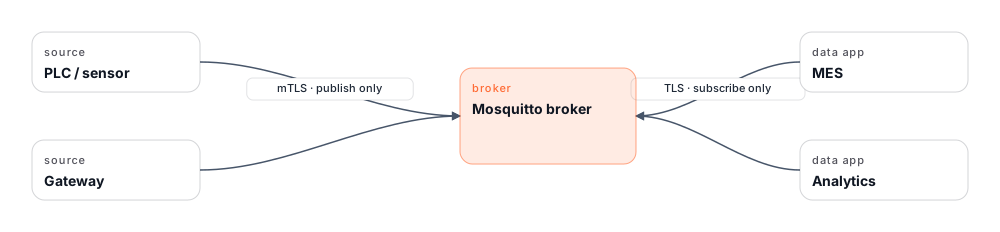
Figure 1: A segmented MQTT architecture. OT devices publish over mutual TLS with publish-only permissions, IT applications subscribe over TLS with subscribe-only permissions, and the broker sits on the controlled boundary (conduit) between the OT and IT zones. Topic level ACLs enforce least privilege on both sides.
Security changes must also follow operational discipline. Updating certificates, access rules, or broker configurations without a rollback plan can disrupt production systems that depend on continuous data flow.
Incident response must consider MQTT as part of the operational backbone. Teams need procedures to isolate clients, revoke access, and restore configurations without shutting down entire data pipelines.
Which regulations and standards influence MQTT security design?
MQTT security in manufacturing environments does not exist in isolation from regulatory expectations. European regulations and industrial standards increasingly require organizations to prove how they protect data flows between systems.
The NIS2 Directive (Directive (EU) 2022/2555) sets cybersecurity risk-management obligations for organizations in scope. Its Article 21 lists broad measures including risk analysis, incident handling, access control policies, and the use of logging and monitoring (Directive (EU) 2022/2555, Art. 21). MQTT brokers that connect OT and IT systems fall inside this security perimeter and should provide traceability and access control evidence.
What NIS2 implies for MQTT operations
The following are practical implications of the NIS2 Article 21 risk-management obligations, not verbatim statutory text:
- Logging of authentication and access events supports the required incident analysis
- Access control should follow least privilege and be demonstrable
- Monitoring should detect abnormal behavior across connected systems
- Governance processes should exist for configuration and security changes
Industrial standards such as ISA/IEC 62443 also influence architecture. Zone and conduit definitions and the associated security requirements (ISA/IEC 62443-3-2 for zoning and risk assessment, ISA/IEC 62443-3-3 for system security requirements) call for segmentation, controlled communication paths, and clear responsibility for security across zones. These directly affect where and how MQTT brokers operate.
Checklist: How do you operate MQTT security in day to day operations?
Security in MQTT does not end after configuration. It requires continuous visibility and disciplined change management to remain effective in production environments.
Operations teams must monitor signals that reveal misuse, misconfiguration, or emerging risks before they affect connected systems such as MES, historians, or analytics platforms.
Security telemetry that must remain visible:
- Authentication failures and unusual connection attempts
- Topic access patterns that deviate from normal behavior
- Certificate errors and expirations
- Configuration and ACL changes on the broker
Change management is equally important. Teams need a repeatable process for updating certificates, access rules, and broker configurations without creating downtime or inconsistent setups across sites.
A simple change workflow helps maintain consistency:
- Validate changes in a controlled environment
- Apply changes with monitoring enabled
- Verify topic access and client behavior after rollout
- Document and replicate the change across other brokers
Without this discipline, organizations quickly end up with one-off brokers that behave differently and create hidden security gaps.
How does Cedalo support secure MQTT operations in production?
Cedalo builds on Eclipse Mosquitto and extends it with enterprise capabilities that address MQTT security as an operational requirement, not only a configuration task. Teams can apply role based access control, topic level authorization, and audit logging consistently across brokers and sites.
The Cedalo Management Center provides centralized visibility into connections, topic access, and broker configuration. This allows operations teams to monitor security relevant events and apply changes in a controlled and traceable way.
Mosquitto Dynamic Security, combined with Cedalo’s management and observability features, enables runtime updates of users, roles, and permissions without interrupting data flows. This supports least privilege design and simplifies ongoing security governance in production environments.
Secure your MQTT infrastructure with Cedalo
See how Cedalo extends Mosquitto with role-based access control, audit trails, and centralized visibility across all your MQTT brokers.
MQTT Security: Frequently Asked Questions
Is MQTT secure enough for industrial and manufacturing environments?
MQTT can be secure enough for industrial use when teams implement proper TLS encryption, strong client identity, and strict topic level authorization. The protocol itself supports secure communication, but the real security level depends on how the broker and clients are configured and operated in production.
What port should MQTT use for secure communication?
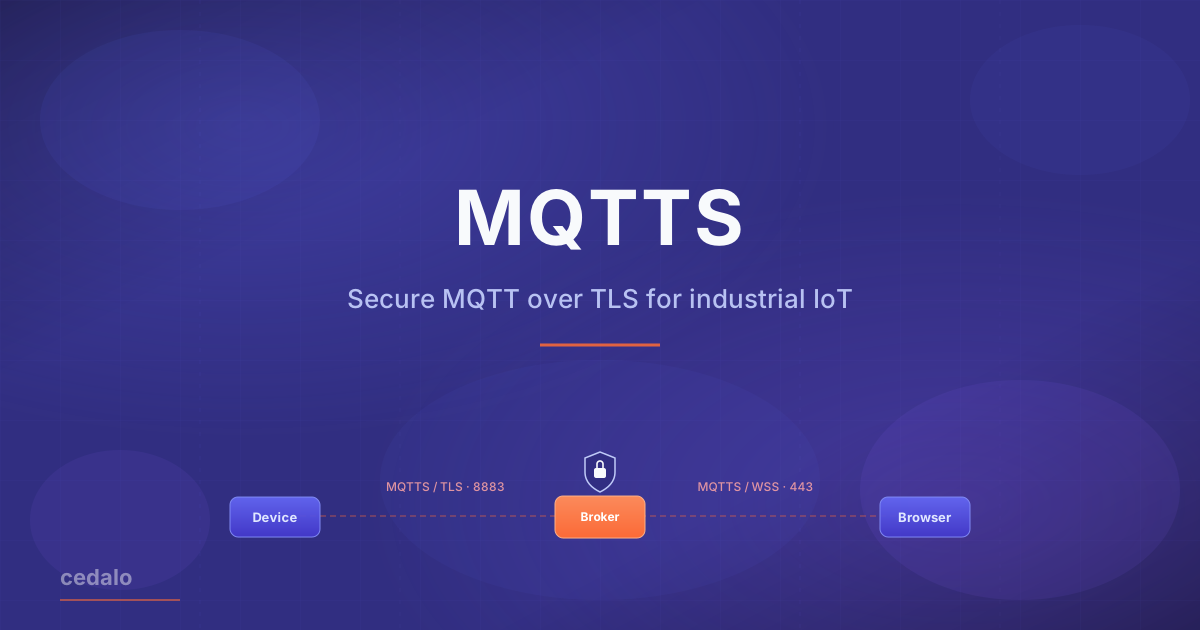
Secure MQTT communication typically runs over port 8883 with TLS enabled instead of the default unencrypted port 1883. Using TLS on the correct port ensures encrypted transport and signals that the broker enforces secure connections by default.
Can MQTT be used safely over public networks or the internet?
MQTT can run safely over public networks when encryption, certificate validation, authentication, and strict authorization are in place. Without these controls, exposing a broker to the internet creates significant risk for unauthorized access and data manipulation.
How do you secure MQTT devices that have limited resources?
Resource constrained devices can still use TLS with lightweight cipher suites and certificate based authentication. Offloading some processing to gateways while maintaining strong identity and authorization rules helps protect these devices without overloading them.
How does Cedalo help manage MQTT security across multiple brokers?
Cedalo provides centralized management and visibility through its Management Center, which allows teams to monitor connections, enforce access control, and track configuration changes across sites.
Why is Mosquitto Dynamic Security important for MQTT authorization?
Mosquitto Dynamic Security enables role based access control and topic level permissions that can be updated at runtime. This allows teams to apply least privilege principles and adapt access rules without restarting brokers or interrupting data flows.
How does Cedalo support audit and compliance requirements for MQTT deployments?
Cedalo adds audit trails, monitoring, and role based access control on top of Mosquitto, which helps organizations demonstrate who accessed which data and when. These capabilities support compliance efforts where traceability and governance of data flows are required.