Most Industrie 4.0 projects fail due to gaps in how OT data is collected, structured, and delivered to the systems that depend on it. Even when data is available, it often lacks structure, governance, or security. The IT vs. OT distinction is not an organizational debate. It’s the architectural foundation your data strategy either rests on or cracks under.
IT vs. OT: Key Takeaways
- IT optimizes data flow and business processes; OT controls physical systems where unplanned downtime is a safety event, not a recoverable disruption.
- OT networks are often segmented or historically isolated, but many legacy OT environments still contain flat structures. These flat architectures can create a significant attack surface once uncontrolled IT connectivity is introduced.
- IT and OT cyber security require separate threat models: IT patches within days, OT systems often run unpatched for years due to vendor and operational constraints.
- The Cedalo MQTT Platform connects IT and OT through a secure, scalable integration layer. It is built on Eclipse Mosquitto with enterprise-grade clustering, access control, and centralized broker management.
What is the Meaning Behind IT and OT?
Information Technology (IT) refers to systems that process, store, and transmit data to support business operations: ERP platforms, cloud infrastructure, analytics environments, and identity management. Operational Technology (OT) covers hardware and software that monitor and control physical processes: PLCs, SCADA systems, Distributed Control Systems (DCS), historians, and industrial sensors.
The IT/OT meaning goes beyond a simple classification. Both domains operate under entirely different design philosophies. IT systems tolerate downtime as a manageable disruption. OT systems treat downtime as a production loss or a safety event. IT environments update continuously; OT equipment runs for a decade or more without a single patch.
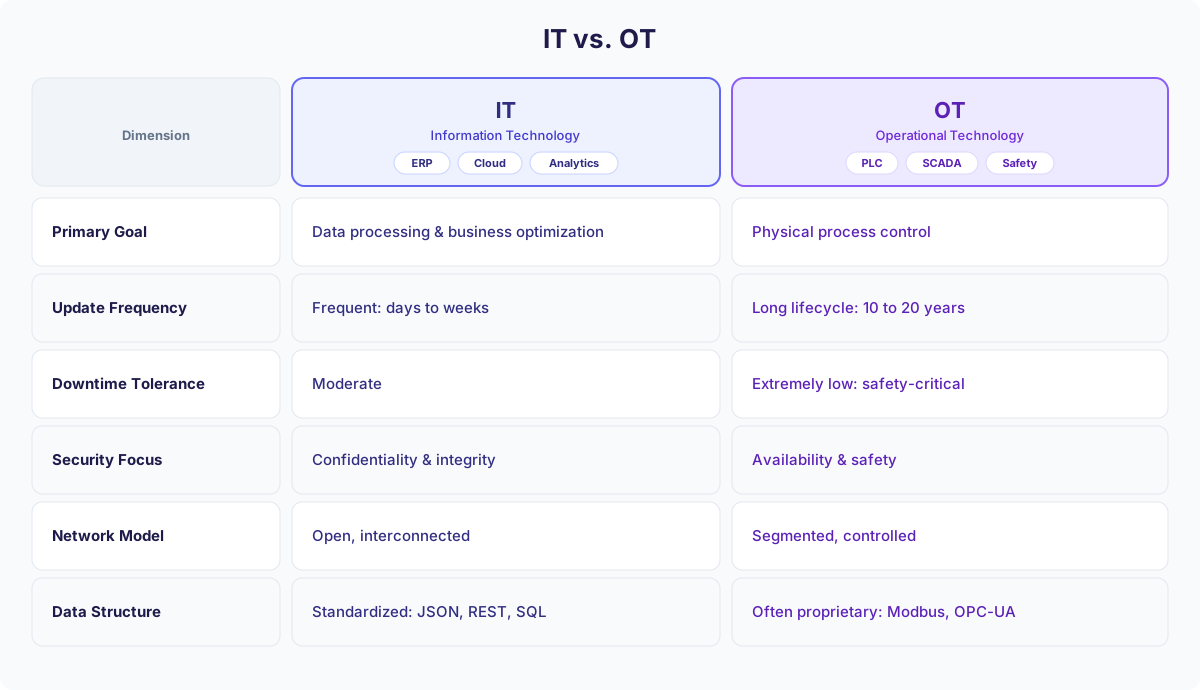
These differences explain why a direct connection between an ERP system and a PLC is not integration. It is a structural risk that bypasses the constraints OT systems depend on for safe operation.
How Do IT and OT Networks Differ in Structure and Risk Profile?
An OT vs. IT comparison at the network level reveals why interoperability in IT does not translate directly into safe connectivity in OT.
IT networks are open, IP-based, and built for interoperability across locations, vendors, and cloud environments. OT networks are segmented by design, historically isolated from enterprise systems, with strict control over what connects and from where.
| IT Network | OT Network | |
|---|---|---|
| Topology | Open, interconnected | Segmented, isolated |
| Access model | Interoperability by default | Strict connection control |
| Legacy risk | Low: frequent updates | High: flat structures, shared broadcast domains |
| Connectivity | Cloud, multi-vendor | Controlled, local |
Many legacy OT environments still operate with flat network structures, where all devices share the same broadcast domain: no separation between a temperature sensor and a safety controller. Once connectivity to IT systems is introduced without architectural controls, this becomes a significant attack surface.
Structured frameworks address this directly:
- Purdue Model: Defines hierarchical levels from field devices through control systems to enterprise networks
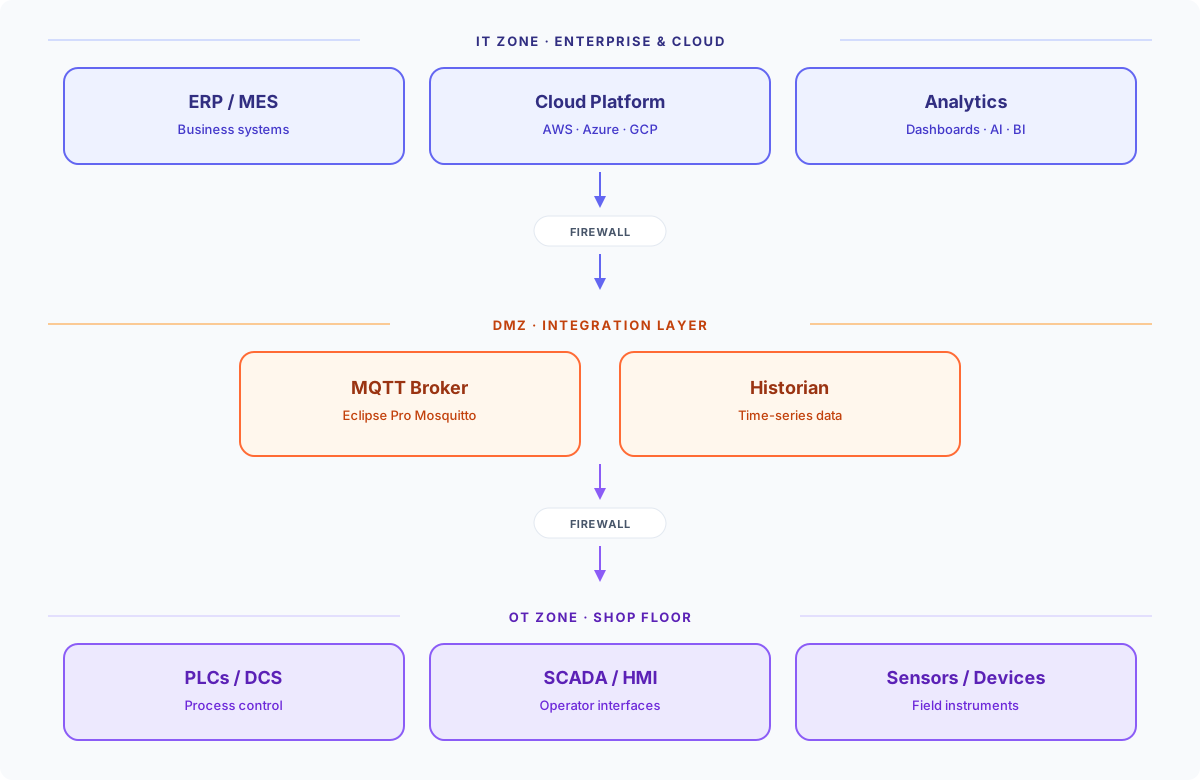
- IEC 62443: Defines security zones and conduits; firewalls and DMZs are common implementation patterns depending on risk and architecture
Both frameworks reflect the same operational reality: insufficiently controlled connectivity in an OT network can affect multiple systems across a production environment.
Where Do IT and OT Networks Actually Intersect?
The intersection points between IT and OT networks are well-defined in practice:
- Machine data forwarded to MES or ERP systems
- Historian data replicated to analytics or data lake platforms
- Edge systems transmitting telemetry to cloud infrastructure
- AI and predictive maintenance models consuming real-time production metrics
At each of these points, a structural tension appears. IT teams demand centralized data access and rapid integration cycles. OT teams demand local autonomy and zero disruption to running processes. Direct coupling without a defined integration layer produces both security gaps and operational fragility. An architecture that resolves this tension through structured layering rather than direct coupling is what separates a scalable IT/OT setup from an improvised one.
IT vs. OT Cyber Security: Why Are the Threat Models Fundamentally Different?
IT and OT cyber security share a common objective: protecting systems, operations, and assets. However, the threat models diverge significantly. In IT, security frameworks address confidentiality, integrity, and availability, often with a stronger emphasis on confidentiality and integrity. In OT, availability and safety typically take priority, because operational disruption can directly impact physical processes, equipment, and personnel.
The practical consequences are significant. IT environments apply patches within days or weeks. OT systems often run unpatched for years: vendors do not certify updates for active production hardware, and patches require scheduled downtime that production schedules rarely accommodate. Standard IT security tools like antivirus agents and endpoint detection software frequently cannot run on OT hardware at all.
Typical OT-specific attack vectors include:
- Ransomware targeting production systems: Encrypting historian data or HMI interfaces to extort a restart of operations.
- Air-gap bridging: USB devices or compromised contractor laptops introduced directly into OT environments.
- Supply chain compromise: Malicious firmware embedded in industrial components before installation.
- Lateral movement from IT to OT: Exploiting insufficiently segmented networks after an initial IT-side breach.
What Does a Secure IT/OT Integration Look Like in Practice?
A secure OT/IT setup applies layered controls rather than a single perimeter.
These steps reflect current best practices across industrial environments:
- Define network zones: Separate OT, DMZ, and IT segments with firewalls that enforce directional data flow
- Place an integration layer in the DMZ: A message broker receives data from OT and distributes it to IT systems without creating direct network connections between the two domains
- Enforce role-based access control: Every user and system requires explicit, scoped permissions with no shared credentials across OT and IT
- Log and audit all data flows: Centralized audit trails document who accessed what, when, and from which network zone
- Apply least-privilege by design: OT systems publish data; IT systems subscribe and consume: directional governance, not open access
A centralized MQTT broker in the DMZ can structurally limit the attack surface by decoupling OT publishers from IT consumers. In this architecture pattern, IT systems do not need direct connections into the OT network in order to receive production data.
How Do You Bring IT and OT Together Without Disrupting Operations?
Connecting IT and OT systems without destabilizing OT behavior requires an event-driven architecture. Instead of point-to-point APIs that create tight dependencies, event-driven messaging decouples producers from consumers. OT systems publish data events; IT systems subscribe to exactly the data they need. Neither side depends on the internal state of the other.
MQTT is one common protocol that makes this separation practical in many industrial environments. It runs on constrained hardware, uses little bandwidth, and supports three Quality of Service (QoS) levels that can be aligned with different message reliability requirements in OT environments:
| QoS Level | Delivery Guarantee | Typical OT Use Case |
|---|---|---|
| QoS 0 | At most once | High-frequency sensor telemetry |
| QoS 1 | At least once | Status updates, alarms |
| QoS 2 | Exactly once | Messages where loss or duplication is unacceptable |
This separation means different message classes can be assigned different delivery guarantees based on their requirements. QoS, however, defines delivery semantics rather than traffic prioritization or isolation by itself.
The publish/subscribe model maps well onto IT/OT integration: machines publish, and applications consume.
A structured IT/OT architecture places the MQTT broker at the integration layer between the OT execution zone and the IT data platform, where it governs all cross-boundary data flow without touching control logic.
How Does MQTT Enable Structured Data Flow From OT to IT?
The topic structure in MQTT directly reflects the physical asset hierarchy of a production environment. A sensor on line 1 at a Berlin plant publishes to berlin/plant1/line1/temperature. An analytics platform subscribes to berlin/+/+/temperature to collect temperature readings across all lines without any changes on the OT side.
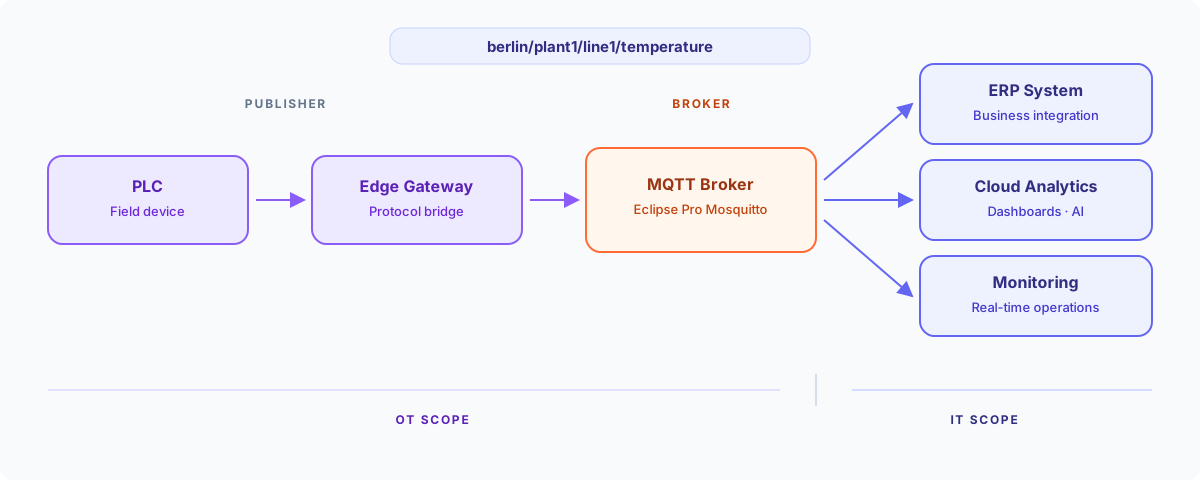
The pub/sub model delivers three concrete structural advantages for IT/OT integration:
- Decoupling: OT systems publish without knowing who consumes the data. Adding a new analytics subscriber or AI model requires zero changes on the OT side.
- Scalability: A single broker handles thousands of concurrent connections. New sites, lines, or consumers connect to the existing topic structure without architectural redesign.
- Traceability: Topic hierarchies can help document the data model, while retained messages can preserve the latest known value for selected topics. Full auditability requires additional logging and audit capabilities to record who published, accessed, or changed what and when.
What Changes When You Manage IT and OT Data From a Single Platform?
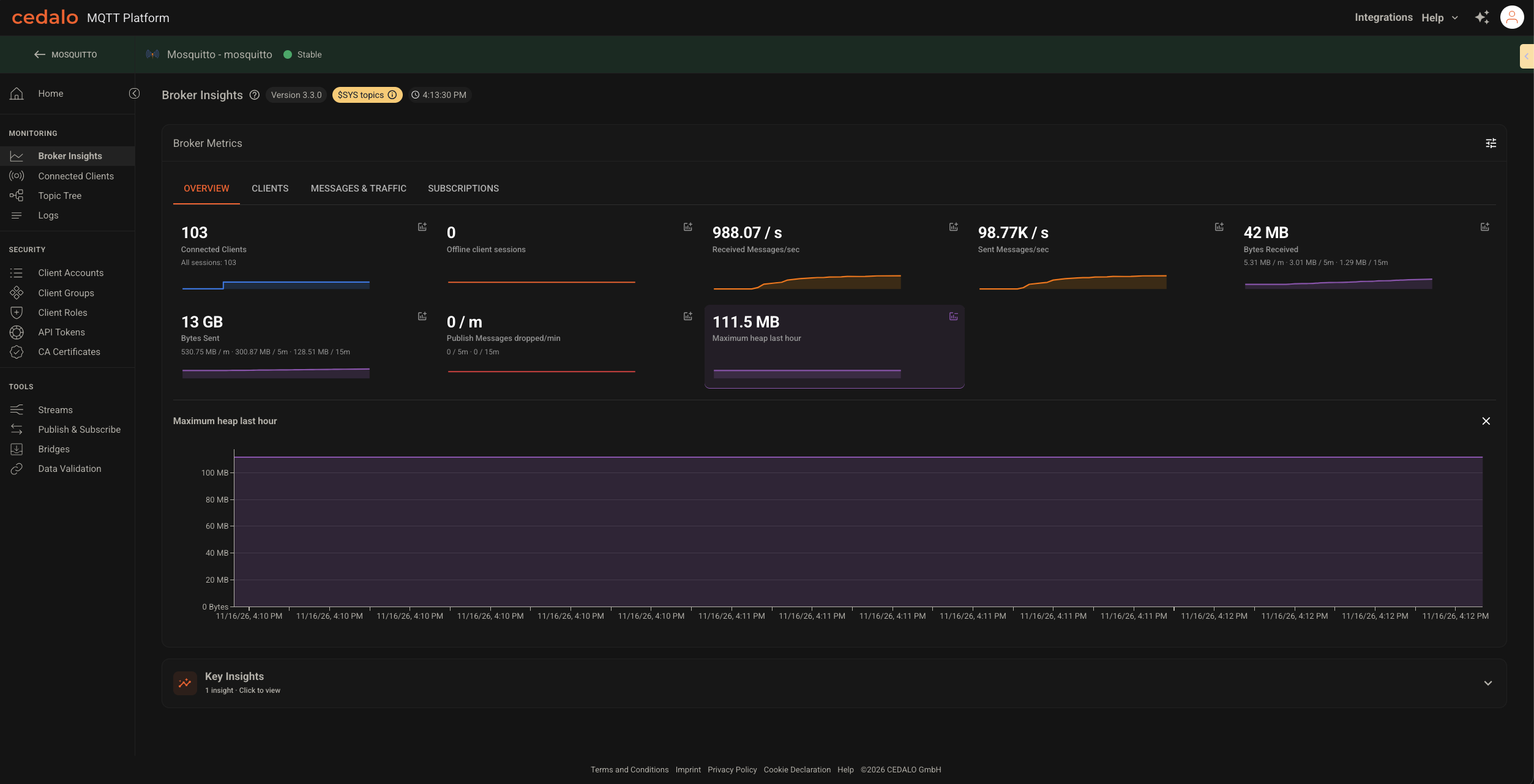
Managing IT and OT data from a single platform reduces operational complexity. Instead of working across separate tools for configuration, monitoring, and access control, teams manage the broker landscape from one central environment.
OT teams keep control over device connectivity and topic structures, while IT teams handle integrations, users, and data flows. With shared visibility across all broker instances, incidents can be identified faster and managed with less effort.
In distributed environments, this centralized approach becomes even more valuable. Operators gain a consolidated view of connection states, throughput, errors, and certificate status across sites, without logging into each broker separately.
IT and OT Belong Together: Here Is How to Connect Them Without Risk
Most organizations already have the data. The missing piece is the architectural layer that moves it securely from the shop floor into the systems that need it, without exposing OT networks and without rebuilding integrations every time a new use case appears.
Your advantages with Cedalo:
- Configure brokers, topics, users, and monitoring across all sites from a single Management Center.
- Clustering and automated failover keep OT data flowing even when individual nodes go offline.
- Role-based access control, TLS encryption, and audit trails cover both IT governance and OT compliance.
- Cedalo extends Eclipse Mosquitto, a broker used in millions of deployments worldwide, with more than 600 million Docker pulls reported separately, which should not be equated with deployments.
Ready to Connect Your IT and OT Infrastructure?
Start your free trial and see how the Cedalo MQTT Platform connects your IT and OT infrastructure: secure, scalable, and production-ready from day one.
IT vs. OT: Frequently Asked Questions
What Is the Difference Between IT Convergence and IT/OT Integration?
IT/OT convergence describes the organizational process of aligning IT and OT teams, goals, and workflows. IT/OT integration is the technical implementation, connecting systems, protocols, and data flows across both domains. Convergence sets the strategy; integration builds the infrastructure that makes it operational.
Can OT Systems Run Standard IT Security Software?
Most OT systems cannot run conventional IT security tools like antivirus agents or endpoint detection software. OT hardware often lacks the processing capacity, and vendors do not certify such software for active production environments. Security in OT relies on network segmentation, access control, and monitoring at the communication layer instead.
What Is the Purdue Model in Industrial Network Security?
The Purdue Model defines five hierarchical levels separating field devices, control systems, and enterprise networks into distinct zones. It remains a widely referenced framework for IT/OT network segmentation, though modern architectures adapt it to account for cloud connectivity and edge computing scenarios that the original model did not anticipate.
How Does MQTT Differ From OPC UA in IT/OT Integration?
MQTT is a lightweight publish/subscribe protocol optimized for high-frequency telemetry and cross-network data transport, making it well-suited for moving OT data into IT environments. OPC UA is a machine-to-machine protocol designed for structured, semantically rich communication within OT environments. Both protocols serve different layers of the integration stack and are often combined.
What Does Cedalo Add on Top of Open-Source Mosquitto?
Cedalo extends Eclipse Mosquitto with enterprise capabilities that the open-source version does not provide, including clustering, automated failover, role-based access control, audit trails, and a centralized Management Center for multi-broker environments. This makes Cedalo suitable for production-grade IT/OT architectures where availability, governance, and scalability are non-negotiable requirements.
How Does Cedalo Support Compliance in Regulated Industries?
The Cedalo MQTT Platform logs all connection events, topic activity, and configuration changes through built-in audit trails, giving compliance teams the traceability they require. Role-based access control ensures that OT and IT teams operate within defined permission boundaries, which directly supports regulatory frameworks such as IEC 62443 and industry-specific cybersecurity standards.
What Happens to OT Stability When IT Systems Access Production Data?
Direct access from IT systems into OT networks risks disrupting deterministic control processes that depend on predictable timing and isolation. A structured integration layer, such as an MQTT broker positioned in a DMZ, decouples IT data consumers from OT systems, so analytics and enterprise applications receive data without ever opening a direct connection into the production network.