A manufacturing execution system (MES) is software that plans, controls, and documents production processes on the shop floor in real time. It sits between enterprise resource planning (ERP) on one side and machines, sensors, and control systems on the other, turning production orders into tracked, quality-assured output.
Manufacturing Execution System: key takeaways
- A manufacturing execution system connects production planning with real-time shop floor execution, covering scheduling, quality, and performance monitoring.
- MES manages minute-by-minute production events, unlike ERP’s long-term planning or SCADA’s raw equipment control.
- A cloud-based manufacturing execution system depends on a stable data layer between machines and software, which may use MQTT, Sparkplug B, or a Unified Namespace.
- Cedalo builds MQTT-based data infrastructure that connects machines and sensors to MES and ERP systems, designed to provide manufacturers with a standards-based link between shop floor data and execution software.
What is a manufacturing execution system?
A manufacturing execution system is MES software that manages and documents the transformation of raw materials into finished products on the production floor. It tracks work orders, machine status, labor, and quality data as production happens, not after the fact.
MES sits in the ISA-95 model between ERP, which handles business planning on a weeks-or-months horizon, and SCADA or PLC systems, which supervise processes or control machines at machine level. Manufacturing execution software closes the gap between these two layers by translating high-level production orders into shop floor instructions and feeding real-time results back up to the business systems.

How does MES differ from ERP and SCADA?
MES, ERP, and SCADA operate at different levels of the production stack and answer different questions.
| System | Time horizon | Core question | Typical data |
|---|---|---|---|
| ERP | Weeks to months | What should we produce and when? | Orders, inventory, finance |
| MES | Minutes to shifts | What is happening on the floor right now? | Work orders, quality, OEE |
| SCADA/PLC | Milliseconds to seconds | How does this specific machine behave? | Sensor values, control signals |
An MES pulls from SCADA data and reports up to ERP, without duplicating either layer’s function.
What does an MES system do in manufacturing?
An MES system for manufacturing coordinates four core functions: production scheduling, quality management, material and genealogy tracking, and performance analysis.
- Production scheduling and dispatching: Work orders from ERP get translated into detailed shop floor sequences, adjusted for machine availability and shift patterns.
- Quality management: In-process inspections, statistical process control, and non-conformance handling happen at the point of production, not in a separate audit step.
- Material and genealogy tracking: Every batch, lot, and component gets a traceable record from raw material to finished good.
- Performance analysis: Overall Equipment Effectiveness (OEE) and downtime data get captured continuously, giving production teams a live view instead of an end-of-shift report.
How does MES improve quality assurance and transparency?
MES improves quality assurance by catching defects at the point of origin instead of at final inspection. Rather than discovering a tolerance deviation days later during a customer audit, an MES flags it the moment a sensor reading or manual entry falls outside spec, and stops the affected batch from moving downstream.
This level of detail depends on how machine data reaches the MES in the first place. A SCADA system supplies the raw process values, but the MES needs that data structured and available in real time to act on it, which is where the underlying data communication layer becomes the limiting factor.
How does MES connect to IIoT and industrial data communication?
MES only performs as well as the data infrastructure feeding it. Without a reliable, standardized way to move data from machines to software, even a well-configured MES ends up working with delayed or incomplete information.
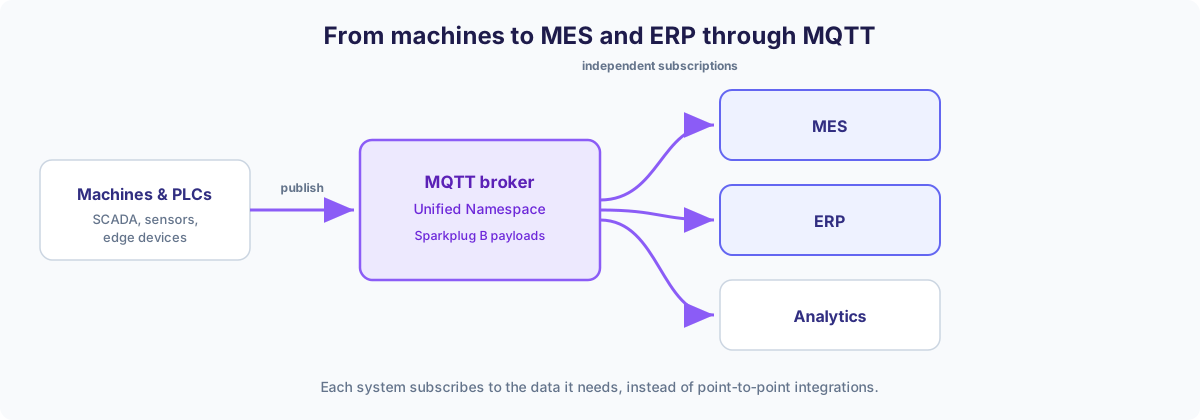
MQTT has become a common standardized protocol for this connection because it handles unreliable networks and large numbers of devices efficiently. Layered on top of MQTT, Sparkplug B adds a defined payload structure and device state messages, so an MES can trust that a machine is actually online rather than assuming it based on the last received value.
A Unified Namespace can then organize this machine data into one consistent, hierarchical structure that MES, ERP, and analytics tools can subscribe to independently, instead of each system requiring its own point-to-point integration.
Why do hybrid OT/IT architectures matter for MES?
Most manufacturing environments run a mix of legacy PLCs, newer IIoT sensors, and cloud-based analytics side by side, and few plants can replace this hybrid environment in one project. An MQTT broker, combined with gateways or edge devices, acts as the connective layer that lets an MES access data from decades-old equipment and modern sensors through a common interface, without a separate integration for each machine generation.
A reliable data layer behind your MES
Machine data helps your MES most when it arrives complete and on time. See how an MQTT-based data layer keeps production data consistent.
What are the benefits of a manufacturing execution system?
An MES gives manufacturers real-time visibility into production, which translates into fewer defects, faster response to disruptions, and stronger compliance documentation.
- Reduced scrap and rework: In-process quality checks catch deviations before they propagate through an entire production run.
- Faster response to downtime: Live OEE data shows exactly which machine or shift is underperforming, instead of surfacing the issue in a weekly report.
- Audit-ready traceability: Full genealogy records support regulatory audits and customer complaints without manual data reconstruction.
- Better resource planning: Accurate, current shop floor data feeds back into ERP planning, improving the accuracy of future schedules.
On-premises vs. cloud-based manufacturing execution system: what’s the difference?
The core functions of an MES stay the same regardless of deployment model, but where the software and data live changes how it scales, what it costs, and who maintains it.
| Criteria | On-premises MES | Cloud-based manufacturing execution system |
|---|---|---|
| Initial investment | High upfront hardware and licensing costs | Lower upfront cost, subscription-based |
| Scalability | Requires additional hardware for growth | Scales with demand, minimal added infrastructure |
| Maintenance | Managed by internal IT/OT teams | Largely managed by the vendor |
| Data location | Fully on-site, under direct control | Depends on provider, often multi-region |
| Latency | Typically lower, no external network dependency | Depends on connectivity and architecture |
A cloud-based manufacturing execution system still needs a dependable bridge between shop floor devices and the cloud. Edge gateways, brokers, historians, or time-series databases such as InfluxDB connected via MQTT are common ways to buffer, store, or forward sensor data into cloud-hosted MES platforms, even when connectivity is inconsistent.
How do you choose among MES software vendors?
Selecting among MES software vendors comes down to how well a platform fits the existing OT/IT environment, not just its feature list.
- Integration depth: Confirm the MES can connect to your existing PLCs, SCADA systems, and databases without custom middleware for every machine type. Integration paths such as MQTT, OPC UA, historians, APIs, or SQL databases show how structured data can move into storage that MES and reporting tools can query directly.
- Scalability across sites: A vendor’s architecture should handle one production line and multiple global sites without a fundamentally different setup.
- Standards support: Look for native support of MQTT, Sparkplug B, and OPC UA rather than proprietary protocols that lock you into a single vendor’s hardware ecosystem.
- Total cost of ownership: Compare licensing, integration effort, and ongoing maintenance, not just the initial quote.
How is MES used in practice?
In pharmaceutical manufacturing, MES can support electronic batch records and genealogy tracking used to meet regulatory documentation requirements, and can be configured to block a batch from release if a required inspection step was skipped. In automotive production, MES coordinates tight takt times across assembly stations, feeding OEE data back to line supervisors within seconds of a stoppage.
Both industries increasingly run hybrid architectures, where established SCADA systems handle legacy equipment while newer MQTT-based data layers connect additional sensors and edge devices. The MES sits on top of this combined data stream, and how well it performs depends directly on how consistently that underlying data reaches it.
Make your production data work for your MES, not against it
A manufacturing execution system only delivers on its promise when the data reaching it is complete, current, and structured. MES handles scheduling, quality, traceability, and performance analysis, but all of that depends on a stable connection between machines and software, whether that connection runs on-premises or through a cloud-based manufacturing execution system. Choosing among MES software vendors ultimately means evaluating how well a platform fits into your existing OT/IT data flow.
Your benefits with Cedalo:
- You connect legacy PLCs and modern IIoT sensors through the same MQTT-based data layer, without a separate integration for each machine generation.
- You get Sparkplug B and Unified Namespace support built on Eclipse Mosquitto, the open-source broker your engineers likely already trust.
- You can reduce the risk of incomplete or delayed shop floor data reaching your MES or ERP system.
- You scale your data infrastructure from a single production line to multiple global sites with less rearchitecture than point-to-point integrations may require.
Build a stable data foundation for your MES
Before evaluating MES software vendors, it’s worth confirming the data layer underneath can actually deliver real-time, structured machine data. Cedalo’s MQTT platform, built on the open-source Eclipse Mosquitto broker, gives industrial teams a tested, standards-based way to connect machines, sensors, and control systems to MES, ERP, and cloud platforms. Explore how a Unified Namespace approach can simplify your OT/IT data flow before your next MES project.
Proven at scale before it reaches your MES
Cedalo's MQTT layer runs on Eclipse Mosquitto, tested across more than 600 million downloads in production environments worldwide.
Manufacturing Execution System: frequently asked questions
How long does it typically take to implement a manufacturing execution system?
Implementation timelines range from a few months for a single production line to over a year for multi-site rollouts. The biggest variable isn’t the MES software itself, but how much work is needed to connect existing machines, PLCs, and databases to it reliably.
Can an MES work with older machines that aren’t natively networked?
Yes, older machines typically connect through a gateway or edge device that translates their signals into a protocol like MQTT. This lets an MES read data from decades-old equipment without requiring a full hardware replacement.
What happens if machine data reaches the MES late or incomplete?
Delayed or missing data breaks the real-time accuracy an MES depends on for scheduling, quality checks, and OEE reporting. Even a well-configured MES produces unreliable output if the underlying data connection drops messages or introduces lag.
How does a Unified Namespace change what data an MES can access?
A Unified Namespace organizes all machine and sensor data into one consistent, subscribable structure instead of separate point-to-point feeds. This lets an MES pull exactly the data it needs without a custom integration for every device or system.
How does Cedalo’s MQTT platform support MES data integration without replacing the MES itself?
Cedalo provides the MQTT-based connectivity layer between machines and the MES, structuring and delivering real-time data through Sparkplug B and Unified Namespace architectures. The MES platform itself can often remain unchanged, since Cedalo supports the underlying data transport and related data-layer functions.
Does Cedalo’s platform work alongside SCADA and PLC systems already feeding an MES?
Yes, Cedalo’s MQTT platform is built to sit alongside existing SCADA and PLC infrastructure rather than replace it. It adds a standardized data layer that pulls from these systems and makes their data consistently available to MES, ERP, and analytics tools.