AIoT stands for Artificial Intelligence of Things, the combination of AI and IoT sensor networks into one connected system. Instead of only collecting data, AIoT enables devices to analyze it and act on it in real time.
AIoT: Key takeaways
- AIoT merges IoT connectivity with AI-based analysis, so devices don’t just send data; they interpret it and trigger actions on their own.
- Edge AI runs the analysis directly on or near the device, while other IoT architectures may process data locally, in the cloud, or both.
- Industrial AIoT projects concentrate their value in predictive maintenance, quality inspection, and energy optimization, where faster decisions cut downtime and waste.
- Cedalo’s MQTT-based data infrastructure connects sensors and edge devices with OT and IT applications, providing a data backbone that AI models can use in AIoT projects.
What does AIoT mean?
AIoT describes systems where artificial intelligence processes the data that IoT devices generate, so machines can recognize patterns and make decisions without constant human input. A temperature sensor on its own reports a value. An AIoT-enabled sensor recognizes that the value signals an approaching equipment failure and triggers a maintenance alert.
How does AIoT differ from IoT and Edge AI?
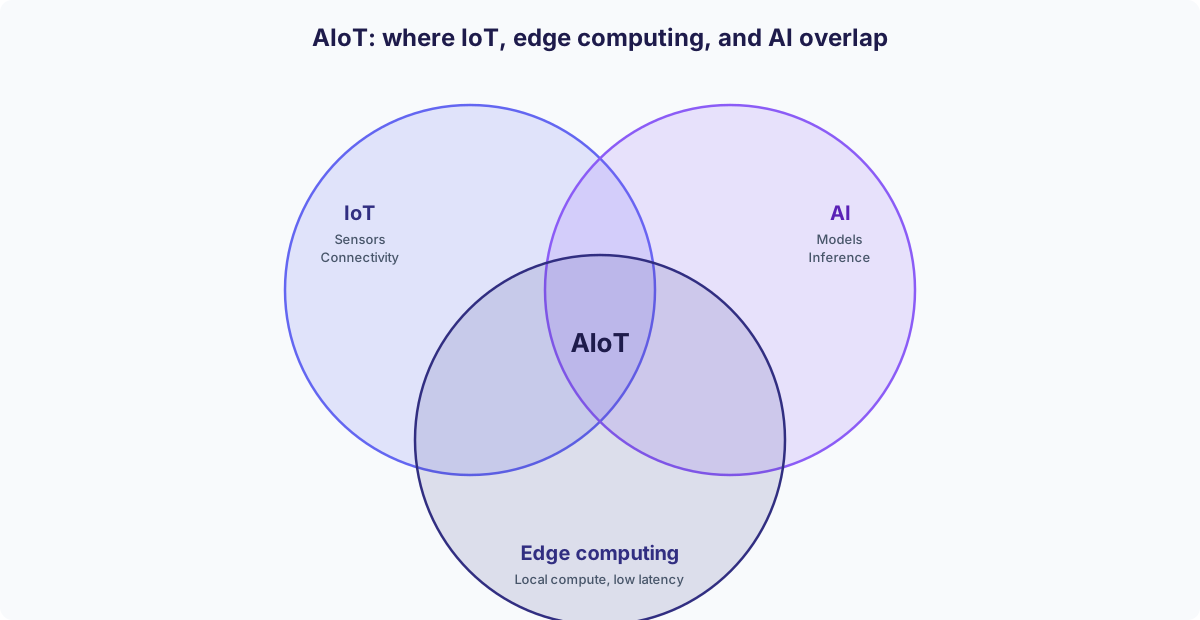
IoT covers the sensors, network, and data pipeline that connect physical devices to software systems. Edge AI describes where the intelligence runs, directly on the device or on local hardware, close to the data source.
AIoT is the combination of both. IoT provides the connected devices and data flow, AI provides the analysis, and edge computing often determines where that analysis physically happens.
How does AIoT technology work?
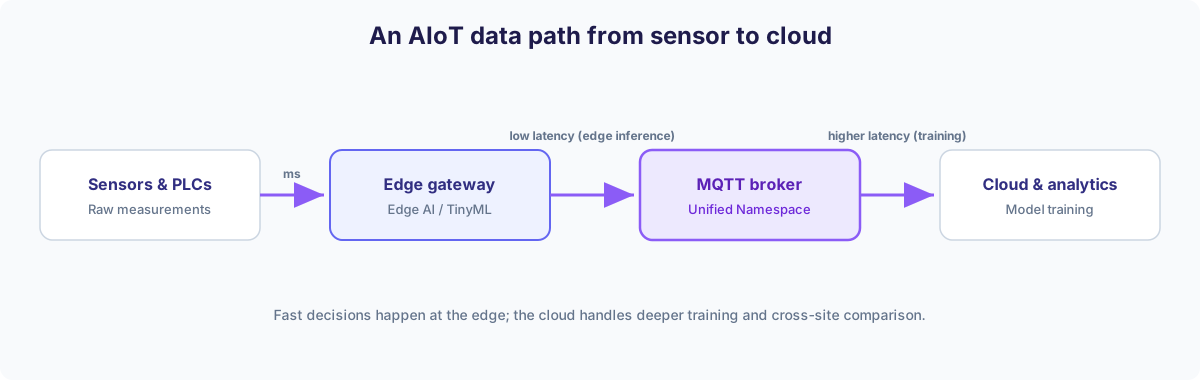
An AIoT system connects three layers: sensing hardware, a data infrastructure that moves the information, and an AI layer that turns raw signals into decisions. The data layer often uses lightweight protocols such as MQTT, especially where industrial environments send small, frequent messages over constrained or unreliable networks.
If you want the technical comparison to HTTP-based communication, HTTP vs. MQTT for IoT breaks down why publish/subscribe models fit industrial data better than request-response patterns.
Sensing, edge, and cloud layers
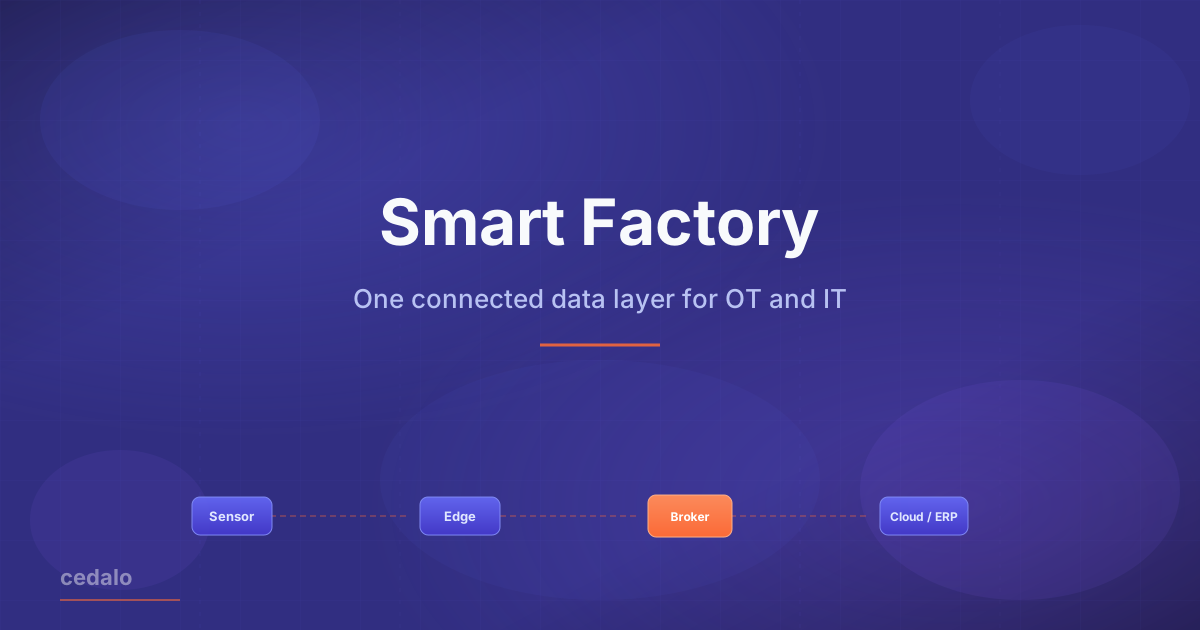
Sensors and PLCs generate raw measurements. A broker or gateway layer collects and routes this data, often using a Unified Namespace so connected systems can access a shared, structured data model instead of relying on point-to-point connections. From there, data moves either to edge hardware for immediate analysis or to the cloud for deeper model training and cross-site comparisons.
The role of Edge AI and TinyML
Edge AI primarily shifts inference onto local hardware, although some systems also support local training, so a machine can flag anomalies with lower latency instead of waiting for a cloud round trip.
TinyML takes this further by optimizing and compressing models to run on constrained devices such as sensors or microcontrollers, trading some model complexity for speed and reduced dependence on network connectivity. Both approaches matter when a production line cannot tolerate the latency or the connectivity risk of sending every data point to a remote server.
Where does AIoT create value in industry?
AIoT often creates value where a fast decision prevents a costly consequence, such as a machine failure, a quality defect, or wasted energy. The table below shows common areas for industrial AIoT projects.
| Industry | Typical AIoT use case | Data source | Core benefit |
|---|---|---|---|
| Manufacturing | Predictive maintenance on production lines | Vibration, temperature, and current sensors | Fewer unplanned stops |
| Energy & utilities | Load forecasting and grid anomaly detection | Smart meters, grid sensors | Better capacity planning |
| Logistics | Fleet condition monitoring and route optimization | Vehicle telematics, GPS | Lower fuel and maintenance cost |
| Smart buildings | Occupancy-based HVAC and lighting control | Occupancy and environmental sensors | Reduced energy consumption |
For interoperability across machine vendors, many manufacturing projects use MQTT Sparkplug, which standardizes topic namespaces, payloads, and state management, reducing custom integration work across equipment brands.
What ROI can companies expect from AIoT?
AIoT projects pay off when the cost of the data infrastructure and AI models is lower than the cost of the problem they prevent. The table below outlines where the savings typically come from.
| Cost driver without AIoT | Value lever with AIoT |
|---|---|
| Unplanned downtime from late failure detection | Earlier fault detection through continuous sensor analysis |
| Manual quality inspection | Automated visual or sensor-based defect detection |
| Fixed maintenance schedules | Condition-based maintenance triggered by real data |
| Energy use based on fixed schedules | Demand-based control that adjusts to actual usage |
The size of the return depends heavily on your baseline: a plant with frequent unplanned stops has more room for improvement than one that already runs a mature maintenance program. Before committing budget, it helps to map your current downtime, inspection, and energy costs against these levers so the business case reflects your own numbers rather than industry averages.
Turn your sensor data into decisions you can trust
A stable MQTT data layer can support AIoT reliability as projects move from a lab test to full production scale.
What EU regulations affect AIoT in the EU?
If you deploy AIoT in the EU, several EU legal acts may shape your rollout timeline, including the following three.
- EU AI Act: Risk-based classification for AI systems; Annex III high-risk obligations apply from December 2, 2027 following the AI Omnibus agreement, while GPAI obligations have applied since August 2, 2025.
- Cyber Resilience Act: Reporting of actively exploited vulnerabilities and severe incidents is required from September 11, 2026; the main obligations apply from December 11, 2027.
- NIS2: Cybersecurity requirements apply through national implementation laws. Germany’s implementation law has been in force since December 6, 2025, and entities covered when it took effect had to register by March 6, 2026.
How is AIoT development progressing?
AIoT development is moving toward smaller, more efficient models that run on cheaper edge hardware, reducing the dependency on constant cloud connectivity. Standardization efforts around data structure, such as Sparkplug and Unified Namespace concepts, are making it easier to feed AI models with clean, consistent data instead of custom-built pipelines for every project.
On the infrastructure side, integrations between MQTT and streaming platforms such as Kafka are becoming more common, since AI training pipelines often need the high-throughput event streaming that Kafka provides alongside the lightweight device messaging that MQTT handles.
What challenges slow down AIoT adoption?
A common obstacle in AIoT projects is the data infrastructure underneath the AI model. Common challenges include:
- Data silos between OT and IT systems, which prevent AI models from accessing a complete picture of production data.
- Inconsistent data formats across machine vendors, which force teams to build custom parsing logic for every new device.
- Security gaps at the edge, since AI-enabled devices expand the attack surface compared to simple sensors.
- Limited in-house expertise in combining OT engineering knowledge with data science and MQTT-based architectures.
Choosing the right message broker matters here. Teams evaluating alternatives often compare Mosquitto against EMQX to understand which platform offers the enterprise features, such as clustering and role-based access control (RBAC), that a production-grade AIoT rollout needs.
Build a data foundation that makes AIoT projects succeed
AIoT combines IoT connectivity with AI-based analysis so devices can act on data instead of just reporting it. Common business cases include predictive maintenance, quality control, and energy optimization, where faster decisions can reduce costly downtime. Success depends on both the AI model and a reliable data infrastructure that connects OT and IT systems.
With obligations under the EU AI Act, CRA, and NIS2 applying at different times between 2024 and 2028, building that foundation with compliance in mind from the start can reduce rework later.
Your benefits with Cedalo:
- You replace custom point-to-point integrations with one MQTT-based data layer that scales across your entire sensor and edge device fleet.
- You get a Unified Namespace approach that can give connected, authorized systems, including future AI models, access to the same structured production data.
- You run on Pro Mosquitto, which extends the open-source Eclipse Mosquitto broker with clustering and enterprise security for continuous industrial operation, while the Cedalo MQTT Platform manages the deployment centrally.
- You reduce vendor lock-in risk by using open standards that your team may already know from the open-source Mosquitto ecosystem.
Get started with your AIoT data infrastructure
Cedalo's MQTT platform provides a secure, production-ready data backbone that connects your sensors, edge devices, and AI models across OT and IT.
AIoT: frequently asked questions
What is the difference between AIoT and Industrial IoT?
Industrial IoT (IIoT) focuses on connecting machines and sensors in industrial settings to collect and share data. AIoT adds an analysis layer on top, so the connected devices from an IIoT setup can also interpret data and trigger actions automatically.
Does AIoT always require a cloud connection?
No. Edge AI and TinyML let devices analyze data locally, so an AIoT system can make real-time decisions even with limited or no cloud connectivity. Cloud access still helps with model training and cross-site comparisons.
What skills does a team need to start an AIoT project?
Teams typically need OT engineering knowledge to understand the machines and data infrastructure skills to move sensor data reliably. Data science expertise rounds out the team, since someone still needs to build and maintain the AI models that interpret the data.
How much does an AIoT deployment typically cost?
Costs depend on sensor hardware, data infrastructure, and model development, and vary widely by project scope. Starting with a single high-value use case, such as predictive maintenance on critical equipment, can limit initial investment before scaling further.
How does Cedalo support AIoT data infrastructure projects?
Cedalo provides Pro Mosquitto, an enterprise MQTT broker built on the open-source Eclipse Mosquitto, together with the Cedalo MQTT Platform for central management and commercial support. It can bridge OT and IT systems through a Unified Namespace, helping your team use a shared data layer instead of managing fragmented integrations.
Can Cedalo’s MQTT platform run AI models at the edge?
Cedalo’s platform delivers the data layer that feeds edge AI models. It connects sensors and gateways so AI systems running at the edge or in the cloud receive consistent, well-structured data in real time.