Most IoT fleet management deployments generate data. Few turn it into decisions. The gap sits in the architecture. Without a structured flow from sensor to backend, telemetry accumulates without producing operational value. Field-tested architectures, current EU compliance requirements, and the criteria that separate a scalable platform from a stalled pilot make the difference.
IoT Fleet Management: Key takeaways
- IoT fleet management processes live sensor streams from CAN bus, TPMS, and temperature sensors at the edge and feeds structured data into ERP, SCADA, and analytics systems in real time.
- MQTT is widely used in IoT fleet monitoring because it supports lightweight publish/subscribe messaging, configurable QoS, and unstable networks. With the right broker and infrastructure design, it can scale to large fleet deployments.
- CRA, NIS2, and the EU Data Act may affect connected fleets in parallel. Audit trails, RBAC, TLS encryption, access controls, and incident response processes support compliance readiness.
- For IoT fleet management, Cedalo provides clustered MQTT brokers, centralized monitoring, and security features that support CRA and NIS2 compliance readiness without custom broker-management middleware.
What Does IoT Fleet Management Cover?
IoT fleet management describes the technical architecture and operational processes that connect physical vehicles and machines to data systems for real-time monitoring, control, and analysis. It goes far beyond GPS tracking or simple telematics.
Traditional telematics typically focuses on vehicle location, mileage, speed, diagnostics, fuel data, and driver behavior. IoT fleet management extends this model by integrating live sensor streams from multiple vehicle and cargo data sources, processing that data at the edge or in the cloud, and feeding structured information into ERP, SCADA, or analytics platforms for operational decision-making.
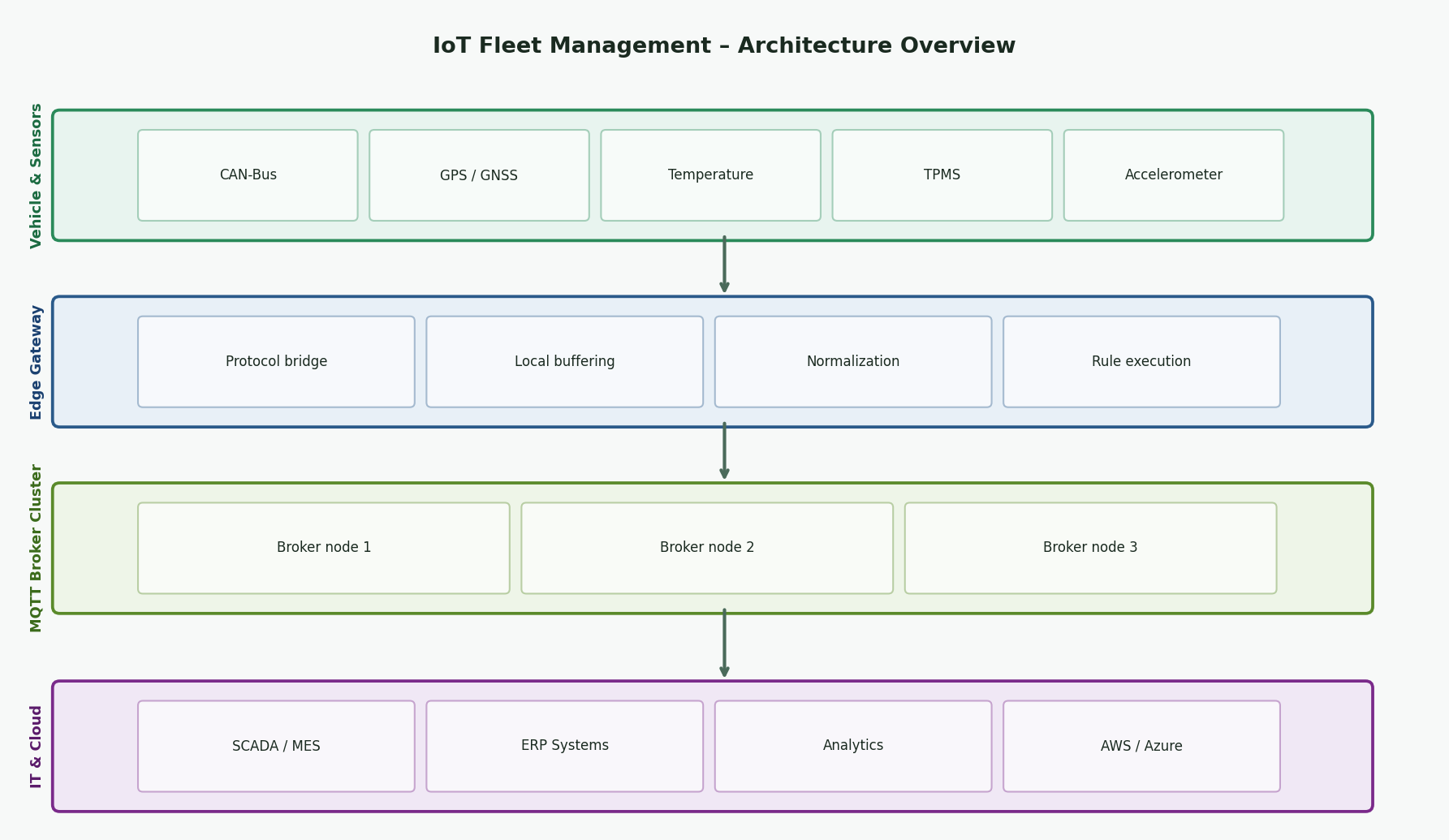
A functional IoT fleet management setup typically includes:
- IoT sensors for fleet management (CAN bus, temperature, TPMS, accelerometers, cameras)
- Edge gateways for local data processing and protocol translation
- A messaging layer for reliable, low-latency data transport
- Backend systems for storage, analytics, and cross-system integration
The decisive factor is not how many data points a fleet generates. It is whether the data flows reliably, arrives in a usable format, and reaches the right system at the right time.
Which IoT Sensors Are Used in Fleet Management?
Modern fleets draw from a wide range of sensor types depending on vehicle class and operational requirements. The table below maps each sensor to its data signal and the use case it feeds.
| Sensor Type | Data Signal | Operational Use Case |
|---|---|---|
| CAN bus reader | Engine load, RPM, fault codes | Predictive maintenance, driver behavior |
| GPS/GNSS module | Position, speed, route | Route optimization, geofencing |
| Accelerometer | G-forces, vibration | Accident detection, road condition analysis |
| Temperature sensor | Cargo or engine temperature | Cold chain compliance, thermal management |
| TPMS | Tire pressure per wheel | Safety alerts, fuel efficiency |
| Camera / LiDAR | Visual data, obstacle detection | ADAS, load documentation |
Each sensor produces raw data. Individually, that data has limited value. Operational insight comes from correlating signals across sensors over time.
From Raw Sensor Data to Operational Insight: The Processing Gap
A temperature spike in the cargo hold means something different depending on current engine load, ambient temperature, and route. Without context, the alert is noise. With context, it triggers a relevant action.
This is the processing gap that most IoT fleet monitoring setups fail to close. Raw signals need normalization (consistent units, timestamps, asset IDs), filtering (removing irrelevant events), and enrichment (adding operational context) before they feed a decision system.
Closing this gap requires processing logic at the edge, not just in the cloud.
How Does a Scalable IoT Fleet Management Architecture Work?
Edge Processing vs. Cloud Processing in Fleet Environments
Edge processing handles time-critical logic close to the vehicle: anomaly detection, threshold alerts, and local buffering during connectivity loss. Cloud processing handles long-term analysis, cross-fleet pattern recognition, and AI model training.
The split is not a binary choice. Scalable IoT fleet management solutions distribute processing based on latency requirements and bandwidth constraints. A vehicle with a 4G connection in a remote area processes safety-critical alerts locally. The same vehicle forwards normalized telemetry to the cloud for trend analysis.
Why MQTT Is the Protocol Standard for IoT Fleet Monitoring
MQTT is widely used in IoT fleet monitoring because it supports lightweight publish/subscribe messaging, persistent connections, and configurable QoS levels. This makes it suitable for mobile environments with frequent connectivity changes.
Compared to HTTP polling, MQTT reduces overhead and lets brokers distribute one published message to all matching subscribers. QoS 1 supports at-least-once delivery, while QoS 2 supports exactly-once delivery at the protocol level.
Reliable recovery after tunnels, rural stretches, or temporary cellular outages also depends on correct client buffering, persistent sessions, queue limits, and broker configuration. This decoupled architecture lets analytics platforms, ERP systems, and Kafka pipelines consume the same fleet data stream without separate point-to-point integrations.
Unified Namespace as the Data Backbone for Fleet Operations
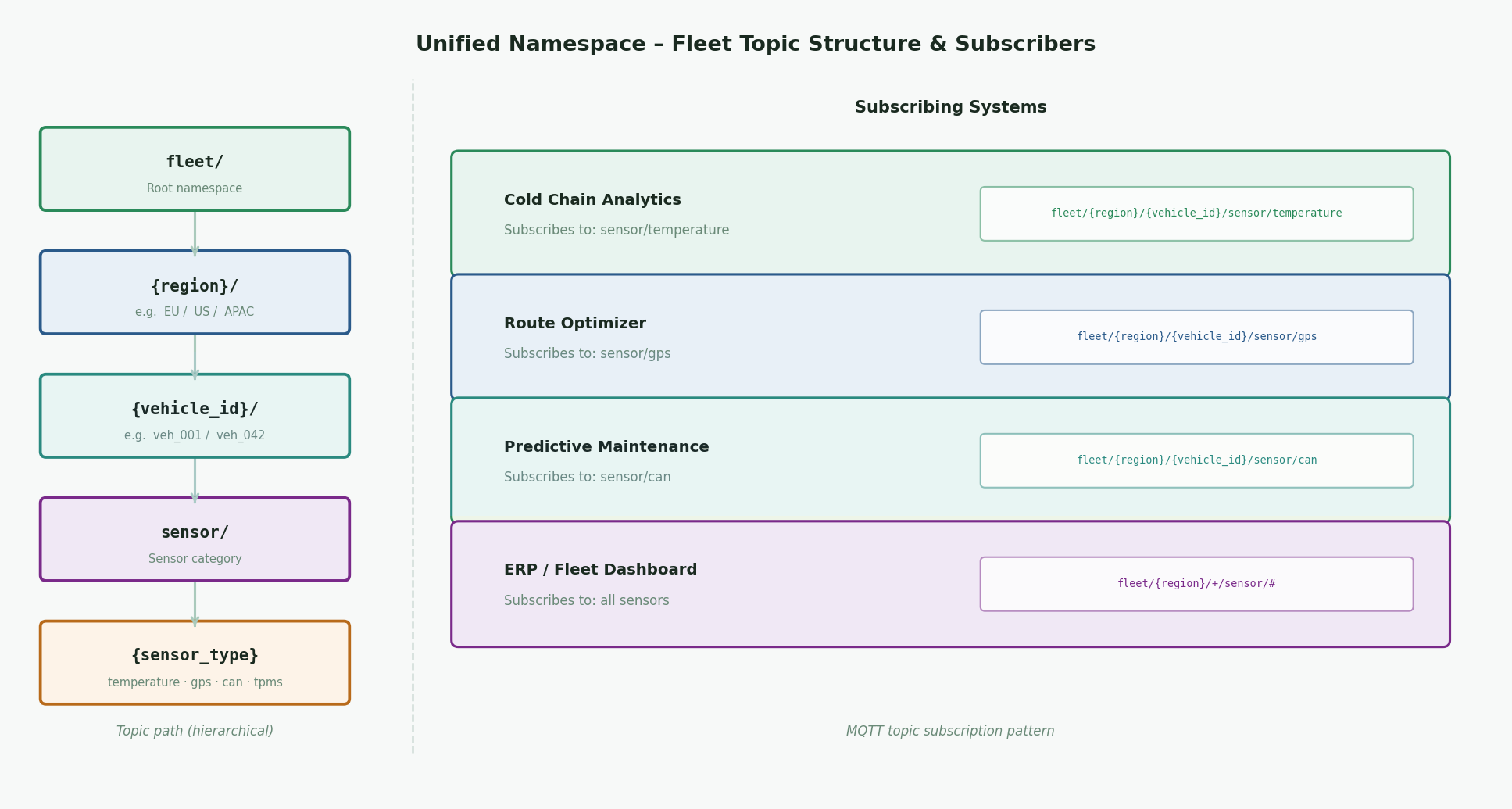
A Unified Namespace (UNS) structures all fleet data under a consistent, hierarchical topic schema. Instead of each system maintaining its own data model, one shared namespace gives every consuming application access to the same real-time data.
For a fleet operator running vehicles across multiple regions, a UNS topic structure might look like:
fleet/{region}/{vehicle_id}/sensor/{sensor_type}
This naming convention makes data discoverable without custom mapping layers. Analytics tools, maintenance systems, and dashboards subscribe to exactly the data they need. A UNS implemented via MQTT dissolves the data silos between OT (vehicles, gateways) and IT (ERP, cloud platforms) at the architectural level.
Multi-Site and Multi-Fleet Broker Architecture
Fleets operating across regions or countries need a broker architecture that reflects this distribution. A single central broker instance can create a point of failure and add latency. Regional broker clusters reduce this risk by keeping fleet traffic local and improving resilience.
A practical solution is to use regional broker clusters connected through bridge configurations or other broker-to-broker replication mechanisms. Each cluster handles local fleet traffic with low latency. A central broker or aggregation layer can collect normalized data for cross-fleet analytics and global monitoring.
Clustering with automated failover keeps IoT fleet monitoring online when a broker node goes down. Session persistence and load redistribution are handled at the broker level, which makes high availability a configuration decision rather than an architecture risk. For operators running mission-critical transport, this is a baseline requirement, not an optional feature.
What Compliance Requirements Apply to IoT Fleet Management in 2025?
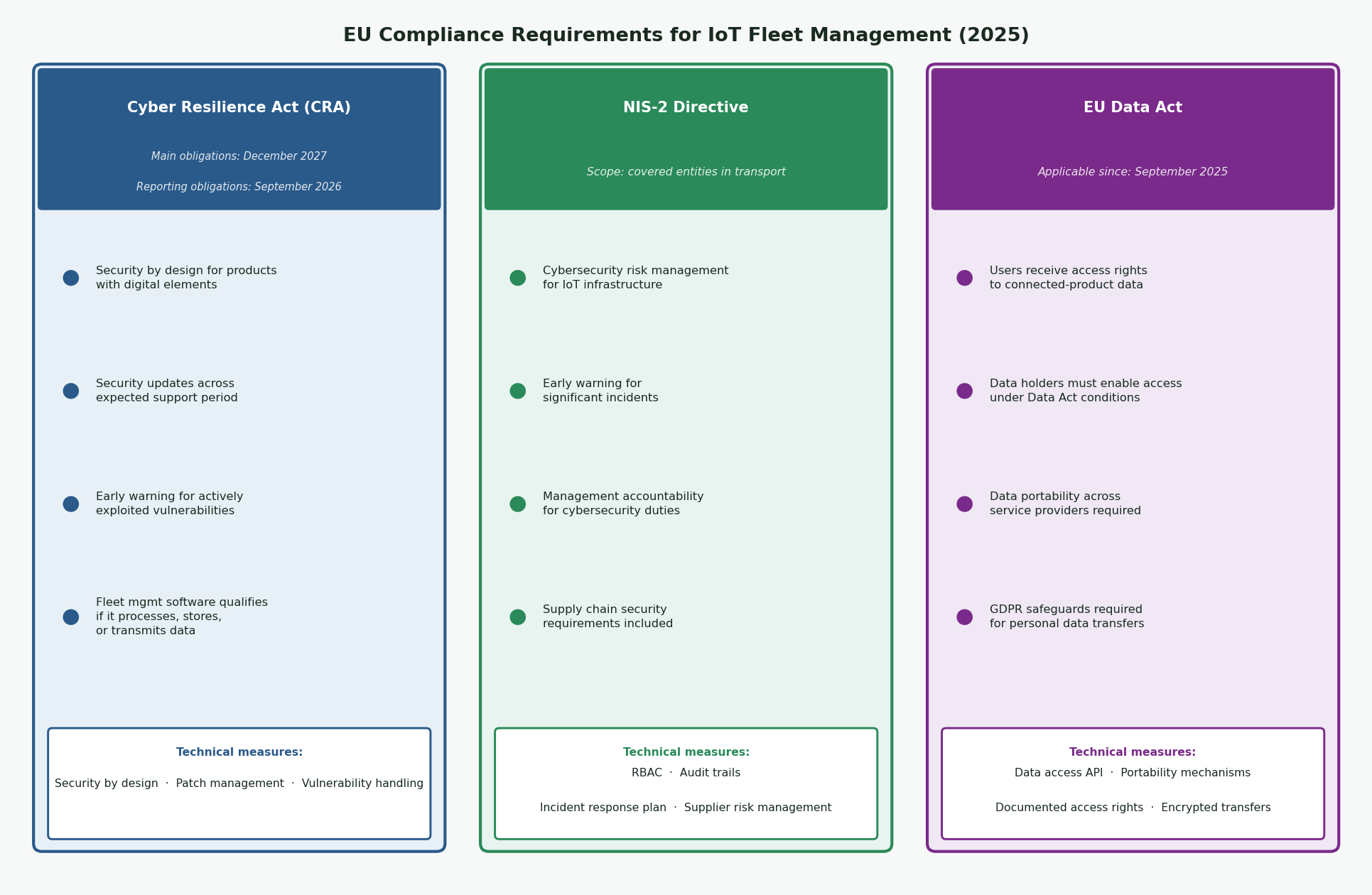
Three EU regulations directly shape IoT fleet infrastructure. The Cyber Resilience Act (CRA) sets cybersecurity requirements for digital products, NIS2 applies to covered entities in transport, and the EU Data Act regulates access to connected-product data. Depending on role, size, and sector, all three apply in parallel.
Cyber Resilience Act: What Changes for Connected Fleet Devices
The CRA introduces cybersecurity obligations for manufacturers, importers, and distributors of products with digital elements. Fleet operators should request supplier documentation on security updates, vulnerability handling, and incident reporting, especially before buying new devices or software after the CRA becomes fully applicable.
EU Data Act and NIS2: Data Sovereignty and Security in Fleet Operations
The EU Data Act can strengthen the negotiating position of fleet operators where they qualify as users of connected vehicles, machines, or devices. In those cases, data access and sharing rights are based on statutory rules rather than only on commercial contracts. For NIS2, covered entities must treat cybersecurity as a management-level responsibility. Non-compliance is therefore not only an IT risk, but can also create governance, reporting, and management-accountability risks.
How Do You Integrate IoT Fleet Management Software into Existing IT/OT Infrastructure?
Vehicles use CAN bus, OBD-II, or proprietary protocols. ERP and MES systems expect structured, normalized data.
Protocol bridging at the gateway layer translates vehicle-native formats into MQTT. From there, the broker routes data to any number of downstream systems: Azure-hosted analytics platforms, SCADA dashboards, ERP connectors, or data warehouses.
| Integration Layer | Without Central Broker | With Central Broker |
|---|---|---|
| ERP connection | Separate adapters often needed | Normalized MQTT data feed |
| SCADA feed | Point-to-point bridges | Standardized topic subscriptions |
| Cloud analytics | Direct device-to-cloud APIs | Broker-routed data streams |
| Multi-fleet monitoring | Separate fleet views | Shared namespace and dashboards |
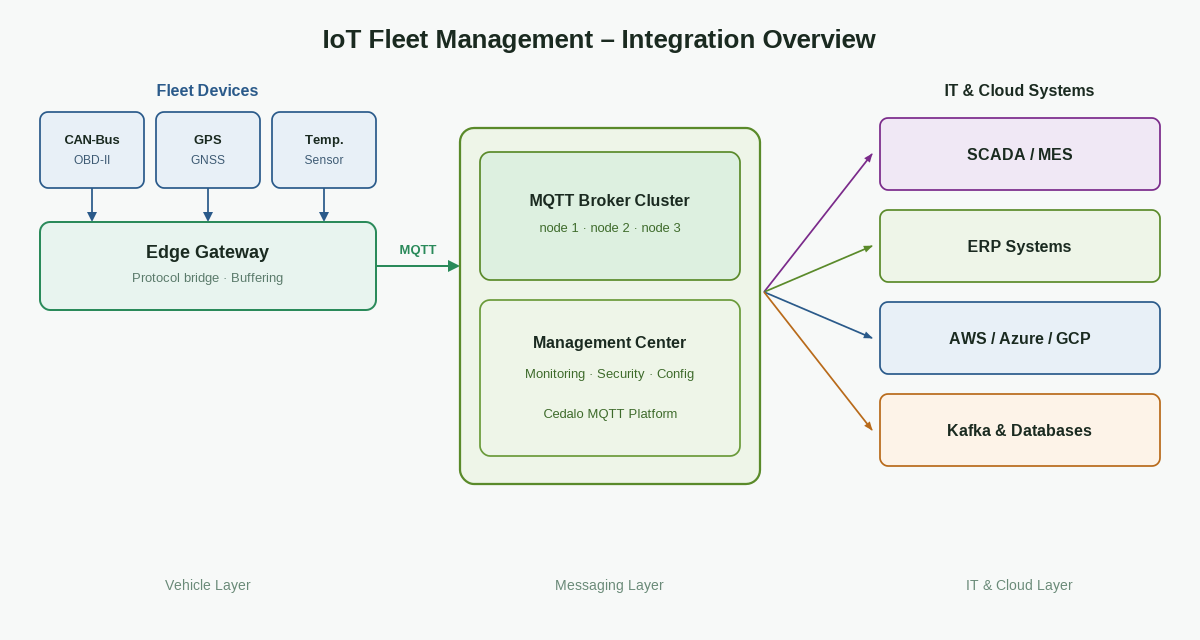
A broker with multi-broker management gives OT and IT teams a single operational view across the entire fleet infrastructure, reducing the configuration and troubleshooting overhead that grows with fleet size.
What Criteria Define a Production-Ready IoT Fleet Management Solution?
When evaluating IoT fleet management software for production deployment, these criteria separate proof-of-concept setups from systems that hold under operational load:
- Protocol support: Native MQTT with QoS 1 and 2, TLS encryption, and configurable clean or persistent sessions for mobile clients.
- Edge processing capability: Local buffering, rule execution, and protocol bridging at the gateway without cloud dependency.
- Clustering and high availability: Automatic failover, load distribution across broker nodes, and session persistence through node failures.
- Security and compliance features: RBAC, certificate-based authentication, audit trails, and exportable compliance logs for CRA and NIS2 documentation.
- Multi-broker management: A single management interface for distributed broker instances across regions, vehicle types, and organizational units.
- Integration depth: Integration options for Kafka, cloud platforms such as AWS, Azure, and GCP, SCADA environments, ERP systems, databases, and monitoring tools through native connectors, APIs, bridges, or standard integration patterns, reducing the need for custom middleware.
Open-source MQTT brokers like Eclipse Mosquitto provide a widely used foundation for MQTT-based IoT deployments. For production-grade IoT fleet monitoring, requirements such as clustering, centralized management, enterprise security features, auditability, and operational support may call for a managed or enterprise platform built on top of that foundation rather than a standalone open-source broker instance.
Why Your IoT Fleet Management Architecture Stands or Falls with the Right Data Layer
Sensors, gateways, and cloud platforms are often standardized components in fleet architectures. The differentiating factor is the layer in between: a messaging infrastructure that keeps data flowing reliably, routes it to the right systems, and supports security, traceability, and compliance documentation.
Fleets that get this layer right stop reacting to failures and start anticipating them. Those that don’t continue patching data gaps manually while compliance obligations pile up.
Your Advantages with Cedalo:
- No data gaps under real conditions: Clustered MQTT broker architecture with automated failover keeps fleet telemetry flowing even when nodes fail or vehicles lose connectivity in remote areas.
- Compliance-ready from day one: RBAC, audit trails, TLS encryption, and exportable logs give you the technical documentation that CRA, NIS2, and the EU Data Act require without retrofitting later.
- One view across your entire fleet infrastructure: The Cedalo Management Center consolidates broker instances, connection monitoring, and configuration across regions and vehicle types into a single interface.
- Built on the world’s most deployed MQTT broker: Eclipse Mosquitto runs in over 600 million installations. Cedalo adds the enterprise layer on top of that proven foundation, not a replacement for it.
Run Your First Fleet Data Pipeline in Minutes
Connect your vehicles, test broker clustering, and validate your security and compliance-readiness configuration in a live environment. No lengthy onboarding, no guesswork.
IoT Fleet Management: Frequently Asked Questions
What is the difference between IoT fleet management and traditional telematics?
Traditional telematics tracks position and mileage. IoT fleet management integrates multi-sensor data streams from CAN bus, TPMS, and temperature sensors, processes them at the edge, and feeds structured data into ERP, SCADA, and analytics systems for operational decisions beyond simple location tracking.
How many IoT devices can an MQTT broker handle in a fleet management setup?
The number of IoT devices an MQTT broker can handle depends on the broker implementation, cluster architecture, hardware resources, message size, message frequency, QoS level, persistence settings, and network conditions. Properly designed clustered MQTT infrastructures can scale from small fleet pilots to very large deployments, but global fleets usually require deliberate capacity planning, regional architecture, monitoring, and load testing.
What data does IoT fleet management collect and who owns it under EU law?
IoT fleet management can collect sensor, engine, position, cargo, and vehicle-behavior data. Under the EU Data Act, users of connected products gain access and sharing rights to data generated through product use. Vehicle operators may benefit if they qualify as users. Access remains subject to data protection, security, trade-secret, and contractual limits.
How does Cedalo support compliance requirements like CRA and NIS2 in fleet environments?
Cedalo provides the technical infrastructure that CRA and NIS-2 require in fleet environments: RBAC, TLS encryption, audit trails, and exportable compliance logs. These features document access controls, secure data transport, and monitor broker activity. Overall compliance readiness also depends on the organization’s processes, incident response, and supplier documentation.
Can Cedalo’s MQTT platform integrate with existing SCADA and ERP systems in fleet operations?
Yes, the Cedalo MQTT Platform can support integration with SCADA, MES, ERP systems, Kafka pipelines, databases, and cloud platforms such as AWS, Azure, and GCP through MQTT, APIs, connectors, bridges, and standard integration patterns. Protocol bridging at the gateway layer can translate vehicle-native formats such as CAN bus and OBD-II into MQTT, reducing the need for custom middleware.
How does IoT fleet management software handle poor connectivity in remote or underground locations?
IoT fleet management handles poor connectivity with MQTT session handling, local buffering, retry logic, and edge processing. When configured correctly, clients store messages during outages and forward them once connectivity resumes, while local alerts can continue running independently.