Internet of Things (IoT) protocols define how connected devices, gateways, brokers, cloud platforms, and enterprise systems exchange data. The right protocol choice affects latency, power use, security, and compliance readiness. It also determines whether an IoT architecture scales beyond early tests.
IoT protocols: key takeaways
- Choose a protocol by the data flow it has to support, where the data starts, where it must go, and the constraints in between, not by a feature checklist. MQTT, CoAP, AMQP, HTTP, OPC UA, DDS, LoRaWAN, NB-IoT, and BLE each fit different points in that flow.
- The protocol is only half the decision. The infrastructure that runs it, including clustering, monitoring, access control, and failover, decides whether a deployment survives production.
- Encryption is not authorization. TLS protects the channel, but device identity, topic-level permissions, and logging define who may publish, subscribe, or configure.
- Regulation (CRA, NIS2, MDR) increasingly expects secure defaults, device identity, monitoring, and evidence, so protocol and infrastructure choices should be evaluated together.
- Cedalo provides enterprise MQTT infrastructure based on Eclipse Mosquitto, with clustering, monitoring, role-based access control, and audit trails for secure IoT data flows.
What are Internet of Things (IoT) protocols?
Internet of Things (IoT) protocols are communication rules that define how connected devices and systems exchange data. They determine how data is transferred, acknowledged, secured, routed, and interpreted across device, gateway, broker, and cloud layers.
In practice, IoT protocols appear at different layers of the architecture. Some protocols connect low-power devices over short or long distances. Others structure industrial machine data, transfer telemetry to a broker, or move events into cloud and enterprise systems.
A useful distinction separates four groups:
| Layer | Purpose |
|---|---|
| Device and field layer | Connect sensors, machines, controllers, and embedded devices |
| Gateway and edge layer | Translate protocols, normalize payloads, buffer data, and apply local rules |
| Broker and cloud layer | Distribute telemetry, commands, events, and state updates |
| Enterprise layer | Connect data to analytics, SCADA, ERP, MES, and monitoring systems |
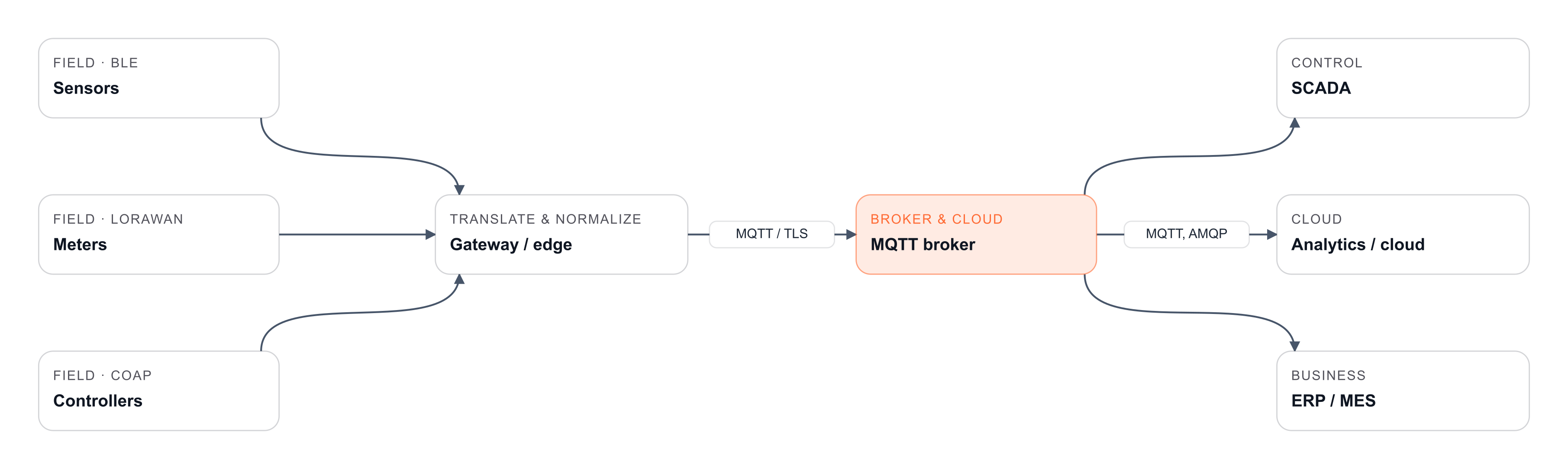
Figure 1: IoT protocols operate at different layers. Constrained field protocols reach a gateway, which normalizes data and forwards it over MQTT to a broker, which in turn distributes it to enterprise and cloud systems.
How do IoT protocols differ by architecture layer?
IoT protocols differ by where they operate and which constraint they solve. A device-side protocol often prioritizes low power consumption and small payloads. A broker-side protocol prioritizes reliable distribution, session behavior, access control, and integration with multiple consumers.
Key terms:
- Application layer: Defines how applications structure and exchange messages, such as MQTT, CoAP, AMQP, HTTP, and OPC UA.
- Transport layer: Transfers data between endpoints, commonly Transmission Control Protocol (TCP) or User Datagram Protocol (UDP).
- Broker: Receives messages from publishers and distributes them to subscribers.
- Gateway: Translates field or device data into a format that backend systems can process.
- Payload: The actual data inside a message.
- Quality of Service (QoS): MQTT delivery behavior that defines how strongly the client and broker confirm message transfer.
Which IoT protocols matter most in 2026?
Choosing the right IoT protocol depends on the specific architecture and use case. MQTT, CoAP, AMQP, HTTP, OPC UA, DDS, LoRaWAN, NB-IoT, and Bluetooth Low Energy each address different requirements around connectivity, latency, power consumption, scalability, and interoperability.
How do MQTT, CoAP, AMQP, and HTTP compare?
MQTT, CoAP, AMQP, and HTTP cover different communication patterns in IoT architectures, from lightweight telemetry to constrained-device communication and backend integration.
- MQTT is a lightweight publish/subscribe protocol designed for telemetry, gateway communication, and unreliable networks. Its broker-based model supports scalable data distribution and configurable delivery guarantees. For very constrained or non-TCP networks, the MQTT-SN (MQTT for Sensor Networks) variant carries the same publish/subscribe model over UDP and low-power links, bridged to a standard MQTT broker through a gateway.
- CoAP uses a compact request/response model over UDP and is well suited for constrained devices with limited processing power, bandwidth, and energy resources.
- AMQP provides advanced queueing and routing capabilities for enterprise messaging and backend integrations, but is typically too heavy for resource-constrained devices.
- HTTP and HTTPS remain common for APIs, provisioning, configuration, and firmware updates. For continuous telemetry, however, they generally create more overhead than broker-based protocols such as MQTT.
Where do OPC UA, DDS, LoRaWAN, NB-IoT, and Bluetooth Low Energy fit?
OPC UA, DDS, LoRaWAN, NB-IoT, and Bluetooth Low Energy serve different roles across industrial, real-time, wide-area, and short-range IoT deployments.
- OPC UA fits industrial environments where systems need semantic data models and interoperability between machines, controllers, and industrial software. It is common near the machine or plant layer.
- DDS, the Data Distribution Service, fits real-time systems such as robotics, aerospace, autonomous systems, and latency-sensitive distributed applications. It is more specialized than MQTT and often appears in systems with strict real-time communication needs.
- LoRaWAN fits long-range, low-power sensor networks with small payloads.
- NB-IoT fits cellular low-bandwidth deployments over wide areas.
- Bluetooth Low Energy (BLE) fits short-range, low-power communication, often before a gateway forwards normalized data into a larger architecture.
How should teams choose IoT protocols by use case?
Teams should choose IoT protocols by the data flow they need to support. The key question is where the data starts, where it must go, and which constraints apply between both points.
Use this checklist before selecting a protocol:
- Does the device run on limited battery, bandwidth, or processing power?
- Does the data need to reach one system or several subscribers?
- Is the connection stable, mobile, remote, or intermittent?
- Does the use case require low latency, confirmed delivery, or real-time behavior?
- Does the payload need semantic machine context, such as industrial data models?
- Does the architecture need TLS, mutual TLS, topic-level authorization, or audit trails?
- Do Cyber Resilience Act (CRA), NIS2, MDR, or internal compliance rules require evidence, monitoring, or incident response?
- Will a gateway translate field-layer data into MQTT, HTTP, or another backend protocol?
- Does the setup need to scale across many devices, sites, or downstream systems?
MQTT fits telemetry and broker-based data distribution. OPC UA fits semantic industrial machine data. CoAP, LoRaWAN, NB-IoT, and Bluetooth Low Energy fit constrained or low-power device communication. HTTP fits APIs, provisioning, and firmware workflows. Regulated or safety-critical environments require the protocol and the infrastructure around it to support identity, encryption, access control, monitoring, and lifecycle management.
What security and compliance requirements shape IoT protocol decisions in 2026?
Security and compliance in IoT architectures depend on implementation, identity, access control, certificate handling, monitoring, and documentation. Transport encryption protects the channel, but it does not define who may publish, subscribe, configure, update, or access operational data.
In 2026, European regulatory pressure makes these design choices more visible. The Cyber Resilience Act, NIS2, and the Medical Device Regulation do not define a single universal IoT protocol. Instead, they increase the need for secure communication, vulnerability management, traceability, risk management, and evidence from the outset.
How do TLS, mutual TLS, and authorization protect IoT data flows?
Transport Layer Security (TLS) verifies the server or broker identity and encrypts the communication channel. Mutual TLS gives each device or gateway its own cryptographic identity, which helps avoid reusable static credentials across large fleets.
Authorization defines what an authenticated device may do. In MQTT systems, this often means topic-level permissions for publishing and subscribing. A temperature sensor may publish to one topic hierarchy, while a dashboard may subscribe to selected topics without publish rights.
Frequent operational risks include expired certificates, hostname mismatches, incomplete certificate chains, hardcoded credentials, weak topic permissions, and missing logs for rejected access attempts.
How does the Cyber Resilience Act affect IoT protocol architecture in 2026?
The Cyber Resilience Act (CRA) is already in force. Reporting obligations for actively exploited vulnerabilities and severe security incidents apply from 11 September 2026, while the main CRA obligations apply from 11 December 2027.
For IoT architectures, that timeline matters now. Protocol choices should support secure defaults, encrypted communication, device identity, vulnerability handling, logging, and evidence for compliance documentation.
A protocol stack that relies on unmanaged credentials, lacks monitoring, or cannot prove access-control behavior becomes difficult to operate under CRA expectations. Teams should therefore evaluate protocol and infrastructure choices together.
How do NIS2 and MDR affect IoT protocol architecture?
NIS2 affects covered organizations in critical sectors and increases expectations around cybersecurity risk management, incident response, supply chain security, and governance. For IoT systems, this translates into strong access control, monitoring, incident visibility, supplier controls, and recoverable infrastructure.
The Medical Device Regulation (MDR) and related cybersecurity guidance affect connected medical devices and medical software. These environments need strong confidentiality, integrity, availability, traceability, lifecycle risk management, and post-market cybersecurity handling.
How do IoT protocols scale from tests to production infrastructure?
IoT protocols often pass early connectivity tests and fail under production conditions. Typical failure points include reconnect storms, weak session handling, certificate rotation, broker overload, missing monitoring, unclear topic ownership, and unclear responsibility between OT and IT teams.
Production readiness requires load testing, failure testing, observability, and defined operational controls. A protocol decision therefore includes the infrastructure that runs the protocol.
Which failure modes should teams test before rollout?
Teams should validate protocol behavior under realistic failure conditions before the first rollout. The most important cases are:
- Network loss and reconnect behavior: Verify how clients behave after short and long outages.
- Broker failover and load redistribution: Check whether clients reconnect to a healthy broker node.
- Queue limits and message expiry: Confirm what happens when subscribers are offline.
- QoS behavior under latency and packet loss: Verify duplicates, retries, and acknowledgement behavior.
- Certificate expiry and authentication failure: Test how devices fail and how alerts appear.
- Unauthorized publish and subscribe attempts: Confirm that access-control violations are blocked and logged.
Why does the broker layer decide whether MQTT deployments scale?
The broker controls client connections, subscriptions, retained messages, persistent sessions, queue behavior, and Quality of Service state. In small tests, a single broker can appear sufficient. In production, it can become a bottleneck or a single point of failure.
Clustered MQTT infrastructure supports higher availability, load distribution, and operational resilience. It also gives teams a clearer path for maintenance, node failure handling, and multi-site architecture.
How to turn IoT protocol choices into production-ready infrastructure
As the previous sections show, no single protocol wins outright, the right choice depends on the data flow. What they share is that the protocol defines how data moves, while the infrastructure behind it defines whether that data stays secure, observable, and available in production. This holds for any protocol, but it becomes most visible with broker-based ones.
MQTT is a good example, because it often becomes the broker-centered data layer between gateways, cloud services, SCADA systems, analytics platforms, and enterprise applications, which is exactly where these infrastructure concerns concentrate. At that point, teams need more than protocol support. They need clustering, access control, monitoring, audit trails, and integration paths into the systems that use the data.
Your advantages with Cedalo:
- Stable MQTT infrastructure based on Eclipse Mosquitto for industrial and enterprise IoT systems.
- Clustered broker architecture for high availability across sites, workloads, and operational environments.
- Security features such as TLS, role-based access control, and audit trails for controlled IoT data flows.
- Cedalo Management Center for monitoring, configuration, and troubleshooting across broker environments.
Build secure MQTT-based IoT data pipelines
Move IoT data from devices and edge gateways to SCADA, cloud, analytics, and enterprise systems with secure MQTT broker infrastructure.
IoT protocols: frequently asked questions
What is the best IoT protocol for industrial telemetry?
MQTT is often the strongest fit for industrial telemetry that must move from gateways to several backend systems. OPC UA is stronger when machines need semantic data models and structured industrial interoperability.
In many environments, both protocols appear in the same architecture. OPC UA or fieldbus protocols remain close to machines, while MQTT distributes normalized data to SCADA, analytics, cloud platforms, and enterprise systems.
Are IoT protocols secure by default?
IoT protocols provide security building blocks, but secure operation depends on implementation. TLS, mutual TLS, device identity, authorization, monitoring, patching, and audit trails determine whether the architecture meets security requirements.
A protocol that supports encryption can still be deployed insecurely. Certificate handling, credential rotation, topic permissions, and logging must be designed and tested before production.
Is MQTT better than CoAP for IoT?
MQTT fits broker-based telemetry, persistent connections, and many-to-many data distribution. CoAP fits constrained devices that use a compact request/response model over UDP.
The better option depends on power budget, network conditions, payload size, and backend architecture. In some systems, CoAP connects constrained devices to a gateway, and MQTT transfers normalized data from the gateway to the broker layer.
Which IoT protocols are relevant for NIS2 compliance?
NIS2 does not prescribe one specific IoT protocol. It increases the need for risk management, secure access, incident response, supply chain controls, and reliable monitoring across IoT infrastructure.
Protocols used in NIS2-relevant environments should support encryption, identity, authorization, logging, and operational visibility. The surrounding infrastructure must also provide evidence for incident handling and access control.
How does Cedalo support MQTT-based IoT protocol architectures?
Cedalo provides an enterprise MQTT Platform and Pro Mosquitto based on Eclipse Mosquitto. It adds clustering, monitoring, role-based access control, audit trails, and management features for production IoT architectures. This helps teams operate MQTT as a secure and observable data layer between devices, gateways, cloud systems, SCADA, analytics, and enterprise applications.