
The BACnet protocol is a global communication standard for building automation and control networks. It enables devices from different vendors to exchange data across HVAC, lighting, access control, energy metering, and building management systems.
BACnet Protocol: Key takeaways
- The BACnet protocol standardizes communication between building automation devices such as HVAC controllers, lighting systems, access control systems, energy meters, and building management systems.
- BACnet/IP fits Ethernet-based backbones and building management systems, while BACnet MS/TP fits RS-485 field-level networks with controllers, sensors, and actuators.
- BACnet Secure Connect extends BACnet with encrypted, certificate-based communication over TLS and WebSockets for modern IP networks.
- Cedalo helps teams distribute BACnet-derived building automation data through MQTT-based IIoT architectures for OT/IT integration, cloud connectivity, monitoring, and scalable data flows.
What is the BACnet protocol in building automation?
The BACnet protocol is an open data communication protocol for Building Automation and Control Networks. It is defined as ANSI/ASHRAE Standard 135 and is also standardized as ISO 16484-5.
BACnet gives building automation devices a shared language. A chiller controller, room automation controller, lighting controller, fire detection interface, and building management workstation can exchange data even when they come from different vendors.
BACnet matters because building automation rarely runs on one manufacturer. Projects combine legacy controllers, new IP devices, supervisory systems, cloud gateways, analytics tools, and energy platforms. BACnet creates interoperability at the automation layer.
How does the BACnet protocol work technically?
BACnet works through objects, properties, and services. Objects represent devices or data points, properties describe their values and metadata, and services define how systems read, write, discover, subscribe to, and alarm on that information.
Typical BACnet objects include:
| BACnet object | Typical use | Important property | Project relevance |
|---|---|---|---|
| Device | Controller, gateway, workstation | Object_Identifier | Identifies a BACnet device in the network |
| Analog Input | Temperature, humidity, pressure | Present_Value | Reads live sensor values |
| Analog Output | Setpoint or control signal | Present_Value | Writes control values |
| Binary Input | Switch, relay feedback, alarm state | Present_Value | Reads on/off states |
| Schedule | Time-based control | Weekly_Schedule | Automates building functions |
| Trend Log | Historical values | Log_Buffer | Supports diagnostics and reporting |
BACnet services act as commands. Who-Is and I-Am discover devices. ReadProperty reads values. WriteProperty changes values. SubscribeCOV reports changes of value. Alarm and event services report abnormal states.
This structure explains why BACnet troubleshooting often starts with object IDs, device IDs, network numbers, and properties. A physical connection alone does not prove that systems understand each other at the application level.
Which layers does the BACnet protocol stack use?
The BACnet protocol stack separates the building automation data model from the network transport. The application layer carries BACnet objects, properties, and services. The lower layers depend on the chosen BACnet variant.
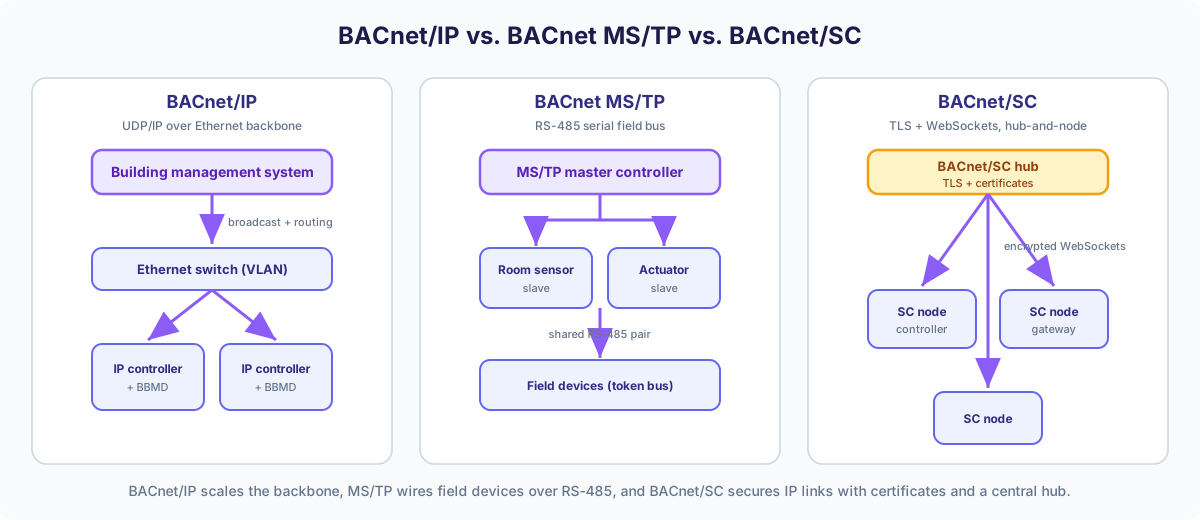
BACnet/IP sends BACnet messages over IP networks. BACnet MS/TP sends BACnet messages over RS-485 serial networks. BACnet Secure Connect sends BACnet messages through a secure data link based on TLS and WebSockets.
| Variant | Transport | Typical role | Main strength | Main limitation |
|---|---|---|---|---|
| BACnet/IP | UDP/IP over Ethernet | Building backbone, BMS, controllers | Fast integration with IT networks | Needs careful segmentation and routing |
| BACnet MS/TP | RS-485 serial bus | Field controllers, room devices | Proven and cost-effective for field networks | Limited bandwidth and more physical-layer troubleshooting |
| BACnet/SC | TLS and WebSockets over IP | Secure IP-based BACnet communication | Encryption, authentication, IT alignment | Requires certificate and trust management |
What is the difference between BACnet/IP, BACnet MS/TP, and BACnet/SC?
BACnet/IP, BACnet MS/TP, and BACnet/SC carry BACnet messages across different network environments. BACnet/IP suits IP-based backbones, BACnet MS/TP suits field-level RS-485 device networks, and BACnet/SC suits secure IP architectures with stronger cybersecurity requirements.
When should you use BACnet/IP?
Use BACnet/IP when the project relies on Ethernet networks, building management systems, site controllers, supervisory workstations, virtual servers, or campus-wide building automation.
BACnet/IP works well when teams need higher bandwidth, easier routing across IP networks, and integration with IT-managed infrastructure. It also fits multi-building environments where building automation traffic must move across VLANs, routed networks, or central management platforms.
Plan BACnet/IP carefully. Broadcast discovery, BACnet routers, network numbers, BBMD configuration, firewall rules, and VLAN boundaries can create communication problems when IT and OT teams work from different assumptions.
When does BACnet MS/TP still make sense?
BACnet MS/TP still makes sense for field-level devices, retrofit projects, room controllers, and small device networks that already rely on RS-485 wiring.
Its strength lies in simplicity and cost efficiency. It works well for low-bandwidth automation data such as temperatures, damper positions, valve states, occupancy states, and basic control points.
Common MS/TP issues include missing termination, wrong polarity, duplicate MAC addresses, inconsistent baud rates, poor cable quality, and overloaded segments. These problems often look like protocol errors, although the cause sits at the physical layer.
What is BACnet Secure Connect?
BACnet Secure Connect, often written as BACnet/SC, is a secure BACnet data link for IP-based networks. It uses WebSockets and TLS to support peer authentication, message encryption, and reliable connection-oriented communication between BACnet/SC devices.
BACnet/SC helps building automation teams align with modern IT security expectations. It uses certificates, encrypted communication, and a hub-and-node structure instead of relying on open broadcast behavior across large IP networks.
How does BACnet fit into IoT and MQTT architectures?
BACnet fits the building automation layer. MQTT fits the scalable data distribution layer for IoT, IIoT, analytics, cloud platforms, and enterprise systems.
A common architecture uses BACnet for local automation and an MQTT gateway for data integration. The gateway reads BACnet objects from controllers or a BMS, maps values into MQTT topics, and publishes them to a broker. From there, applications can consume the data for dashboards, alerts, digital twins, energy optimization, Kafka pipelines, or data lakes.
Example mapping:
| BACnet source | BACnet property | MQTT topic | Consuming system |
|---|---|---|---|
| AHU-01 supply temperature | Present_Value | building/ahu-01/supply-air/temp | SCADA dashboard |
| Chiller status | Present_Value | building/chiller-02/status | Operations monitoring |
| Energy meter | Present_Value | building/meter-01/kwh | Analytics platform |
| Room controller | Occupancy state | building/floor-2/room-214/occupancy | Facility optimization |
For broader operational visibility, BACnet data can feed SCADA systems, a Unified Namespace, or an UNS implementation that structures machine, facility, and enterprise data in one consistent model.
Cedalo fits this architecture as an MQTT data backbone. The Pro Edition for Eclipse Mosquitto™ adds enterprise features such as clustering and fine-grained access control on top of Eclipse Mosquitto, and the Cedalo MQTT Platform manages these brokers with central monitoring, user management, Multi-Broker Management, and integrations with Kafka, databases, and cloud platforms.
How can BACnet data be integrated into a Unified Namespace?
BACnet data can be integrated into a Unified Namespace by mapping building automation objects into a structured MQTT topic hierarchy. The BACnet object remains the source of automation meaning. The MQTT topic adds enterprise context.
A useful UNS structure follows the asset model that engineering and operations teams already use:
site/building/floor/system/equipment/point
Example:
berlin/building-a/floor-03/hvac/ahu-01/supply-air-temperature
This topic can carry a value that originally came from an Analog Input object in BACnet. The consuming system usually does not need to know the BACnet device ID, object type, or property details. It receives contextualized data.
For stronger interoperability, teams can model MQTT payloads with standards such as Sparkplug MQTT or move operational data into analytics pipelines through MQTT to Kafka integration.
What are the main security risks in BACnet networks?
The main security risks in BACnet networks can come from exposed IP communication, weak segmentation, open discovery, unmanaged remote access, poor credential processes, and missing monitoring. BACnet/SC can reduce several of these risks through encrypted, authenticated communication over modern IP infrastructure.
For project teams, security depends on architecture as much as protocol choice.
Important controls include:
- Network segmentation: Separate building automation traffic from office IT, guest networks, and public internet access.
- Firewall policy: Allow only required BACnet traffic between known systems.
- Secure remote access: Replace uncontrolled port exposure with managed access paths.
- Certificate lifecycle: Treat BACnet/SC certificates as operational assets with expiry, rotation, and ownership.
- Monitoring: Track device availability, data flow, authentication events, and unexpected network behavior.
- Auditability: Keep traceable records for configuration changes, access events, and operational incidents.
Cedalo’s target environments often require security, compliance, high availability, and OT/IT integration across critical industrial and infrastructure settings. Encryption, audit trails, user management, and monitoring are key parts of that positioning.
How do you choose between BACnet/IP, BACnet MS/TP, BACnet/SC, and MQTT?
Choose BACnet/IP for building automation backbones, BACnet MS/TP for field-level RS-485 segments, BACnet/SC for secure IP-based BACnet communication, and MQTT for scalable data distribution beyond the automation network.
| Scenario | Recommended architecture | Why it fits |
|---|---|---|
| New building with Ethernet backbone | BACnet/IP plus planned segmentation | Supports fast controller and BMS communication |
| Retrofit with existing RS-485 devices | BACnet MS/TP with BACnet/IP routing | Preserves field infrastructure and connects to the backbone |
| Security-driven modernization | BACnet/SC for IP-based BACnet traffic | Adds TLS, certificates, and IT-aligned security |
| Cloud analytics or enterprise dashboards | BACnet gateway to MQTT | Moves building data into scalable IoT data flows |
| Multi-site operational visibility | MQTT backbone with UNS structure | Standardizes data across buildings, systems, and platforms |
| Kafka or data lake integration | MQTT broker plus Kafka integration | Connects operational data with analytics pipelines |
Practical decision guide for project teams
- Identify the automation layer: List controllers, sensors, actuators, BMS platforms, and existing field buses.
- Map communication paths: Separate field communication, backbone communication, remote access, and enterprise data flows.
- Define security requirements: Clarify segmentation, encryption, authentication, logging, and compliance needs.
- Select the BACnet variant: Use BACnet/IP, MS/TP, or BACnet/SC based on topology and risk profile.
- Add an integration layer: Use MQTT when data must reach cloud systems, Kafka, analytics tools, digital twins, or a UNS.
- Validate operations: Test discovery, object mapping, write priorities, alarms, latency, and failover.
- Document ownership: Assign responsibility for certificates, network rules, device IDs, topic structures, and monitoring.
How should teams troubleshoot BACnet communication problems?
BACnet troubleshooting should move from the physical layer to the application layer. Start with wiring, IP reachability, network numbers, and routing. Then validate devices, objects, properties, services, and security settings.
Use this checklist:
- Confirm the physical connection: Check cabling, switches, RS-485 polarity, termination, and grounding.
- Verify addressing: Check IP addresses, subnets, MS/TP MAC addresses, device IDs, and duplicate identifiers.
- Test discovery: Use Who-Is and I-Am to confirm that devices respond as expected.
- Inspect routing: Check BACnet routers, BBMDs, VLANs, firewalls, and network numbers.
- Validate objects: Confirm object type, object identifier, property name, units, and Present_Value.
- Review write behavior: Check priority arrays and relinquish defaults before blaming the controller.
- Check security: For BACnet/SC, inspect certificates, trust stores, hub connectivity, TLS configuration, and node status.
- Test gateway mapping: For MQTT integration, verify topic naming, payload format, polling intervals, retained messages, and quality indicators.
This workflow prevents expensive guesswork. It also helps IT and OT teams isolate whether the fault sits in the field bus, IP network, BACnet application model, security layer, or MQTT integration.
Connect BACnet data securely with Cedalo
BACnet remains the automation language for controllers, BMS platforms, and field devices. When that data needs to reach SCADA, a Unified Namespace, Kafka, or cloud systems, MQTT often becomes a suitable data layer. Cedalo provides the MQTT infrastructure to distribute, monitor, and help secure those BACnet-derived data flows.
Make BACnet Data Usable Across Your Entire IoT Stack
Cedalo helps you move BACnet-derived data beyond the building management system into MQTT-based architectures for analytics, cloud, and operational visibility.
BACnet Protocol: Frequently Asked Questions
What is BACnet used for in smart buildings?
BACnet is used to connect building systems such as HVAC, lighting, access control, fire detection interfaces, and energy meters. It allows devices from different vendors to exchange operational data through a shared building automation protocol.
Is BACnet suitable for cloud-based building automation?
BACnet can feed cloud-based building automation through gateways that translate BACnet objects into cloud-ready data formats. Many projects use MQTT between BACnet systems and cloud platforms because it supports scalable, event-driven data flows.
How does BACnet support interoperability between vendors?
BACnet supports interoperability through standardized objects, properties, and services. A building management system can read device data, write setpoints, receive alarms, and discover devices across vendor boundaries when all systems implement the relevant BACnet functions correctly.
Can Cedalo connect BACnet data with enterprise IT systems?
Cedalo can distribute BACnet-derived data through MQTT once a BACnet-to-MQTT gateway converts BACnet objects into MQTT topics. This helps teams connect building automation data with Kafka, cloud platforms, databases, and analytics tools.
Why use MQTT with BACnet instead of sending BACnet data directly?
MQTT is better suited for distributing operational data beyond the building automation network. BACnet handles local device communication, while MQTT carries selected data to dashboards, data platforms, cloud services, and multi-site IoT architectures.
How does Cedalo help protect BACnet-to-MQTT data flows?
Cedalo provides MQTT infrastructure with security functions such as encrypted connections, user management, monitoring, and audit trails. These functions can help teams control how BACnet-derived data moves from building systems into IT, cloud, and analytics environments.