Architecting a resilient data infrastructure requires choosing between the lean efficiency of MQTT and the sophisticated routing of AMQP, as selecting the wrong protocol leads to bottlenecks in high-throughput enterprise environments. This analysis provides the technical depth needed to align your messaging layer with specific industrial or microservice requirements, moving beyond surface-level comparisons to actionable architectural insights.
AMQP vs. MQTT: key takeaways
- MQTT is optimized for IIoT and Unified Namespace architectures, delivering ultra-low protocol overhead, lightweight publish-subscribe messaging, and massive device scalability.
- AMQP is designed for enterprise messaging and transactional integrity, supporting durable queuing and reliable delivery semantics when properly configured.
- Choosing between AMQP vs. MQTT directly impacts latency, scalability, and system reliability, depending on whether edge telemetry efficiency or backend processing control is the priority.
AMQP vs. MQTT: what are the core technical differences?
The selection of a messaging protocol dictates the efficiency and reliability of your entire data infrastructure. At their core, these protocols differ in their binary representation and how they manage connection states over TCP.
Operational logic: telemetry speed vs. transactional integrity
While both protocols facilitate asynchronous data exchange, their internal logic serves different primary goals:
- The MQTT approach (efficiency first): MQTT is designed to be “silent”. It minimizes metadata to ensure that even the smallest battery-powered sensor can transmit data without exhausting its resources. It assumes the network might be unstable and focuses on maintaining a lightweight session with an MQTT broker.
- The AMQP approach (reliability first): AMQP treats data as a formal contract. Every message can carry extensive metadata (headers, properties, footers), allowing the protocol to handle transactional acknowledgments and multi-hop routing natively. This makes it a natural fit for integrating diverse enterprise IT systems.
How does the messaging model of AMQP compare to MQTT’s publish-subscribe?
Beyond the binary level, the fundamental difference in the AMQP vs. MQTT debate lies in the system topology. The choice here determines how your data physically moves from a sensor to an application.
MQTT: the centralized hub-and-spoke pattern
MQTT is the digital equivalent of a radio broadcast. It relies on a central hub to decouple components.
- Spatial decoupling: Publishers and subscribers never interact; the broker handles all distribution.
- Broadcast efficiency: A single message from a sensor is replicated by the broker and pushed to thousands of subscribers simultaneously with minimal latency.
- State awareness: The Last Will and Testament (LWT) feature provides a native way to monitor the health of edge devices without constant polling.
AMQP: the flexible message queuing framework
AMQP is a flexible messaging protocol that supports link-based routing and message distribution between nodes.
- Store-and-forward: AMQP excels at buffering. Messages can exist in a queue long after the producer has disconnected, ensuring no data loss during consumer downtime.
- Worker distribution: Both protocols can distribute work across a pool of consumers. AMQP does it through its queue and acknowledgment model; MQTT 5 does it through shared subscriptions (
$share/<group>/<topic>), which load-balance matching messages across the members of a subscriber group. AMQP’s per-message ack and queue durability give finer control where transactional guarantees matter. - Peer-to-peer links: AMQP 1.0 allows for direct communication between two nodes without a central broker, which is vital for high-performance cross-cloud synchronization.
How do routing logic and topic structures differ in the AMQP vs. MQTT comparison?
Data distribution efficiency depends heavily on how precisely messages find their destination. While MQTT relies on a rigid, hierarchical structure, AMQP provides flexible messaging semantics, while advanced routing logic is typically implemented by the broker.
MQTT: structured hierarchy via topic trees
In MQTT, routing is handled through topic strings. These are organized hierarchically (e.g., factory/hall1/machine4/temperature), allowing for straightforward filtering.
- Hierarchical filtering: Subscribers use wildcards to aggregate data streams. The single-level wildcard (+) replaces one level, while the multi-level wildcard (#) covers all subsequent levels.
- The advantage of simplicity: Since the MQTT broker only performs string comparisons, routing is extremely fast and resource-efficient.
- Limitations: Routing is static. A message is always delivered to everyone whose subscription exactly matches the topic path.
AMQP: dynamic distribution through exchanges and bindings
Common exchange types such as Direct, Fanout, Topic, and Headers exchanges are features of specific broker implementations (e.g., RabbitMQ with AMQP 0-9-1). They provide flexible routing capabilities but are not defined as core constructs in the AMQP 1.0 specification.
Selecting the right routing approach
To determine the optimal structure for your AMQP vs. MQTT architecture, follow these steps:
- Analyze recipients: Do all consumers require the same data (MQTT), or must tasks be specifically distributed to available workers (AMQP)?
- Define filtering depth: Is a geographic or functional hierarchy sufficient (e.g., Site/Device/Sensor)? If so, MQTT is the ideal fit.
- Evaluate metadata: Do messages need to be routed differently based on their content (e.g., Priority: High) without altering the topic? Use a broker implementation that supports header-based routing.
- Plan for scalability: If you are pursuing a Unified Namespace (UNS) strategy, the MQTT hierarchy provides the best foundation for factory-wide standardization.
How do protocol overhead and transmission efficiency compare in AMQP and MQTT?
The choice between AMQP and MQTT directly impacts network utilization and hardware requirements. In industrial radio networks or satellite links, protocol overhead determines operational costs and system latency.
Wire-level efficiency: binary footprint and header analysis
MQTT was engineered to eliminate every unnecessary byte, whereas AMQP prioritizes metadata portability, resulting in a larger data footprint.
- MQTT efficiency: An MQTT header can be as small as 2 bytes. This allows for the efficient transmission of tiny telemetry packets without the protocol data overwhelming the actual payload.
- AMQP overhead: AMQP utilizes a complex type system and extensive descriptors. AMQP messages typically include a richer structured message format with properties and annotations, which can increase protocol overhead compared to MQTT.
Pro tip: minimizing transmission costs
To optimize efficiency in your messaging architecture, consider these steps:
- Payload compression: Use binary formats like Protobuf to keep the actual data small.
- Topic shortening: In MQTT, keep topic names concise as they are included in every packet.
- Edge filtering: Deploy a local MQTT broker to filter data before sending it over expensive Wide Area Networks (WAN) to an AMQP backend.
How do delivery reliability and transactional control differ?
In mission-critical environments, the decision between AMQP or MQTT depends on how the system handles communication failures. Both protocols offer mechanisms to verify data arrival, but their approaches to persistence vary significantly.
MQTT Quality of Service (QoS) levels
MQTT uses three distinct QoS levels to manage message delivery between the client and the MQTT broker, balancing reliability with network overhead:
- QoS 0 (at most once): “Fire and forget.” Best for high-frequency telemetry where losing an occasional data point is acceptable.
- QoS 1 (at least once): Guarantees delivery via acknowledgment (PUBACK). Duplicates may occur if the network drops before the confirmation is processed.
- QoS 2 (exactly once): Uses a four-step handshake to ensure the message is delivered exactly one time. Critical for command-and-control systems but increases latency.
AMQP reliability and transactional integrity
AMQP 1.0 focuses on “settlement” and “disposition”, offering enterprise-grade features for data consistency:
- Transactional messaging: Allows grouping multiple messages into a single transaction. Either all are processed, or none are (atomic operations).
- Flow control: Uses a credit-based system. The receiver tells the sender how many messages it is ready to handle, preventing system crashes during traffic spikes.
- Persistent queuing: Many AMQP broker implementations support durable queues and disk persistence, allowing messages to survive consumer downtime when configured accordingly.
How do scalability and resource consumption compare under production load?
When evaluating between AMQP and MQTT for large-scale deployments, performance is measured by how effectively the system handles concurrent connections and message throughput while minimizing CPU and memory usage.
MQTT: engineered for massive device connectivity
MQTT’s lightweight architecture makes it the superior choice for scaling horizontally across thousands, or even millions, of connections.
- Low memory footprint: Because an MQTT broker maintains a simple state for each client, it can support a high density of connections on modest hardware.
- Minimal CPU cycles: The protocol’s simple fixed header requires very little processing power to parse, allowing edge gateways to handle high message frequencies without overheating.
- Efficient keep-alives: The “ping” mechanism is designed to maintain connections with minimal data exchange, which is vital for preserving battery life in remote IIoT sensors.
AMQP: built for high-throughput enterprise data
AMQP is designed for “heavy lifting” within a data center. It prioritizes the volume and complexity of data over the total number of connected clients.
- Multichannel efficiency: AMQP allows multiple “sessions” or “links” over a single TCP connection. This enables a single backend application to process different types of data streams simultaneously without opening multiple ports.
- High throughput for complex payloads: While the overhead is higher, AMQP is optimized for moving large batches of data between servers, making it more efficient for backend microservices than for small edge devices.
- Resource intensity: Advanced routing features and richer message metadata in many AMQP broker implementations may require more RAM and CPU compared to a lightweight MQTT setup.
Which protocol should you choose for your project?
Deciding between AMQP and MQTT is not about finding the “better” protocol, but about matching the protocol to the job. For industrial IoT, MQTT is the right default across the whole path, from constrained edge devices to a Unified Namespace that spans the enterprise. AMQP earns its place for specific backend workloads: transactional messaging and worker-queue distribution where per-message acknowledgment and complex routing outweigh MQTT’s efficiency.
AMQP vs. MQTT: the decision matrix
This overview summarizes the key strengths of each protocol to guide your final architectural decision.
| Use case category | Recommended protocol | Why? |
|---|---|---|
| IIoT and remote sensors | MQTT | Lowest overhead, battery-friendly, and handles unstable networks. |
| Unified Namespace | MQTT | Topic hierarchies provide the best structure for organizational data. |
| Financial/ERP integration | AMQP | Support for transactional messaging and reliable delivery semantics (implementation-dependent). |
| Microservices (internal) | AMQP | Advanced routing (exchanges) and task distribution to worker pools. |
| High-volume telemetry | MQTT | Optimized for massive fan-in from millions of devices to a broker. |
The power of the hybrid approach
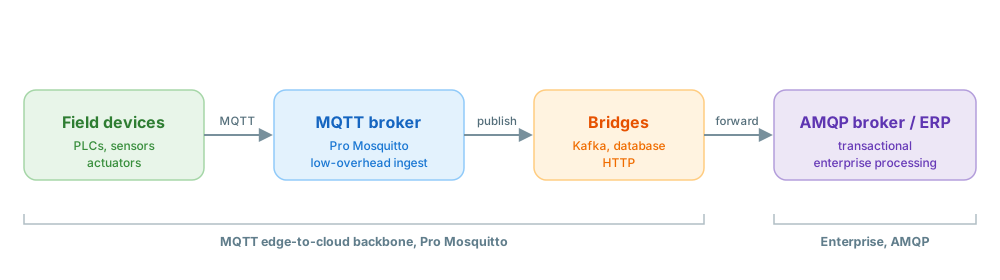
Modern industrial digital transformation (Industry 4.0) rarely relies on a single protocol. The most successful architectures utilize a protocol bridge to leverage the strengths of both:
- At the edge: Deploy an MQTT broker (like Pro Mosquitto) to collect real-time data from PLCs, sensors, and actuators using low bandwidth.
- In the backend: Forward the high-value MQTT data via Pro Mosquitto’s bridges (Kafka, database, HTTP) into your enterprise stack, where an AMQP broker or ERP consumes it for complex processing and long-term storage.
- The result: You achieve the high-speed responsiveness of MQTT with the transactional reliability of AMQP.
Architect your scalable MQTT-AMQP infrastructure
Build a secure, high-performance MQTT backbone for IIoT with Pro Mosquitto, and stream data into your enterprise systems through its Kafka, database, and HTTP bridges.
Why choosing the right messaging strategy defines your success
A technical analysis of the AMQP vs. MQTT landscape reveals that resilient infrastructures do not rely on a single protocol. Instead, they implement a cohesive architecture that synchronizes real-time shop floor data with high-level enterprise cloud systems. MQTT and a Unified Namespace give you one data backbone from the shop floor to the enterprise. Where a specific workload needs AMQP’s transactional processing, that system consumes from the same MQTT backbone rather than replacing it.
Your advantages with Cedalo:
- A single MQTT/UNS backbone that feeds enterprise systems, including AMQP brokers, through Pro Mosquitto’s Kafka, database, and HTTP bridges.
- Reliable bridging of MQTT telemetry with enterprise AMQP backends to maintain a robust Unified Namespace across the entire organizational infrastructure.
- Pro Mosquitto performance combined with integrated stream processing and dynamic, real-time access control for mission-critical reliability.
- A unified management cockpit that enables scaling from a single gateway to millions of concurrent connections without increasing architectural or operational complexity.
- A web-based Management Center for configuring brokers, managing dynamic security (clients, roles, and topic ACLs), and monitoring traffic across all nodes from one GUI, without hand-editing config files on every broker.
AMQP vs. MQTT: frequently asked questions
How does MQTT Sparkplug B fit into an MQTT-based IIoT architecture?
MQTT Sparkplug B is an application-layer specification built on top of MQTT that standardizes data representation and state management for industrial automation. It defines “birth” and “death” message concepts to ensure consistent data origins and real-time awareness of device state across the network. In the hybrid pattern described above, Sparkplug B keeps the MQTT edge layer consistent before data is bridged into an AMQP or ERP backend.
How do AMQP and MQTT handle message acknowledgment?
MQTT uses three QoS levels to guarantee delivery between clients and brokers through simple acknowledgments. AMQP utilizes a settlement process that enables coordinated acknowledgment and transactional handling, depending on broker configuration and application design.
Why is a Unified Namespace easier to implement with MQTT?
A Unified Namespace requires a consistent hierarchical structure, which is natively supported by MQTT’s topic-tree architecture. Unlike AMQP’s exchange-based logic, MQTT enables every device to publish into a global hierarchy, simplifying the creation of a semantic data model.
Which security protocols are best for securing messaging traffic?
Both protocols rely on TLS/SSL encryption, but enterprise environments often implement Mutual TLS (mTLS) for certificate-based device identity. While MQTT uses topic-level ACLs, AMQP integrates with SASL frameworks to leverage corporate identity providers like LDAP or Kerberos.
Does Cedalo Pro Mosquitto support high-availability for mission-critical IIoT?
Cedalo Pro Mosquitto enables advanced clustering and high-availability (HA) configurations to prevent downtime during hardware or network failures. By synchronizing state across multiple nodes, it ensures the Unified Namespace remains accessible for 24/7 production environments.