Manufacturing plants generate terabytes of sensor, machine, and process data every day. Most of it goes unanalyzed. AI in manufacturing changes that: it processes continuous data streams in real time, surfaces anomalies before they cause downtime, and turns production data into decisions your team can act on immediately.
AI in Manufacturing: Key Takeaways
- AI in manufacturing turns continuous sensor and machine data into real-time operational decisions, from anomaly detection to dynamic line scheduling.
- Many AI efforts stall before they scale. The data infrastructure lacks real-time delivery, consistent formats, and a unified namespace.
- AI in manufacturing delivers the highest ROI when deployed against a specific, measurable problem like predictive maintenance, quality control, or energy optimization, rather than as a broad platform initiative.
- Cedalo connects machines, edge devices, and cloud systems into one structured MQTT data path, giving AI models the clean, continuous data streams they need to reach production.
What Does AI in Manufacturing Actually Mean?
AI in manufacturing refers to the application of machine learning models, computer vision systems, and data-driven algorithms directly within industrial production environments. The term covers a broad set of technologies, from supervised learning models that classify defect images to reinforcement learning agents that optimize scheduling across production lines.
Three categories dominate practical deployments:
| AI Category | Primary Function | Required Data Foundation |
|---|---|---|
| Machine Learning | Predictive maintenance, anomaly detection, yield optimization | Time-series sensor data, historical failure logs |
| Computer Vision | Visual defect detection, dimensional inspection, pick-and-place guidance | High-resolution camera feeds, labeled training data |
| Natural Language Processing | Maintenance documentation, operator support, reporting automation | Structured logs, machine event records |
What separates production-grade AI from lab demos is not the model architecture but the data pipeline behind it. An ML model trained on incomplete or inconsistent sensor data produces outputs no engineer trusts. AI in manufacturing works when the underlying data infrastructure is reliable, real-time, and structured.
Where Is AI Used in Manufacturing?
The most credible examples of AI in manufacturing share one trait: they solve a specific, measurable problem. The following use cases reflect where AI for manufacturing has proven its value in production environments.
Predictive Maintenance: From Failure Reaction to Condition-Based Intervention
Predictive maintenance is one of the most common high-ROI AI use cases in manufacturing. Instead of relying on fixed schedules or running equipment to failure, AI models analyze vibration, temperature, current, and acoustic data to estimate asset health and support timely maintenance.
Because unplanned downtime can cost hundreds of thousands of dollars per hour, reliable low-latency data flow is essential. A production-grade MQTT broker provides the continuous telemetry stream AI systems need, with appropriate QoS, persistence, and high-availability settings.
Quality Control and Defect Detection with Computer Vision
Computer vision improves consistency and speed in visual quality inspection, especially in high-volume production. Camera-based systems can detect defects, measure tolerances, and verify assembly completeness.
In areas such as automotive paint inspection, AI-assisted systems help reduce manual variability and support more consistent, higher-throughput quality control.
AI in Factory Automation: Dynamic Line Control and Scheduling
AI in factory automation goes one step further than monitoring. Production scheduling systems powered by ML respond to real-time constraints: machine availability, order priority, material supply, and energy costs. A scheduling model that recalculates production sequences every few minutes reacts faster to disruptions than any manual planning process.
This category connects directly to MES and SCADA data. The cleaner and more consistent the data coming from those systems, the more reliable the AI-generated schedules become.
Energy Optimization and Resource Efficiency
AI models can reduce energy use by shifting non-critical processes to lower-cost time windows and identifying inefficient equipment. In energy-intensive industries such as cement, steel, and chemicals, case studies report meaningful savings, though results vary by process and implementation.
These models require granular machine-level consumption data rather than facility-wide meter readings. Submetering and reliable data transport create the foundation they need.
Supply Chain Intelligence and Demand Forecasting
AI systems that process order data, production capacity, supplier lead times, and external signals such as port congestion or weather disruptions give production planners an advantage that static ERP forecasting cannot match. By combining structured production data with external signals in real time, these systems react to disruptions faster than any rule-based forecast model, directly reducing both stockouts and excess inventory.
Five AI Use Cases That Change How Production Runs
| Use Case & Data Source | Measurable Output |
|---|---|
| 1. Predictive Maintenance Vibration · Temperature · Current Draw · Acoustic Signatures | Early Failure Warning |
| 2. Quality Control & Defect Detection Camera Feeds · Dimensional Sensor Data · Labeled Training Sets | Lower Defect Escape Rate |
| 3. Factory Automation & Line Scheduling MES Orders · Machine Availability · Energy Cost Signals | Real-Time Schedule Recalculation |
| 4. Energy Optimization Machine-Level Consumption · Load Profiles · Energy Price Curves | Energy and Cost Savings |
| Supply Chain & Demand Forecasting Order Data · Supplier Lead Times · External Disruption Signals | Improved Forecast Accuracy |
What Are the Real Prerequisites for AI in Manufacturing?
Most AI projects in production fail before the model ever runs. The common cause: the data infrastructure was not ready. AI in the manufacturing industry requires specific conditions at the data layer, conditions that many OT environments do not meet by default.
The prerequisites:
- Continuous, structured data streams: AI models need consistent, timestamped telemetry from sensors and controllers, not batch exports from historian databases.
- Low-latency transport: A delay of seconds is too slow for in-line reject or closed-loop control.
- Consistent payload formats: Mixed payload schemas from different device generations break feature extraction pipelines.
- Reliable delivery guarantees: Message loss at the broker level creates gaps in training data and degrades model performance over time.
- Unified topic structure: Without a clear namespace convention, downstream systems cannot subscribe selectively or route data correctly.
MQTT addresses many of these requirements when deployed correctly. Its publish-subscribe architecture, quality-of-service levels, and lightweight protocol overhead make it a widely used choice for industrial telemetry transport. Teams that invest in a clustered, well-configured MQTT infrastructure before selecting AI tooling often reach production faster and with fewer integration problems.
The Management Center gives teams a centralized view of MQTT clients, topics, and broker health so they can see whether streams are arriving, making it practical to validate data quality before feeding streams into AI pipelines.
Your AI is only as good as the data it receives
The Management Center gives you a centralized control layer for MQTT brokers, client connections, and data routing, designed for production use from the start.
How Does AI Connect to Existing Manufacturing Systems?
AI systems in manufacturing do not operate in isolation. They sit within an architecture that spans OT equipment, edge processing nodes, on-premises servers, and cloud infrastructure. The integration question is not whether to connect AI, but at which layer inference should happen and which systems consume the results.
A typical architecture for AI in production follows this path:
- OT layer: PLCs, sensors, drives, and controllers publish data via MQTT or OPC UA to an edge broker.
- Edge layer: An edge node filters, aggregates, and forwards relevant data streams. Lightweight AI inference for latency-critical tasks, such as real-time anomaly detection, runs here.
- Integration layer: A clustered MQTT broker normalizes incoming data streams and routes them to SCADA, MES, ERP, and cloud endpoints. This layer also applies the Unified Namespace structure.
- AI and analytics layer: Training pipelines, dashboards, and model serving infrastructure consume structured data from the integration layer. Results feed back into scheduling systems, maintenance tickets, or operator interfaces.
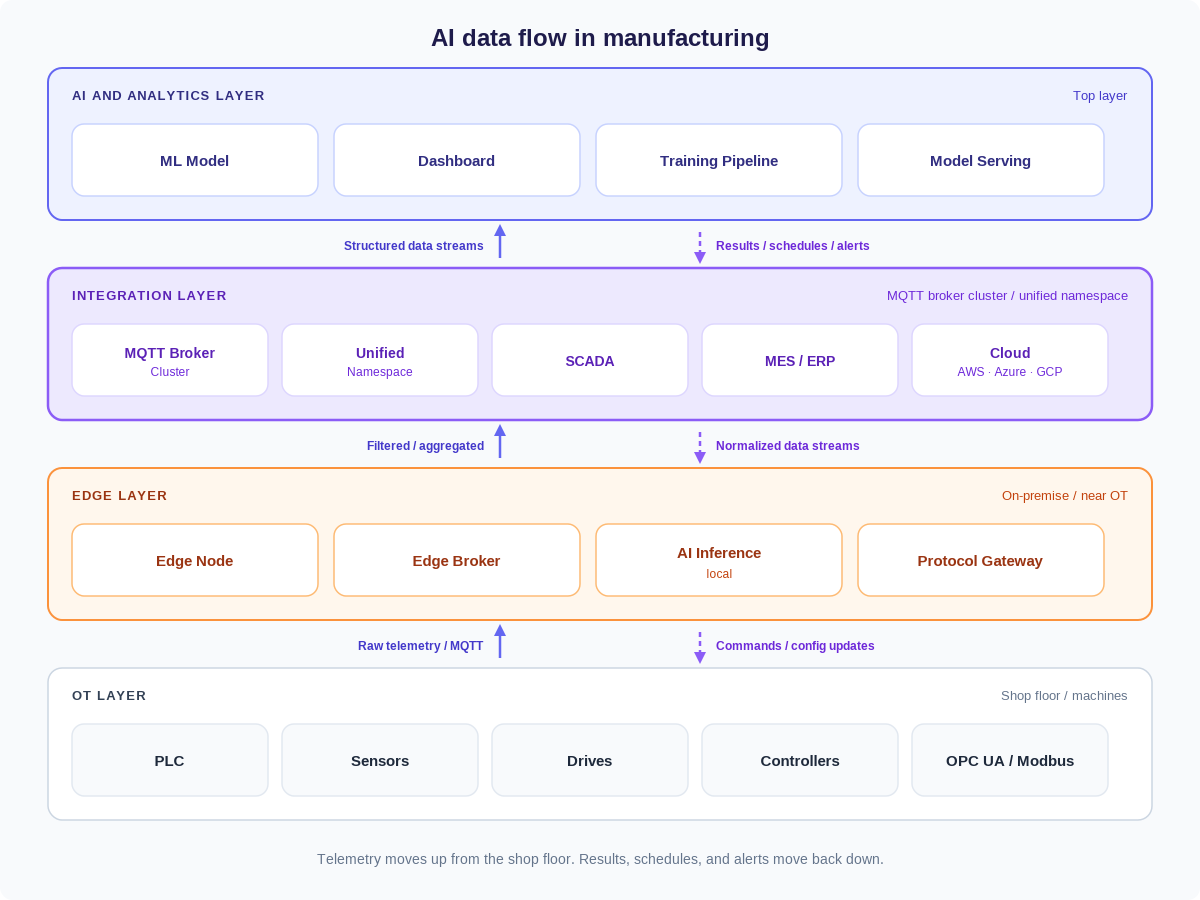
A Unified Namespace approach at the integration layer removes the need for point-to-point data mappings between systems. Instead of building custom connectors between every OT system and every analytics tool, teams publish all data to a single structured namespace. Any consuming system, whether a monitoring dashboard or an AI model, subscribes to the topics it needs.
Typical integration points in a production AI setup:
- SCADA systems for real-time process state
- MES for production orders, work center status, and quality records
- ERP for demand signals, material availability, and maintenance cost tracking
- Cloud services (AWS, Azure, GCP) for model training, storage, and large-scale analytics
- Time-series databases for historian-grade data retention
What Challenges Do Teams Face When Deploying AI in Manufacturing?
McKinsey’s 2025 Global AI Survey found that only 39 percent of organizations report any measurable EBIT impact from AI at the enterprise level and just 6 percent qualify as genuine high performers. In manufacturing, additional OT-specific barriers such as fragmented data environments, legacy systems, and inconsistent asset information make scaling AI especially difficult.
| Challenge | Root Cause | Practical Solution |
|---|---|---|
| Data silos between OT and IT | Separate networks, protocols, and ownership structures | Unified MQTT namespace as shared data layer |
| Missing real-time data paths | Historian-based batch exports, no live telemetry | MQTT-based edge-to-cloud streaming with QoS guarantees |
| Security and compliance friction | OT systems without modern authentication | Centralized certificate management, role-based access control |
| Pilot-to-production scaling | Architecture designed for one line, not twenty | Clustered broker setup with load balancing from day one |
| Inconsistent data quality | Mixed device generations with different payload schemas | Namespace standardization, payload validation at ingestion |
The data silo problem deserves particular attention. In most manufacturing facilities, OT and IT teams operate separate data environments with different tools, different update cycles, and different definitions of the same asset. An AI model that tries to correlate production throughput from MES with vibration data from the OT historian faces mismatched timestamps, different asset identifiers, and contradictory quality flags.
Resolving this requires an edge-to-cloud architecture that creates one consistent data path from machine to consumer, with a single broker layer acting as the authoritative relay point. Once that layer exists, AI systems on either side consume data without custom adapters for each source.
How Does a Scalable AI Infrastructure for Manufacturing Look in Practice?
The following four-step model reflects how engineering teams with real production constraints build AI-ready infrastructure.
Step 1: Establish a Reliable Data Transport Layer
Deploy an MQTT broker cluster at the edge or on-premise. Configure QoS levels appropriate for each data type: QoS 1 for telemetry, QoS 2 for critical state changes. Verify message delivery rates and latency under production load before adding any AI workload.
Step 2: Define and Enforce a Unified Namespace
Agree on a topic structure that maps to your asset hierarchy: site, area, line, and machine, data type. Publish all telemetry and state data to this namespace. Prohibit unstructured ad hoc topics from the start. This step alone removes the majority of downstream integration problems.
Step 3: Connect Consuming Systems Through the Broker
Route data from the MQTT namespace to SCADA, MES, time-series databases, and cloud storage through broker-native bridges or integration services. Keep the broker as the single relay point, not a sidecar. Validate that each consuming system receives the correct subset of data at the correct frequency.
Step 4: Deploy AI Models Against Clean, Structured Data
Start with one well-defined use case, predictive maintenance on a critical asset class, for example. Train models on data that has already passed through the validated namespace. Monitor model performance against production outcomes, not training metrics. Scale to additional use cases once the data pipeline has proven stable.
The Cedalo MQTT Platform covers the broker steps from one interface: the cluster, client permissions, topic monitoring, and integration bridges. Training and running the model stay in your AI tools.
AI Solutions in Manufacturing: Build vs. Buy vs. Integrate
Teams building AI infrastructure in the manufacturing industry face a recurring decision: assemble a custom stack, buy a proprietary AI platform, or integrate AI tooling into an open data infrastructure they already control. The choice determines how fast you reach production, how much vendor dependency you accept, and how much of your integration work survives the next technology shift.
Option 1: Buy a Proprietary AI Platform
- Fast initial setup and vendor-managed infrastructure
- Data flows lock into vendor-specific formats from day one
- Extending or replacing components becomes expensive once the platform owns the data path
- Teams that go this route often rebuild their integration layer within two to three years as requirements change
Option 2: Build a Custom Stack
- Maximum architectural control and no vendor dependency
- Requires significant internal expertise across OT, networking, and ML infrastructure
- Building a reliable, clustered, secure MQTT layer from scratch exceeds the capacity of most OT teams running active production environments
- High time-to-value: months of infrastructure work before the first model runs
Option 3: Integrate Open-Standards Infrastructure with Specialized AI Tooling
- An open MQTT platform handles data transport, normalization, and routing
- AI frameworks plug into structured data streams the platform already provides
- Each component stays easier to replace: if a better computer vision model becomes available or cloud pricing changes, only the affected layer needs to be updated.
- The data layer can remain more consistent across changes when topic structures, payload definitions, and governance are enforced
| Criteria | Buy Proprietary | Build Custom | Integrate Open Standards |
|---|---|---|---|
| Time-to-Value | Fast | Slow | Medium |
| Flexibility | Low | High | High |
| Vendor Lock-in | High | None | Low |
| Internal Effort | Low | Very High | Medium |
| Replaceability | Low | High | High |
Cedalo fits this integration approach. Eclipse Mosquitto provides the open broker core, while the enterprise layer adds clustering, security, and management. AI systems connect via standard MQTT subscriptions or integration bridges to Kafka, databases, and cloud services.
How to Get AI in Manufacturing to Production: Not Just to Pilot
Most AI projects in production don’t fail because the model is wrong. They fail because the data pipeline underneath it is unreliable, fragmented, or not built for real-time industrial workloads. The architecture decision at the infrastructure layer determines whether your AI deployment scales across 20 production lines or stays stuck at one pilot.
Your advantages with Cedalo:
- Eclipse Mosquitto as the broker core is used in millions of deployments worldwide. Docker Hub reports already more than 600 million image pulls.
- Clustering, high availability, role-based security, and centralized management are available within one platform, reducing additional integration and operational effort.
- AI systems connect via standard MQTT subscriptions or integration bridges to Kafka, databases, and cloud services, reducing dependence on proprietary formats and lowering lock-in risk.
- One management interface covers the MQTT path: brokers, clients, permissions, and bridges. Device protocols stay at the gateway, and model training stays in the AI tools.
Stop Losing AI Projects at the Infrastructure Layer
Confirm telemetry is arriving, and route it to AI systems that subscribe to MQTT or use a supported bridge, such as Kafka, a database, or a cloud service, from one reliable, production-ready MQTT platform.
AI in Manufacturing: Frequently Asked Questions
What Is the Difference Between AI in Manufacturing and Traditional Automation?
Traditional automation executes fixed, pre-programmed rules, so it reacts the same way every time. AI in manufacturing adapts based on incoming data, detects patterns that no rule set could anticipate, and improves its outputs over time without manual reprogramming.
How Long Does It Take to Implement AI in a Manufacturing Environment?
A focused first use case, such as predictive maintenance on one asset class, reaches production in three to six months when the data infrastructure is already in place. Without a reliable data transport layer, integration work alone extends that timeline significantly.
What Role Does Edge Computing Play in AI for Manufacturing?
Edge computing moves AI inference closer to the machine, reducing latency for time-critical decisions like real-time anomaly detection or quality rejection. It also reduces the volume of raw data sent to the cloud, cutting bandwidth costs and keeping sensitive production data within the plant network.
Does AI in Manufacturing Require Replacing Existing OT Systems?
No, many production AI deployments run alongside existing PLCs, SCADA systems, and MES without requiring full replacement. The key is a protocol layer, often MQTT in combination with gateways, connectors, or existing interfaces, that reads data from legacy equipment and forwards it to AI systems with minimal change to the underlying OT infrastructure.
How Does Cedalo Support AI Deployments in Industrial Environments?
Cedalo provides the MQTT infrastructure layer that connects machines, edge devices, and cloud systems into one structured data path. With built-in clustering, security, and integration bridges to Kafka and cloud services, the Cedalo platform gives AI models the clean, continuous data streams they need to perform reliably in production.
Which Industries Benefit Most from AI in Manufacturing?
Automotive, electronics, pharmaceuticals, and process industries such as chemicals and food production report the strongest ROI from AI deployments. These sectors combine high production volumes, strict quality requirements, and large volumes of sensor data. Exactly the conditions where AI-driven optimization delivers measurable results.
Can Cedalo’s MQTT Platform Be Used with Any AI or Analytics Tool?
Cedalo builds on open standards, so AI frameworks, time-series databases, and analytics platforms that support MQTT subscriptions or the relevant integration protocols can connect directly. This gives teams broad tooling flexibility and helps avoid restrictions created by proprietary data formats.