Teams often compare MQTT and WebSockets as if they solved the same problem. This leads to architectural decisions where messaging requirements, browser constraints, and network policies get mixed up.
This article explains what MQTT and WebSockets actually provide, where they differ fundamentally, and when combining them is the right choice for real IIoT and enterprise environments.
MQTT vs WebSocket: Key takeaways
- MQTT defines how data is structured, routed, and delivered, while WebSocket only defines how data is transported.
- MQTT over TCP or TLS is the preferred choice for devices and backend services that can open direct connections.
- MQTT over Secure WebSockets enables browser clients and restricted networks to use MQTT over standard HTTPS ports.
- Separating listeners and security policies for devices and web clients is essential for a clean and secure architecture.
What is MQTT?
MQTT is an application layer messaging protocol designed for efficient, event driven communication between many clients through a central broker. It defines how messages are published, how they are routed through topics, and how subscribers receive data without direct connections to each other.
In this comparison, MQTT provides the messaging semantics that determine how data is distributed, how sessions behave, and how devices and systems interact over time.
MQTT provides:
- A broker based publish and subscribe model
- Topic namespaces to structure and distribute data
- Session awareness between clients and broker
- Delivery options and retained state patterns
- A clear authorization model based on users, clients, and topics
What is WebSocket?
WebSocket is an application-layer protocol that establishes a persistent, bidirectional channel over a single TCP connection between a client and a server. It starts as an HTTP request and then upgrades the connection to allow continuous data exchange without reopening connections.
In this comparison, WebSocket provides a way to move data through networks that are optimized for HTTP and HTTPS traffic, especially in browser and enterprise environments.
WebSocket provides:
- A long lived, bidirectional connection over HTTP or HTTPS
- Compatibility with browsers, proxies, and corporate firewalls
- Transport for arbitrary data without defining message structure
- No built in concept of topics, publish and subscribe, or routing logic
WebSocket vs MQTT: Main differences
MQTT and WebSockets solve different problems. MQTT defines how messages are structured, routed, and delivered between many clients through a broker. WebSockets only define how bytes travel between a client and a server over an upgraded HTTP connection.
This is why treating WebSockets as an alternative to MQTT often leads to confusion. In practice, many systems use MQTT over WebSockets, which combines MQTT’s messaging model with WebSocket’s transport path.
| Aspect | MQTT | WebSocket |
|---|---|---|
| Role | Messaging protocol | Transport channel |
| Data model | Topics, publish and subscribe | Raw bidirectional stream |
| Routing | Broker distributes to many clients | Point to point connection |
| Session behavior | Defined by protocol | Not defined |
| Authorization model | Users, clients, topic permissions | Depends on application layer |
| Typical use | Device and system telemetry | Browser and web communication |
When should you use MQTT over TCP or TLS?
MQTT over TCP or TLS is the default choice for devices, gateways, and backend services that can open direct network connections to a broker. This setup avoids unnecessary protocol layers and keeps communication efficient and predictable.
It also provides the cleanest operational model because the broker listens on dedicated MQTT ports and handles connections without intermediaries such as proxies or load balancers designed for HTTP traffic.
Use MQTT over TCP or TLS when:
- Devices and services are not running inside a web browser
- Network policies allow direct connections to MQTT ports
- You want minimal overhead and maximum performance
- You control both client and network environment
- You want straightforward troubleshooting and observability
When does MQTT over WebSockets make sense?
MQTT over WebSockets becomes relevant when clients cannot use raw TCP connections to the broker. This is common for web applications running in browsers and for environments where network policies only allow traffic over standard HTTP or HTTPS ports.
In these cases, WebSockets provide a transport path that fits existing firewall, proxy, and load balancer setups while still allowing MQTT to handle messaging, topics, and routing.
MQTT over WebSockets fits when:
- Clients run in web browsers that do not support native MQTT over TCP
- Corporate networks restrict traffic to ports 80 and 443
- Proxies and security appliances expect HTTP or HTTPS traffic
- You want web applications to subscribe to and publish MQTT topics directly
Modern enterprise environments often require MQTT clients that cannot use raw TCP connections, such as web dashboards or applications behind strict proxies. In these scenarios, MQTT can be transported over WebSockets, enabling clients to operate on standard HTTPS ports.
Tip: For a practical, step by step guide on how to configure WebSocket support with Eclipse Mosquitto, see Cedalo’s guide on enabling WebSockets over MQTT with Mosquitto.
What are the practical trade-offs of MQTT over WebSockets?
MQTT over WebSockets solves transport and network constraints, but it also introduces additional layers that influence performance, stability, and troubleshooting. These effects become visible in real environments with proxies, load balancers, and security appliances in the path.
Understanding these trade-offs helps teams decide where MQTT over WebSockets is appropriate and where native MQTT over TCP or TLS remains the better option.
| Symptom | Likely cause | Mitigation |
|---|---|---|
| Unexpected connection drops | Proxy or load balancer idle timeouts | Adjust keepalive and timeout settings |
| Higher latency than expected | Extra network intermediaries (proxies, load balancers, TLS termination) | Use native MQTT where possible |
| Difficult troubleshooting | Traffic passes through HTTP infrastructure | Enable detailed broker and proxy logging |
| Inconsistent behavior across sites | Different network policies and intermediaries | Standardize listener and network setup |
| TLS termination confusion | Load balancer handles TLS before broker | Clearly define where encryption terminates |
These issues do not make MQTT over WebSockets unreliable, but they require more coordination between application, network, and operations teams compared to direct MQTT connections.
How do security considerations differ between MQTT and WebSockets?
Transport security and application security are often confused when teams introduce WebSockets into MQTT environments. WebSockets can run over HTTPS, but this only protects the transport path and does not replace MQTT’s own authentication and authorization model.
Security decisions must therefore cover both layers consistently.
Transport encryption does not replace MQTT authorization
Using WSS or TLS ensures that traffic is encrypted between client and broker. It does not control which topics a client can access or what actions it can perform.
MQTT users, client identities, and topic level permissions remain the primary mechanism for enforcing access rules.
Browser clients introduce different credential patterns
Web applications often rely on tokens, cookies, or short lived credentials instead of static usernames and passwords. This requires careful integration between identity management and MQTT authentication.
Without this integration, teams risk exposing MQTT listeners that are reachable over standard HTTPS ports without proper access control.
Trust zones should remain separated by listener design
Devices, backend services, and browser clients often operate in different trust zones. Mixing them on the same listener increases risk and makes policy enforcement harder.
A clean setup uses separate listeners and policies for MQTT over TCP or TLS and for MQTT over WebSockets.
Operate MQTT over TCP, TLS, and WebSockets with confidence
Learn how Cedalo helps you manage brokers, listeners, and security policies across devices, services, and web clients at scale.
How do you design a clean architecture for devices and web clients?
Devices, backend services, and web applications have different network capabilities and security requirements. A clean architecture reflects these differences instead of forcing all clients to connect in the same way.
The goal is to keep transport paths, trust zones, and access policies clearly separated while using the same broker and topic structure.
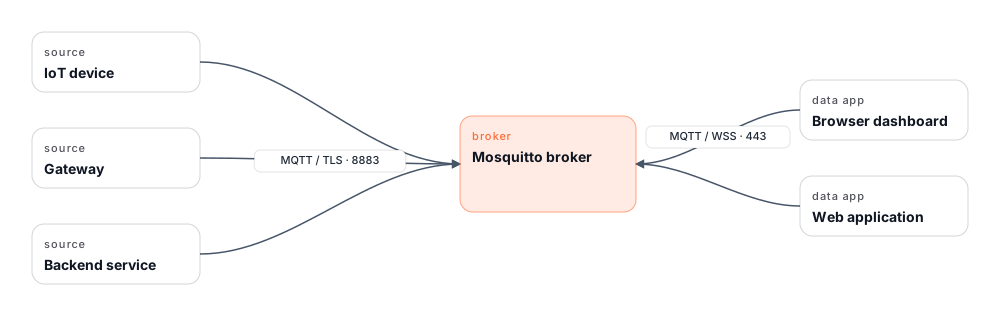
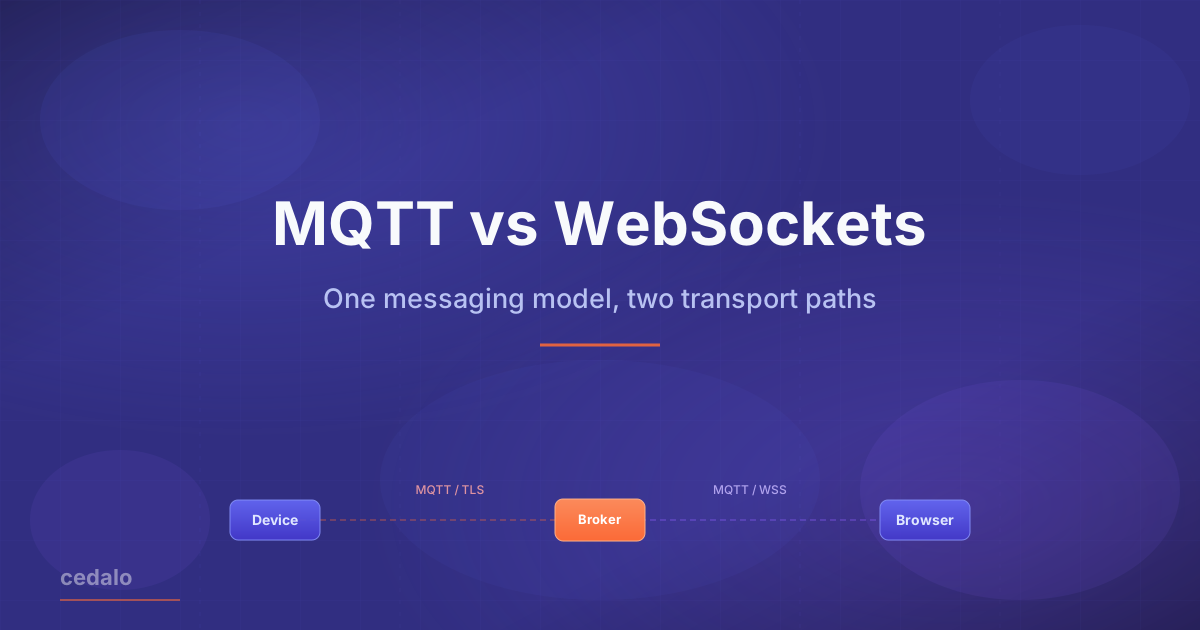
Figure 1: One broker, two listeners. Devices and backend services connect over MQTT on a dedicated TLS listener, while browser and web clients connect over MQTT on a separate Secure WebSockets listener. Both share the same topic structure, but transport paths and trust zones stay cleanly separated.
Devices and gateways should connect via MQTT over TLS on dedicated listeners. This path avoids HTTP infrastructure and keeps communication efficient and easy to observe.
Web applications should connect via MQTT over Secure WebSockets on separate listeners that align with HTTPS traffic and browser capabilities. This allows dashboards and tools to use MQTT topics without introducing direct TCP connections.
By separating listeners, you can apply different security rules, monitor connection types, and avoid mixing traffic from fundamentally different environments on the same entry point.
How do you choose quickly: WebSocket vs MQTT decision matrix
The right choice depends on whether you need MQTT messaging semantics, whether your clients can use raw TCP connections, and how restrictive your network environment is. In many cases the real decision is between native MQTT transport and MQTT over WebSockets, not between MQTT and WebSockets as alternatives.
| Requirement | Best fit |
|---|---|
| Devices and services need broker based pub/sub | MQTT over TCP or TLS |
| Web browsers must publish and subscribe to topics | MQTT over Secure WebSockets |
| Network allows only 80 or 443 | MQTT over Secure WebSockets on 443 |
| Lowest overhead and simplest operations | MQTT over TCP or TLS |
| Point to point realtime channel without broker semantics | WebSocket without MQTT |
This matrix keeps the decision anchored to client constraints and required messaging behavior instead of superficial protocol comparisons.
How Cedalo helps you operate MQTT and WebSocket listeners at scale
Running MQTT over TCP, TLS, and WebSockets in parallel quickly becomes an operational challenge. Teams must keep listener configurations, security policies, and access rules consistent across brokers and sites while maintaining visibility into how clients actually connect.
Cedalo builds on Eclipse Mosquitto and adds the management and observability layer required to operate these mixed listener environments reliably in production.
With Cedalo you can:
- Centrally manage multiple brokers and their listener configurations across environments
- See which clients connect via TCP, TLS, or WebSockets and monitor connection health
- Enforce role based access control and topic permissions consistently across all listeners
- Prevent configuration drift between sites through centralized management
- Maintain a clear security posture while supporting devices and web applications on the same MQTT backbone
Operate MQTT over TCP, TLS, and WebSockets with confidence
Learn how Cedalo helps you manage brokers, listeners, and security policies across devices, services, and web clients at scale.
MQTT vs WebSocket: Frequently Asked Questions
Can WebSocket replace MQTT in IoT and IIoT architectures?
WebSocket cannot replace MQTT because it only provides a bidirectional transport channel without messaging semantics. MQTT defines topics, publish and subscribe behavior, session handling, and delivery logic that WebSocket does not offer.
Why do browsers require MQTT over WebSockets instead of native MQTT?
Browsers do not allow raw TCP socket connections, which MQTT typically uses. MQTT over WebSockets provides a compatible transport path that allows browser applications to publish and subscribe to MQTT topics.
Does MQTT over WebSockets affect performance compared to native MQTT?
MQTT over WebSockets adds a one-time HTTP upgrade handshake plus small per-message WebSocket framing. In most practical scenarios this is acceptable, but native MQTT remains more efficient where direct connections are possible.
How do firewalls and proxies influence the choice between MQTT and WebSockets?
Many enterprise networks block uncommon ports like 1883 or 8883 while allowing traffic over 80 and 443. WebSockets allow MQTT traffic to pass through these environments using standard HTTPS infrastructure.
Is WebSocket security enough to protect MQTT communication?
WebSocket security only encrypts the transport path when used with TLS. MQTT still requires its own authentication and topic level authorization to control which clients can access which data.
How does Cedalo help manage MQTT and WebSocket listeners in production?
Cedalo provides centralized visibility into brokers, listeners, and client connections across environments. This allows teams to see how clients connect and enforce consistent security and configuration policies.
How can Cedalo simplify MQTT over WebSockets configuration with Mosquitto?
Cedalo offers practical guidance and tools for configuring Mosquitto listeners for WebSockets alongside TCP and TLS. This helps teams avoid common misconfigurations and operate mixed client environments reliably.