An AI agent communication protocol over MQTT setup connects multiple AI agents through a lightweight publish/subscribe broker instead of direct HTTP or WebSocket calls. Each agent publishes and subscribes to topics, so the broker handles routing and delivery. That can reduce coordination complexity and, depending on the setup, latency compared with direct agent connections.
AI Agent Communication Protocol over MQTT: Key Takeaways
- MQTT connects AI agents through a publish/subscribe broker, so agents never need to open a direct connection to each other or track each other’s network address.
- QoS 1 (at-least-once) and QoS 2 (exactly-once) add broker-level delivery guarantees per hop, though not end-to-end task completion.
- Architecture patterns like MCP-over-MQTT and broker-side AI processing route AI agent traffic through standard MQTT broker infrastructure, the same systems that already handle industrial MQTT messaging.
- Cedalo’s Management Center gives you one interface to monitor, secure, and manage agent traffic across every broker in your fleet.
What Is an AI Agent Communication Protocol Built on MQTT?
An AI agent communication protocol over MQTT setup uses the publish/subscribe model to move messages between agents. Each agent connects to a broker, publishes updates to specific topics, and subscribes to the topics it needs. The broker forwards every message to matching subscribers, so no agent opens a direct connection to another.
A broker is the server that receives every message and routes it to subscribers. A topic is the named channel an agent publishes to or subscribes to, similar to a folder path such as agents/scheduler/status.
- Publish/subscribe removes the need for agents to know each other’s address and, with persistent sessions or retained messages, to be online at the same moment.
- QoS 1 and QoS 2 can support redelivery after a restart when persistent session state is retained, but do not guarantee task completion.
- Retained messages let a newly subscribed agent receive the last retained state for matching topics, so AI agent communication need not depend on strict startup order.
When Is MQTT Better Suited Than HTTP and WebSockets for Agentic AI?
For agent messaging, MQTT’s pub/sub and low per-message overhead often fit better than request/response HTTP or raw WebSockets, because MQTT decouples sender and receiver and adds built-in delivery guarantees. A well-designed AI agent protocol needs exactly these properties once you move beyond a handful of agents.
| Property | MQTT | HTTP | WebSocket |
|---|---|---|---|
| Connection model | Publish/subscribe via broker | Point-to-point request/response | Point-to-point, persistent |
| Delivery semantics | QoS 0, 1, 2 | No MQTT-style QoS | No MQTT-style QoS |
| Message overhead | 2 bytes minimum header | Full HTTP headers per call | Lower than HTTP, no built-in QoS |
| Reconnection handling | Session resume with persistent sessions | Application handles retries | Application re-establishes and resynchronizes |
If you tested HTTP polling or a raw WebSocket link between agents, some latency and reliability gaps may stem from these limitations. MQTT standardizes parts of the delivery and session logic instead of requiring every agent developer to implement them from scratch.
HTTP polling forces an agent to ask repeatedly whether new data exists, which wastes cycles and adds delay between the moment a message is ready and the moment it’s picked up. A raw WebSocket removes the polling delay but still leaves reconnection, application-level delivery confirmation, and resynchronization after interruptions to each agent implementation. MQTT moves parts of session and delivery handling to the broker, while agent code still handles reconnection, authentication, and message processing.
How Do AI Agents Communicate Directly with Each Other over MQTT?
Each AI agent publishes to a dedicated inbox topic and subscribes to the topics of the agents it needs to reach. That gives you an agent-to-agent communication protocol built entirely on topic structure, with no orchestrator process routing every message in between.
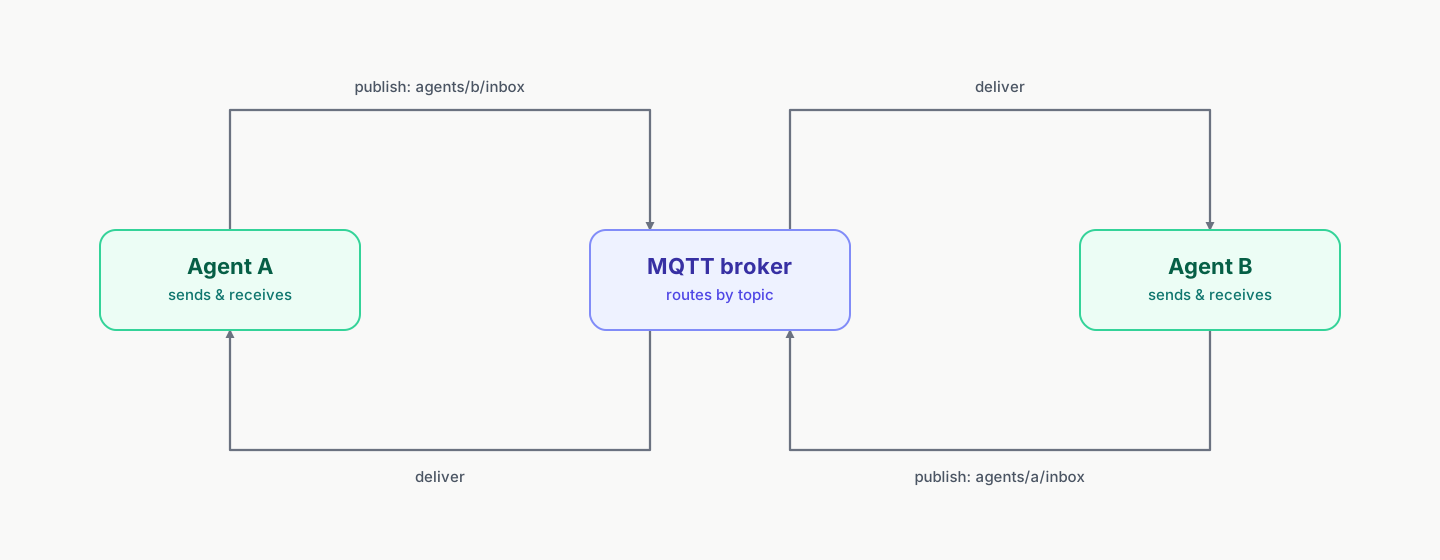
- Give each agent its own inbox topic, for example agents/{agent_id}/inbox, and a status topic for health checks.
- Use the MQTT 5 Response Topic and Correlation Data properties to simulate a request and response between two agents.
- Publish inbox messages with QoS 1 and use persistent sessions so a task request can survive a short agent restart.
What Are Possible Architecture Patterns for MQTT-Based Agent Systems?
Possible architecture patterns for MQTT-based agent systems include custom MCP-over-MQTT transports, broker-side AI processing, and hybrid setups that combine both. Each pattern places agent logic and MQTT routing at a different layer of the stack.
| Pattern | Where logic runs | Best fit |
|---|---|---|
| MCP-over-MQTT | Agents use a custom MQTT transport for Model Context Protocol | Teams extending MCP tool calls with a non-standard transport |
| Broker-side AI processing | Broker plugins classify or route messages before delivery | High message volume, low agent-side compute |
| Hybrid | MCP semantics at the agent, routing rules at the broker | Mixed fleets with legacy and new agents |
See Every Agent Message from One Dashboard
Cedalo's Management Center provides visibility into topics, clients, and message flows through your broker, so you can verify the message flows for each pattern before production.
How Do You Secure and Govern Agentic Communication over MQTT?
TLS or mutual TLS encrypts configured connections, role-based access control limits what each agent can publish or subscribe to, and audit trails record configured events for compliance review.
- TLS or mTLS on port 8883 encrypts traffic and, with mTLS, verifies both sides of the connection.
- Role-based access control limits which topics each agent can publish or subscribe to, so a compromised agent can be prevented from reading unauthorized inbox topics.
- Audit trails can record configured connection, publish, and subscribe events, supporting evidence for applicable NIS2 reviews and internal security audits.
- Policy management per agent identity lets you revoke or restrict a single agent without touching the rest of the fleet.
Each of these controls operates at the broker or transport layer, which keeps enforcement centralized across every agent implementation. That matters once you run agents built by different teams or vendors, since one security policy can then be applied consistently across integrated clients.
How Does MQTT Scale Across Large Agent Communication Networks?
Broker clustering, multi-broker management, and a unified namespace are what make this possible, giving every agent a predictable topic structure regardless of which broker it connects to. Clustering is a capability of Pro Mosquitto, Cedalo’s commercial broker; multi-broker management comes with the Management Center, which manages both open-source Eclipse Mosquitto and Pro Mosquitto brokers. Open-source Eclipse Mosquitto provides the broker, TLS/mTLS, authentication (including dynamic-security ACLs), and the MQTT broker-to-broker bridge.
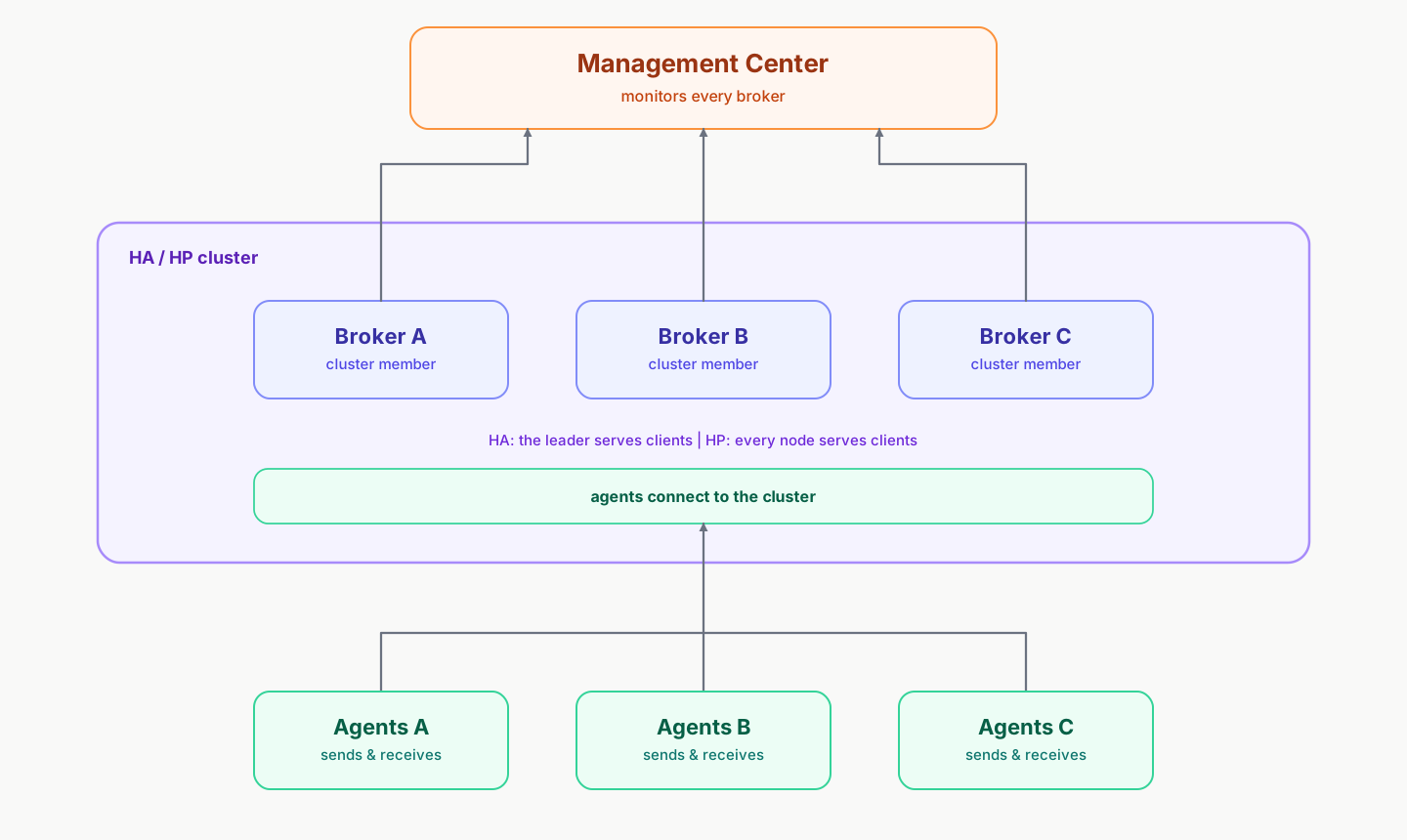
- Clustering provides failover and, in high-performance mode, distributes load across broker instances.
- Multi-broker management gives you one control plane over brokers deployed close to different agent groups.
- A unified namespace keeps topic structure consistent as an AI agent communication network grows from dozens to thousands of agents.
How Do You Integrate MQTT Agent Communication into Existing Systems?
You integrate MQTT agent communication into existing systems through bridges that connect edge brokers to central platforms, so cloud platforms, and - via connectors or bridges - systems such as SCADA or ERP, can consume the same MQTT data. The MQTT broker-to-broker bridge ships with open-source Eclipse Mosquitto; data bridges to non-MQTT systems such as Kafka or databases are a Pro Mosquitto feature.
If you’re new to the protocol itself, the MQTT protocol guide covers the fundamentals, and the beginner’s guide to MQTT connections walks through setting up your first client. Industrial deployments that need standardized payload structures alongside agent traffic typically add Sparkplug B for state and metric reporting.
Make MQTT the Foundation Your Agent Fleet Can Grow On
An agent-to-agent communication protocol built on MQTT gives you delivery semantics, access control, and a topic structure that scales from a handful of agents to a large fleet. Security and compliance controls can be implemented across the transport, broker, identity, and application layers instead of only inside each agent.
The architecture patterns you choose today, whether a custom MCP-over-MQTT transport or broker-side AI processing, can run on the same broker infrastructure as your existing industrial MQTT traffic.
Your benefits with Cedalo:
- You get a Management Center that shows connected agents’ status and message flows in one place.
- You run on Eclipse Mosquitto, the open-source broker with over 600 million Docker pulls, backed by Cedalo’s enterprise support.
- You scale through clustering and multi-broker management while keeping your existing agent topic structure intact.
- You govern agent access through role-based permissions and audit trails that come built into the platform.
Trace Which Pattern Handles Each Agent Message
Cedalo's Management Center lets you inspect topic routing live, so you can trace message flows associated with each implemented architecture pattern before production.
AI Agent Communication Protocol over MQTT: Frequently Asked Questions
What’s the difference between MQTT QoS 1 and QoS 2 for agent messages?
QoS 1 uses at-least-once delivery semantics, which can mean duplicates during a reconnect. QoS 2 uses exactly-once delivery semantics at the MQTT protocol level through an additional handshake, with more overhead and potentially higher latency.
Can AI agents communicate over MQTT without a cloud connection?
Yes. You can run a broker entirely on local infrastructure or at the edge, so MQTT message traffic between agents on the same network can remain on-site. Cloud connectivity becomes optional rather than required.
How does Cedalo’s Management Center help you monitor multiple AI agents?
It provides live visibility into connected clients, topics, and message flows across your brokers. You can see which agents are active, inspect available message payloads, and identify permission issues before or during production use.
What onboarding support does Cedalo provide for enterprise MQTT deployments?
Cedalo’s team supports your rollout with configuration guidance, access to enterprise documentation, and direct support channels for the Cedalo MQTT Platform. Support scope depends on your plan and deployment size.
Is MQTT suitable for real-time voice or video data between agents?
MQTT handles structured messages and events well but isn’t built for continuous media streams. Most agent architectures pair MQTT for control and status messages with a dedicated media transport for voice or video payloads.