OT security protects the industrial control systems, SCADA platforms, and IIoT devices that run physical operations. Compared with many IT environments, it places particular emphasis on uptime and physical safety alongside data confidentiality, and it demands a different approach to patching, monitoring, and access control.
OT security: key takeaways
- OT security protects the availability and safety of industrial control systems, SCADA, and IIoT devices, placing particular emphasis on uptime alongside data confidentiality.
- A priority-based OT security program moves from asset visibility through risk assessment, segmentation, access control, monitoring, and incident response.
- Securing MQTT and IIoT data flows requires TLS/mTLS encryption, authenticated broker access, role-based permissions, and structured logging.
- Cedalo’s MQTT Platform builds on the TLS/mTLS encryption and authentication already in Eclipse Mosquitto, and adds role-based access control, clustering, and the Management Center for Mosquitto to secure OT/IT data communication.
What is OT security and how does it differ from IT security?
OT security covers the policies, technologies, and controls that protect the systems running physical processes, from programmable logic controllers (PLCs) and SCADA systems to industrial sensors and the IIoT devices that connect them to the cloud. Its goal is to keep production running safely, not just to keep data confidential.
IT security and OT cyber security share tools like firewalls and access control, but they face different priorities. IT environments often emphasize confidentiality and rapid patching. OT environments place particular emphasis on availability and safety, because a stopped controller can halt an entire production line or trigger a safety event.
| Aspect | OT security | IT security |
|---|---|---|
| Primary priority | Availability and safety | Confidentiality and data integrity |
| Typical system lifespan | 15–20+ years | 3–5 years |
| Patch approach | Scheduled maintenance windows | Frequent, often automated |
| Common protocols | Modbus, OPC UA, MQTT, Profinet | HTTP, TLS, standard IP protocols |
| Consequence of failure | Production stop, safety incident | Data breach, financial loss |
Industrial environments increasingly connect OT and IT environments, which means SCADA systems built decades ago now exchange data with cloud platforms, ERP systems, and analytics tools. That convergence can create significant OT security gaps.
Why does weak OT security put industrial operations at risk?
Weak OT security exposes production systems that were never designed to face external networks. The consequences reach beyond data loss into physical safety and operational continuity.
Three factors drive this risk:
- Legacy controllers often run firmware that vendors no longer patch, leaving known vulnerabilities open for years.
- IT/OT convergence connects previously isolated production networks to corporate IT and the internet, expanding the attack surface without adding equivalent OT protection.
- Regulatory pressure is rising fast. NIS2 requires in-scope entities to implement cybersecurity risk management and incident reporting, while the Cyber Resilience Act introduces cybersecurity requirements for products with digital elements, with reporting obligations applying from September 11, 2026.
A successful attack on OT infrastructure can shut down a production line, trigger a safety shutdown, or damage physical equipment. Generic OT protection advice built for office IT rarely accounts for these consequences. Industrial teams need an OT-specific approach instead of a repurposed IT security checklist.
How do you build an OT security strategy? (priority implementation model)
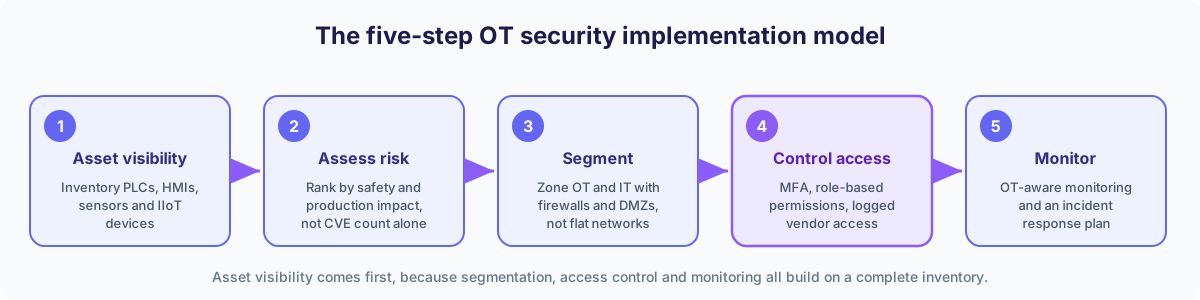
An effective OT security strategy can follow a practical sequence: mapping assets supports effective segmentation, access control, and monitoring. Five steps can turn a vague security goal into a concrete implementation plan.
Step 1: build complete asset visibility
Start by inventorying every device on your OT network. PLCs, HMIs, sensors, gateways, and any IIoT device that publishes or subscribes to data. Passive network scanning tools identify devices without disrupting production, which matters in environments where an active scan could interrupt a running process. Document firmware versions, communication protocols, and network segments for each asset, since this inventory becomes the foundation for every step that follows.
Step 2: assess and prioritize risks
Rank assets by the impact a compromise would have on safety, production, and compliance, not by generic vulnerability scores alone. A legacy PLC controlling a critical process deserves more attention than an idle sensor on a decommissioned line, even if the sensor shows more CVEs. Focus remediation effort on the assets where downtime or manipulation carries the highest operational consequence.
Step 3: segment OT and IT networks
Network segmentation limits how far an intrusion can spread once it reaches your OT environment. Group assets into zones by function and criticality, then control traffic between zones with firewalls and demilitarized zones (DMZs) rather than flat, fully connected networks. Strong OT network security treats every connection between IT and OT zones as a controlled crossing point, not a default path.
Step 4: control access to critical systems
Limit who can reach OT systems, and log every access attempt. Multi-factor authentication for remote access, role-based permissions for engineers and vendors, and separate credentials for OT versus IT systems close the most common entry points attackers use. Vendor remote access deserves particular attention, since third-party maintenance connections are a frequent source of OT incidents.
Step 5: monitor continuously and prepare incident response
Deploy monitoring that understands OT protocols, since standard IT monitoring tools often can’t interpret Modbus or OPC UA traffic. Set clear alert thresholds for anomalous behavior, and build an incident response plan that accounts for OT-specific constraints: you may need to keep a process running safely during containment rather than shutting it down immediately, unlike a typical IT breach response.
How do you secure MQTT and IIoT data flows in OT environments?
MQTT connects sensors, controllers, and cloud applications across your OT infrastructure, and broker security sits at the center of protecting that data path. Generic OT security guides mention MQTT in passing; securing it in practice requires four concrete controls.
Encrypting MQTT traffic with TLS and mTLS
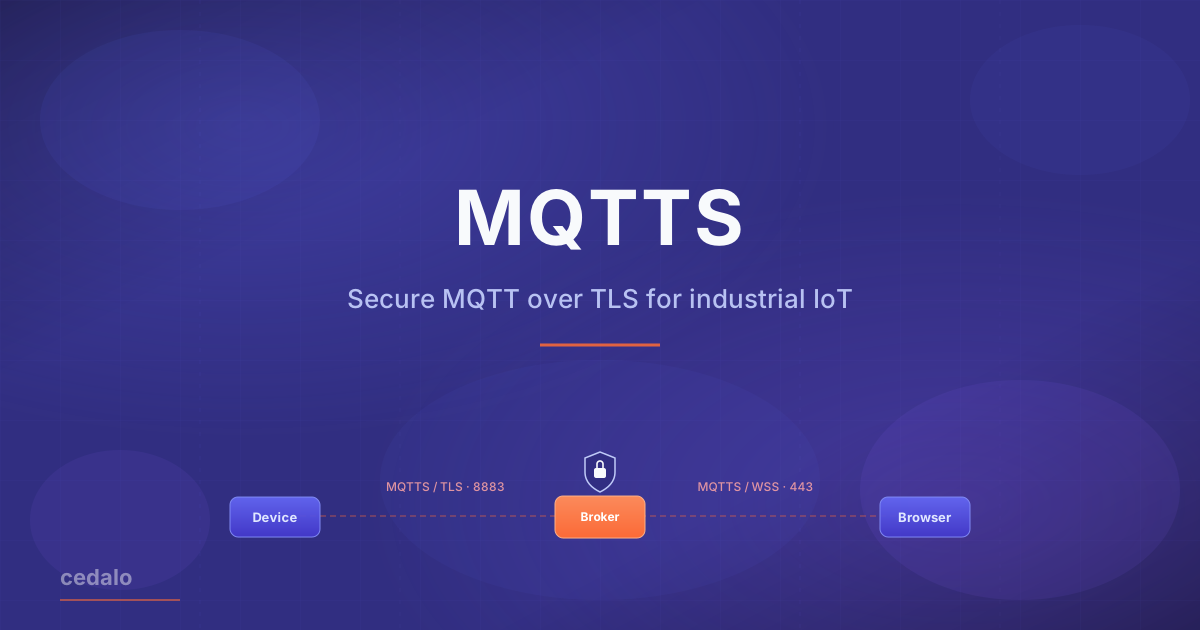
Encrypt every MQTT connection with TLS to prevent eavesdropping on production data as it moves between devices and your broker. For higher-security OT deployments, mutual TLS (mTLS) adds client-side certificates, so the broker verifies the identity of every connecting device instead of just encrypting the channel. Correct MQTT TLS configuration, from certificate generation to broker-side verification, helps ensure devices connect through the intended encrypted endpoints rather than unencrypted connections.
Authenticating and authorizing MQTT clients
Require authentication for every client and restrict what each one can publish or subscribe to. A sensor that only publishes temperature readings shouldn’t hold credentials that let it subscribe to control commands. Role-based access control at the topic level, covered in our guide to MQTT authentication and authorization, limits the damage a single compromised device can cause.
Monitoring and logging broker activity
Log every client connection, disconnection, and authentication failure on your broker, and set up alerts for unusual patterns like repeated failed logins or unexpected topic access. Structured Mosquitto broker logging gives your security team an audit trail that can support security monitoring and applicable compliance requirements.
Designing high-availability OT/IT architectures
A single broker instance creates a single point of failure for every device that depends on it. Depending on the clustering mode, multiple broker nodes can provide failover or distribute load, reducing the risk that a hardware failure interrupts data flow between your OT and IT layers.
Many teams pair this with a Unified Namespace architecture, which provides systems with a consistent data structure instead of point-to-point integrations that are hard to secure individually.
Turn OT security from a compliance task into an operational advantage
OT security succeeds when it treats availability and safety as key constraints alongside confidentiality. A priority-based rollout, from asset visibility through incident response, gives you a practical path instead of a vague checklist.
Once you can see every device on your OT network, segmentation and access control turn abstract risk into ranked, manageable actions. Encrypting and authenticating your MQTT and IIoT traffic closes the layer that most generic security guides skip entirely.
Your advantages with Cedalo:
- You secure MQTT communication with the TLS/mTLS encryption and authentication in open-source Mosquitto, plus role-based access control and audit logging on top.
- You control exactly who reaches which topic through role-based permissions instead of broker-wide credentials.
- You keep production running during failover with clustering and high availability built on Eclipse Mosquitto.
- You trace broker connections and monitor message flows through structured broker logging and monitoring.
Explore MQTT security with the Cedalo platform
See how encrypted authentication, access control, and clustering on Eclipse Mosquitto keep your production data flowing securely, even during a broker failure.
OT security – frequently asked questions
What is the difference between OT security and IT security?
OT security places particular emphasis on availability and physical safety, since a stopped controller can halt production or create a safety hazard. IT security often places greater emphasis on data confidentiality and integrity. The two disciplines can also differ in protocols, patch cycles, and risk tolerances.
Why can’t you patch OT systems the same way you patch IT systems?
Many OT systems run outdated operating systems or proprietary firmware that vendors no longer support, and an unplanned reboot can interrupt a production line. Teams schedule OT patches around planned maintenance windows and test them in staging environments first.
Does NIS2 apply to OT security?
Yes, NIS2 can apply to entities in sectors such as energy and the manufacturing of certain critical products, subject to applicable scope and size criteria. For in-scope organizations, relevant OT systems may fall within the systems covered by cybersecurity risk management, incident reporting, and supply chain security requirements.
What role does MQTT play in OT security?
MQTT connects sensors, controllers, and cloud applications across OT and IT layers. Broker security therefore sits at the center of protecting that data path through encrypted connections, authenticated clients, and access control on every topic.
How does Cedalo secure MQTT communication in industrial environments?
Cedalo’s MQTT Platform adds TLS and mTLS encryption, authenticated client access, and role-based permissions on top of Eclipse Mosquitto. Clustering can maintain broker availability during failover, and centralized logging gives your team visibility into broker connections.
How often should you review your OT security posture?
Review asset inventories and risk assessments at planned intervals, and reassess after significant device, vendor connection, or network changes. Continuous monitoring can help detect anomalies between formal reviews, and the two practices together improve security coverage.