IoT communication stacks are getting more complex: device fleets grow larger, network conditions vary more widely, and architecture decisions made today lock in operational costs for years. At the same time, teams want more control over protocol behavior, deployment location, and infrastructure ownership.
If you currently run MQTT, you have a protocol in place that handles broker-based pub/sub with a fixed header that starts at 2 bytes, persistent sessions, and QoS levels built for unstable networks. That may fit your architecture well. Or it may not anymore. The question is, does your current messaging protocol support the deployment model you need tomorrow?
Go directly to the MQTT Alternatives
Why Do Teams Look for MQTT Alternatives?
The strongest MQTT alternatives share one characteristic: they solve a problem that MQTT genuinely cannot address in a specific context. Four scenarios drive teams to look at alternatives to MQTT.
1. The device has no TCP stack
MQTT runs over TCP and maintains persistent sessions. Devices operating on 6LoWPAN, NB-IoT, or similar low-power radio networks often make TCP impractical due to power, memory, or transport constraints. In those cases, a UDP-based protocol can address a real hardware constraint more directly.
2. The architecture requires peer-to-peer real-time control
MQTT routes all messages through a central broker. Systems with microsecond latency requirements and deterministic timing constraints, such as robotics control planes or automotive safety systems, need direct peer-to-peer communication without a broker in the critical path.
3. The deployment is fully managed on a single cloud provider
Teams building entirely within AWS infrastructure that want to avoid operating broker clusters themselves find a managed connectivity service the more direct path. Device messages route directly into cloud pipelines without internal cluster management.
4. The use case is request/response, not event-driven
MQTT’s pub/sub model delivers events to subscribers. When devices communicate infrequently, transfer large payloads, or integrate with existing REST APIs, the overhead of a persistent broker connection produces no architectural benefit.
MQTT vs. IoT Protocol Alternatives at a Glance
| Option | Transport / Connectivity | Architecture | Broker Required | Device Fit | Primary Use Case |
|---|---|---|---|---|---|
| MQTT | TCP / TLS | Pub/Sub via Broker | Yes | TCP-capable IoT devices | IIoT, telemetry, Unified Namespace |
| CoAP | UDP | Request/Response + Observe | No | Highly constrained | 6LoWPAN, smart metering, low-power sensors |
| HTTP/REST | TCP | Request/Response | No | Any networked device | Cloud APIs, firmware updates, REST integration |
| DDS | UDP / TCP | Peer-to-Peer Pub/Sub | No | Powerful nodes | Robotics, automotive, real-time control |
| AWS IoT Core | MQTT, MQTT over WSS, HTTPS | Managed IoT Service | Abstracted | Cloud-connected IoT devices | Cloud Native IoT on AWS |
Fundamental Differences Between MQTT Alternatives
Protocols positioned as MQTT alternatives often address overlapping IoT requirements on paper. The real differences surface in three areas.
Broker-based vs. brokerless communication
MQTT routes all messages through a central broker that manages sessions, subscriptions, and fan-out. CoAP and DDS remove the broker entirely, placing routing logic directly between endpoints. This choice shapes failure recovery, consumer fan-out, and operational complexity.
Transport layer: TCP vs. UDP
MQTT, HTTP, and AWS IoT Core rely on TCP and its connection guarantees. CoAP and DDS operate over UDP, which removes persistent connection overhead but places reliability decisions at the application layer. This determines hardware compatibility and behavior on lossy networks.
Managed infrastructure vs. operational ownership
AWS IoT Core abstracts broker operations into a cloud service. The other options in this comparison require teams to make their own infrastructure choices and, in many cases, operate, scale, and maintain core components themselves, which can shift responsibility for upgrades, incident response, and compliance auditing to internal teams.
In a nutshell: what should you pay attention to?
- Communication model: Broker-based fan-out vs. direct endpoint communication
- Transport layer: TCP session guarantees vs. UDP efficiency on constrained hardware
- Operational ownership: Managed service abstraction vs. self-operated infrastructure control
- Protocol fit: IoT-native design vs. general-purpose protocols with IoT support
- Cost dynamics: Per-message billing vs. infrastructure-based cost under sustained growth
MQTT vs. CoAP: Which Protocol Fits Constrained Devices?
CoAP (Constrained Application Protocol) is the closest technical relative to MQTT. Both target IoT device communication, both keep protocol overhead minimal, and both appear in similar hardware environments. The architectural difference is fundamental: MQTT uses TCP and a central broker, CoAP uses UDP and direct endpoint communication.
Architecture
MQTT follows a centralized hub-and-spoke model. A broker sits between all publishers and subscribers, manages sessions, and handles fan-out. A single published message reaches thousands of subscribers without any additional client-side logic.
CoAP follows a REST-like request/response model. Clients communicate directly with resource endpoints. The Observe extension (RFC 7641) adds a subscription mechanism where a client registers interest in a resource and receives notifications when it changes, similar to a subscription but without a central distribution layer.
Transport and overhead
MQTT’s fixed header starts at 2 bytes over a persistent TCP connection. The TCP handshake happens once per session, and subsequent messages travel with minimal overhead.
CoAP messages fit within a single UDP datagram. The fixed header is 4 bytes minimum. With no TCP connection to maintain, CoAP suits devices that send data infrequently and cannot sustain a persistent connection. The trade-off is that UDP provides no built-in delivery guarantee, which CoAP addresses through confirmable and non-confirmable message types.
Message reliability and session behavior
MQTT provides three QoS levels: at-most-once (QoS 0), at-least-once (QoS 1), and exactly-once (QoS 2). Session persistence keeps subscriptions and queued messages alive across reconnections, which is particularly relevant for devices on intermittent cellular links.
CoAP handles reliability through confirmable messages. If the recipient does not acknowledge a confirmable message, CoAP retransmits it with exponential backoff. CoAP has no session layer; each exchange is stateless from the protocol’s perspective.
Security model
MQTT secures connections with TLS. CoAP uses DTLS, the datagram equivalent of TLS, which adds security overhead to UDP packets. Implementing DTLS on severely constrained hardware adds complexity that MQTT over TLS does not share.
When to use CoAP instead of MQTT
CoAP fits when devices have no TCP stack, operate on 6LoWPAN or NB-IoT, or run on microcontrollers with kilobytes of RAM where a persistent TCP connection is not feasible.
For architectures requiring broker-based fan-out to multiple consumers, session persistence across reconnections, or three-level delivery guarantees, MQTT covers those requirements where CoAP does not.
| Criterion | MQTT | CoAP |
|---|---|---|
| Transport | TCP | UDP |
| Broker required | Yes | No |
| Persistent session | Yes | No |
| Delivery guarantees | QoS 0/1/2 | Confirmable / Non-confirmable |
| Security | TLS | DTLS |
| Best fit | Device fleets with TCP, broker fan-out needed | Severely constrained devices, no TCP stack |
MQTT vs. HTTP: When Does REST Make More Sense Than Pub/Sub?
HTTP is the most widely understood protocol in IT. Teams evaluate it as an MQTT alternative when devices already communicate via REST APIs, when large payload transfers take priority, or when integration with existing web infrastructure matters more than optimized device communication.
Architecture
MQTT uses a broker-based pub/sub model. Publishers send messages to topics; the broker distributes them to all subscribers. No direct connection exists between publisher and subscriber. A single message from one device reaches multiple consumers simultaneously without client-side polling.
HTTP follows a request/response model. A client asks a server for data or sends data to it. Each interaction requires an explicit request. There is no native fan-out, no subscription layer, and no event-driven distribution without additional infrastructure.
Transport and overhead
MQTT’s 2-byte fixed header over a persistent TCP session keeps per-message overhead minimal. For devices sending hundreds of telemetry messages per hour, this efficiency compounds across millions of connections.
A typical HTTP/1.1 GET request carries 200 to 800 bytes of headers before any payload. HTTP/2 reduces this through header compression, but the request/response model still requires an active request for every data exchange. For high-frequency telemetry from many devices, this overhead accumulates. A detailed comparison of HTTP and MQTT for IoT covers these trade-offs in depth.
Message reliability and session behavior
MQTT’s QoS levels and session persistence handle delivery guarantees and reconnection behavior at the protocol level. Devices that reconnect after a network outage receive queued messages automatically.
HTTP provides no native delivery guarantee beyond the TCP acknowledgment. Applications implement retry logic, polling intervals, and state management themselves, which adds engineering effort and infrastructure complexity.
Security model
Both protocols support TLS. HTTP benefits from decades of tooling: load balancers, proxies, API gateways, and WAFs all understand HTTP traffic natively. MQTT over TLS requires brokers and clients that support the protocol, with less off-the-shelf infrastructure support in standard IT environments.
When to use HTTP instead of MQTT
HTTP fits IoT deployments where devices communicate infrequently, transfer large payloads such as firmware images or configuration files, or integrate with existing enterprise REST APIs. Browser-based management interfaces and cloud service integrations where standard web tooling handles routing and authentication also fit HTTP well. For continuous telemetry from many devices to multiple consumers, MQTT’s broker model handles that workload more efficiently.
| Criterion | MQTT | HTTP/REST |
|---|---|---|
| Communication model | Event-driven pub/sub | Request-driven |
| Connection behavior | Persistent, stateful | Stateless, per-request |
| Fan-out to multiple consumers | Native, via broker | Requires repeated requests |
| Offline handling | Session persistence | Manual retries |
| Best fit | Frequent small messages, multiple consumers | Infrequent communication, large payloads, REST APIs |
MQTT vs. DDS: Real-Time Control Without a Broker
DDS (Data Distribution Service) is an OMG standard for peer-to-peer data distribution. It targets a different architectural problem than MQTT: deterministic, low-latency communication between powerful processing nodes where a central broker would introduce unacceptable latency or become a single point of failure.
Architecture
MQTT centralizes all message routing through a broker. This model scales across large device fleets and simplifies subscription management, but it places the broker in every communication path.
DDS removes the broker entirely. Publishers and subscribers discover each other through a distributed discovery protocol and exchange data directly. Major implementations include Fast DDS by eProsima, RTI Connext DDS, and Eclipse Cyclone DDS.
Transport and overhead
MQTT runs over TCP. DDS operates over UDP or TCP depending on the transport plugin, with UDP as the default for real-time scenarios. The direct peer-to-peer path removes broker routing latency from the critical path, which matters in systems with microsecond timing requirements.
Message reliability and QoS
MQTT provides three QoS levels at the broker level. DDS defines more than 20 QoS policies at the individual data topic level, covering deadline enforcement, liveliness detection, history depth, transport priority, and durability. This fine-grained control suits systems where different data streams within the same architecture carry different timing and reliability requirements.
Security model
MQTT secures connections with TLS and manages access through topic-level ACLs. DDS provides per-topic security policies through the DDS Security specification, covering authentication, access control, and data encryption at the data writer and reader level. This granularity suits defense, aerospace, and automotive environments with strict data compartmentalization requirements.
When to use DDS instead of MQTT
DDS fits architectures with powerful processing nodes, strict real-time timing requirements, and peer-to-peer communication between systems that cannot tolerate broker-introduced latency. It appears in ROS 2, AUTOSAR Adaptive platforms, defense systems, and industrial control environments with deterministic timing constraints. For large device fleets sending telemetry to a central system with multiple consumers, MQTT’s broker model scales more efficiently with lower operational complexity.
| Criterion | MQTT | DDS |
|---|---|---|
| Architecture | Broker-based pub/sub | Peer-to-peer pub/sub |
| Transport | TCP | UDP / TCP |
| QoS granularity | 3 levels (broker level) | 20+ policies (per topic) |
| Broker required | Yes | No |
| Best fit | Large device fleets, telemetry aggregation | Real-time control, robotics, automotive |
MQTT vs. AWS IoT Core: Self-Hosted Broker vs. Managed Cloud Service
AWS IoT Core is not a separate protocol. Devices can connect via MQTT, MQTT over WebSocket Secure, or HTTPS. The difference is in who operates the connectivity layer: your team or AWS. This distinction determines operational effort, deployment flexibility, cost predictability, and architectural control.
Deployment and operational model
A self-hosted MQTT broker, whether open-source Mosquitto or Pro Mosquitto, runs on infrastructure that your team controls. That means full control over configuration, upgrade schedules, and incident response. It also means internal responsibility for availability, capacity planning, and operational tooling. Clustering is part of Pro Mosquitto, not open-source Mosquitto.
AWS IoT Core abstracts all of that. Device connections, session handling, message routing, and scaling run on AWS-managed infrastructure. Teams integrate directly with AWS services such as Lambda, Kinesis, S3, and DynamoDB without operating broker clusters.
Security and identity management
A self-hosted MQTT broker supports TLS, RBAC, and audit trails configured to your specification. Identity management integrates with your existing infrastructure, whether on-prem LDAP, an internal PKI, or a custom authentication service.
AWS IoT Core integrates with AWS IAM and AWS Certificate Manager. Device certificates, policies, and access rules follow AWS semantics. For teams already operating within AWS, this alignment reduces configuration effort. For teams with on-prem identity infrastructure, it adds a dependency on AWS services for device authentication.
When to use AWS IoT Core instead of a self-hosted broker
AWS IoT Core fits cloud-native IoT workloads built entirely around AWS, where device messaging connects directly to cloud data pipelines and teams prefer to avoid internal broker operations. Deployments with on-prem requirements, air-gapped environments, edge nodes, or multi-cloud infrastructure follow different architectural paths where a self-hosted broker with flexible deployment options covers the requirements that AWS IoT Core does not.
| Criterion | Self-hosted MQTT | AWS IoT Core |
|---|---|---|
| Broker operations | Internal team | AWS-managed |
| Deployment flexibility | Edge, on-prem, cloud, hybrid | AWS cloud only |
| Cost model | Infrastructure-based (fixed) | Consumption-based (variable) |
| Identity management | Custom / on-prem | AWS IAM |
| Best fit | Multi-environment, on-prem, air-gapped | Cloud-native AWS deployments |
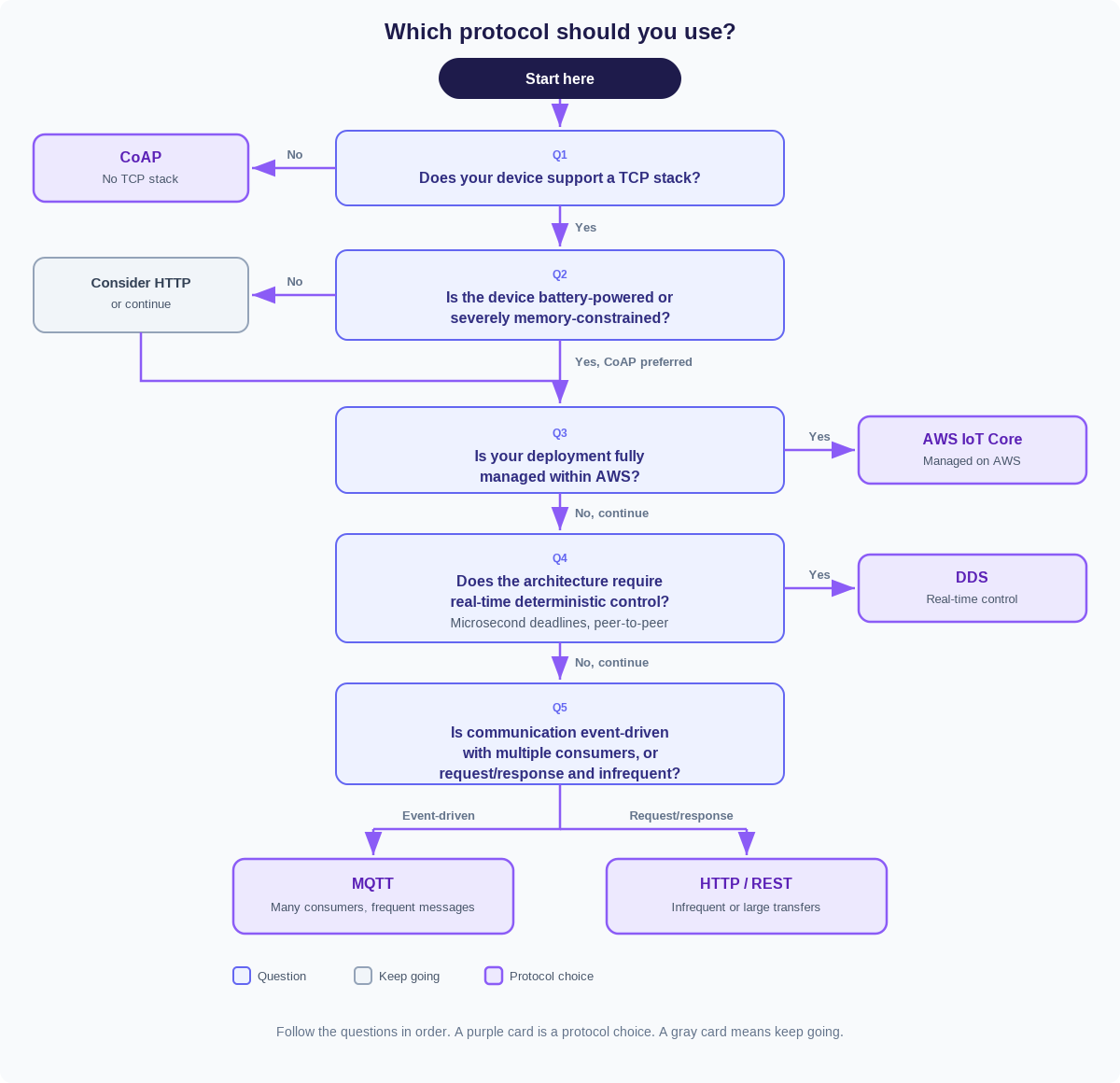
How to Choose the Right MQTT Alternative: A 4-Step Decision Process
The decision between MQTT and an alternative rarely hinges on a single criterion. Work through the following four steps to identify which protocol or platform fits your specific architecture.
Step 1: Assess Your Device Hardware
Devices with full TCP stacks and adequate RAM run MQTT without architectural friction. Devices on 6LoWPAN or NB-IoT with kilobytes of RAM face a structural mismatch with TCP-based protocols, making CoAP’s UDP-based design the more appropriate fit.
Key questions
- Does the device support TCP, or is it limited to UDP?
- What is the available RAM on the target hardware?
- Does the device run on battery power with strict energy budgets?
Step 2: Define Your Delivery Requirements
Identify what your use case actually needs before evaluating alternatives. Microsecond-level deterministic control points toward DDS. Standard telemetry aggregation from device fleets fits MQTT’s three QoS levels directly.
Key questions
- Does message loss have operational consequences?
- Do consumers need deterministic latency guarantees?
- Is event replay or long-term message retention required?
Step 3: Clarify Your Operational Ownership Model
Self-hosted brokers give full control over configuration and incident handling. Managed services reduce internal effort but create provider dependency. Mixed environments need a platform that operates consistently across edge, on-prem, and cloud.
Key questions
- Who operates and maintains the broker infrastructure?
- Does the deployment include air-gapped or edge environments?
- What is the acceptable level of vendor dependency?
Step 4: Map Your Security and Compliance Profile
TLS, RBAC, and audit logging cover most IIoT compliance requirements. The relevant question is how these mechanisms integrate with your existing identity infrastructure. AWS IoT Core aligns with AWS IAM; a self-hosted MQTT platform with RBAC fits regulated on-prem environments.
Key questions
- Does your compliance framework require full audit trails?
- Which identity infrastructure is already in place?
- Are there data residency requirements that exclude managed cloud services?
When MQTT Remains the Right Choice for IoT
The clearest signal to stay with MQTT is a device fleet that connects over TCP, produces frequent small messages, and distributes data to multiple consumers in parallel. MQTT’s broker model handles fan-out to thousands of subscribers from a single published message without any additional client-side logic. Session persistence keeps subscriptions and queued messages alive across reconnections, which matters on cellular and industrial networks with intermittent connectivity.
| Use Case | Protocol | Why MQTT Does Not Fit Here |
|---|---|---|
| Microcontrollers without TCP stack, 6LoWPAN, NB-IoT | CoAP | TCP persistent session not feasible; UDP fits hardware constraints |
| Infrequent communication, firmware updates, REST API integration | HTTP/REST | Pub/sub overhead without event-driven benefit; request/response model sufficient |
| Robotics, AUTOSAR Adaptive, real-time control systems | DDS | Broker latency unacceptable; per-topic QoS policies required |
| Cloud-native workloads fully within AWS | AWS IoT Core | Self-operated broker unnecessary; managed routing into AWS pipelines preferred |
Teams running MQTT in production and hitting scalability, security, or operational limits often find that an enterprise broker platform addresses those gaps without a protocol change. A switch to a different protocol carries migration cost in device firmware and client libraries.
For teams that need to connect MQTT data to backend event streaming, a Kafka bridge adds that capability without replacing the broker layer.
Take Mosquitto to Production: Without Rebuilding What Works
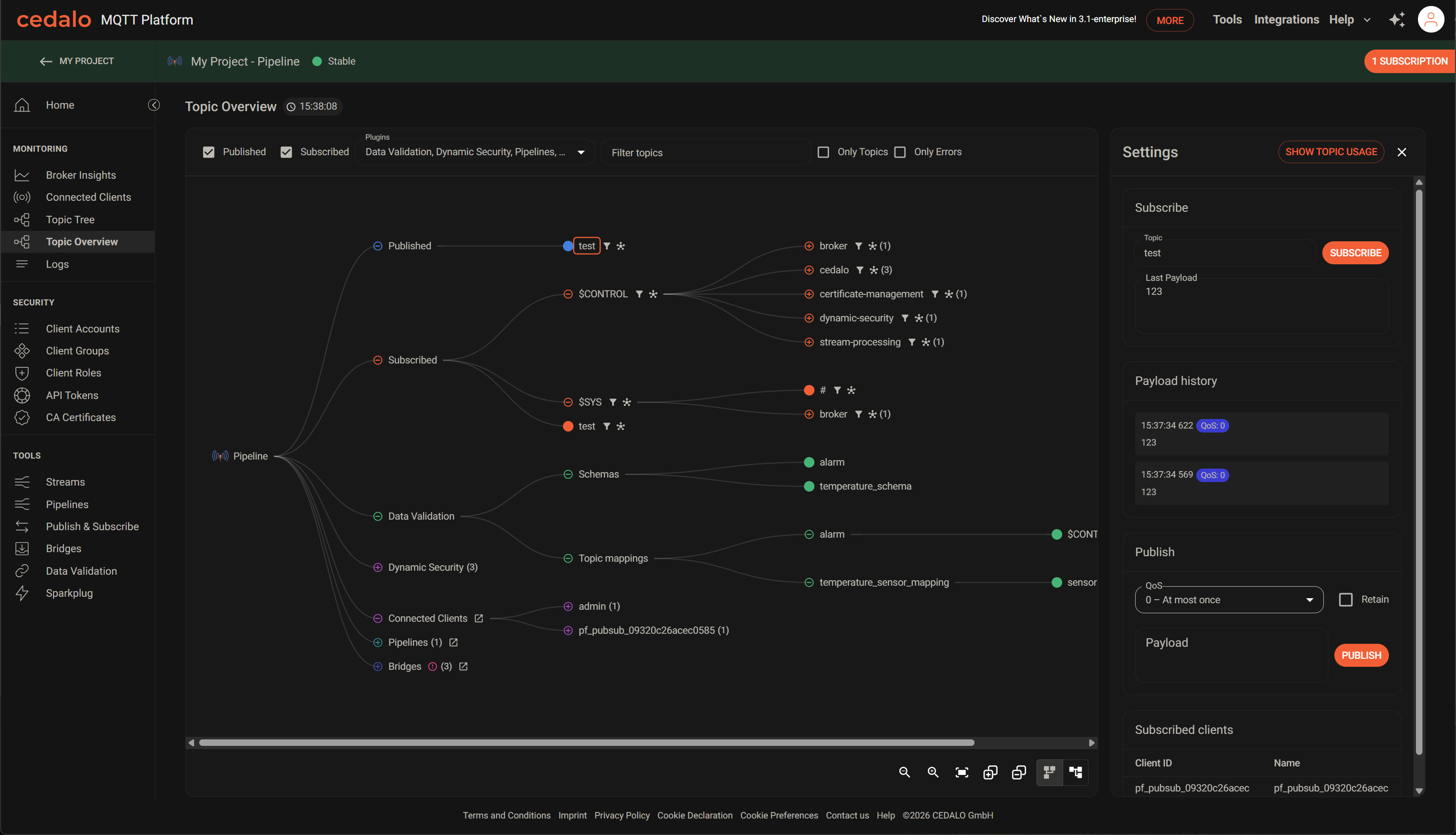
The Cedalo MQTT Platform extends Mosquitto with coordinated clustering, centralized fleet management, and runtime security controls. Configuration, access rules, and monitoring run through the Management Center. Certain runtime security changes take effect without broker restarts, and critical administrative changes are logged for compliance purposes.
Cedalo Strengths
- Mosquitto-based core: Protocol behavior follows a widely adopted reference implementation used in production environments worldwide
- Clustered operation: Coordinated brokers with shared state awareness and automatic failover
- Runtime security management: Role-based access control and audit trails without service interruption
- Deployment flexibility: Edge, on-prem, cloud, and hybrid setups under the Management Center
Pricing
Cedalo offers cloud-based service options and customizable enterprise contracts aligned with connection scale, infrastructure requirements, and operational setup. A free tier is available for teams that want to connect existing Mosquitto brokers to the Management Center. Enterprise agreements include dedicated infrastructure, SLA definitions, and defined support levels.
Already running Mosquitto? Add the enterprise layer.
Cedalo extends Eclipse Mosquitto with clustering, centralized management, and runtime security controls, without changing your existing device firmware, topic structures, or client libraries.
MQTT Alternatives: Frequently Asked Questions
What is the most lightweight alternative to MQTT for IoT?
CoAP (Constrained Application Protocol) is the most direct lightweight alternative. It uses UDP instead of TCP, requires no broker, and operates with a 4-byte fixed header. CoAP fits microcontrollers and 6LoWPAN devices where a TCP stack is not available.
Can MQTT and HTTP be used together in the same IoT architecture?
Yes, and many production architectures combine both. MQTT handles continuous device telemetry over persistent connections, while HTTP covers configuration endpoints, firmware updates, and cloud API integrations. The two protocols serve different communication patterns and complement rather than replace each other.
What protocol do robotics systems like ROS 2 use instead of MQTT?
ROS 2 uses DDS (Data Distribution Service) as its default communication layer. DDS operates peer-to-peer without a central broker and supports more than 20 QoS policies per data topic, making it the standard for real-time robotic control systems with deterministic latency requirements.
Does switching from MQTT to another protocol require changing device firmware?
In most cases, yes. A protocol switch requires updates to client libraries, device firmware, and potentially hardware selection if the new protocol demands a different transport layer. This migration cost is one of the primary reasons teams evaluate enterprise MQTT platforms before committing to a full protocol change.
How does Cedalo differ from switching to a different IoT protocol entirely?
Cedalo does not replace MQTT. The Cedalo MQTT Platform adds clustering, centralized fleet management, and runtime security controls on top of Eclipse Mosquitto, so existing device firmware, topic structures, and client libraries remain unchanged. It addresses operational limits of open-source Mosquitto without a protocol migration.
Which MQTT alternative is best suited for cloud-native IoT deployments on AWS?
AWS IoT Core is best understood as a managed IoT service rather than a separate protocol. It accepts MQTT, MQTT over WebSocket Secure, and HTTPS connections while abstracting broker operations into an AWS-managed service. It fits teams that prefer managed infrastructure over self-operated broker clusters within AWS environments.
Can Cedalo integrate with non-MQTT systems and protocols?
Yes. The Cedalo MQTT Platform integrates with Apache Kafka, relational and NoSQL databases, AWS, Azure, and GCP. SCADA systems can consume the same MQTT data. This makes Cedalo relevant not only for pure MQTT architectures but also for hybrid environments where MQTT connects device data to broader enterprise data infrastructure.