Many teams start AI or LLM projects by connecting models directly to databases, APIs, or data lakes. That works for prototypes and for LLM applications such as retrieval over documents, but it breaks down when machines and devices produce continuous event streams across sites and networks.
MQTT offers a different approach. Instead of pulling data for AI, it provides a live event backbone that feeds models with fresh signals and distributes inference results back into operational systems.
MQTT and AI: Key takeaways
- MQTT provides a real time event backbone that feeds AI systems with live data and distributes inference results to many consumers.
- Clear topic separation between raw data, features, and inference results is essential to keep AI pipelines scalable.
- Persistent governance of topics, payload structure, and access rights prevents operational chaos as AI workloads grow.
- Reliable MQTT operations across sites are critical because AI systems depend on consistent and observable data streams.
MQTT uses in AI and LLM applications
AI and LLM systems depend on continuous, structured, and timely data. MQTT provides an event driven backbone that delivers this data reliably from devices and systems to consumers without tight coupling.
Why MQTT fits AI and LLM workloads
- Real time event streams instead of periodic polling
- Decoupled producers and consumers through topics
- Lightweight transport for device and gateway connectivity that feeds AI services
- Ability to distribute inference results back to many systems at once
- Support for large numbers of devices and data sources across sites
How MQTT is typically used in AI pipelines
- Gateways and MQTT-capable devices publish telemetry and state changes to MQTT topics
- AI or feature extraction services subscribe to these topics and process the data
- Inference results or insights are published back to dedicated topics
- Dashboards, alerting systems, or enterprise platforms subscribe to the results
- Historical data may be forwarded from MQTT to data lakes or streaming platforms for training purposes
Note
In practice, “MQTT AI” does not mean that AI runs inside the broker. It describes an architecture where MQTT acts as the event backbone that connects data producers, AI services, and downstream systems in a consistent way. AI becomes another class of MQTT client that consumes live data streams and publishes derived insights back into the same topic space.
How does an MQTT based AI pipeline work end to end?
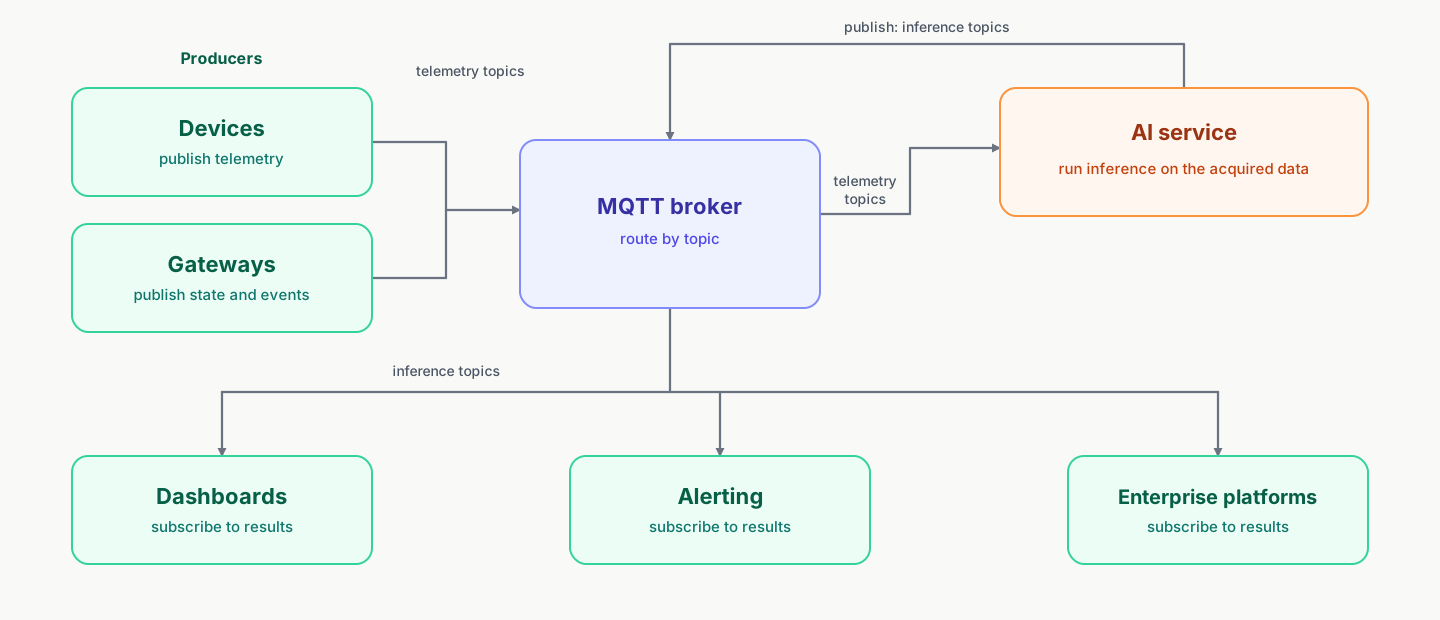
An MQTT based AI pipeline separates data producers, AI processing, and data consumers through topics. This avoids point to point integrations and allows multiple systems to use the same event streams for different purposes.
| Stage | Purpose | Typical component |
|---|---|---|
| Data production | Publish telemetry, state, and events | Devices, PLCs, gateways |
| Event distribution | Route data to all interested consumers | MQTT broker |
| Feature consumption | Subscribe to raw topics and prepare data | AI or analytics service |
| Inference | Generate predictions or classifications | AI model service at edge or cloud |
| Result publication | Publish insights to dedicated topics | AI service |
| Downstream usage | Visualize, alert, store, or integrate | Dashboards, MES, data platforms |
Which architecture patterns work for MQTT and AI?
Not every AI workload interacts with MQTT in the same way. The right pattern depends on bandwidth, latency requirements, and where inference runs.
Integrated pattern: AI consumes and publishes via MQTT
The AI service subscribes to telemetry topics and publishes predictions or classifications back to MQTT. Other systems consume these results without needing direct integration with the AI component.
This pattern keeps the entire data flow inside the MQTT topic space and works well for centralized or cloud based inference.
Edge inference pattern: process locally, publish only results
Inference runs close to the device or gateway. Only the results, alerts, or aggregated data are published to MQTT.
This reduces bandwidth usage and avoids sending raw data across networks.
Egress pattern: MQTT in, results to other systems
The AI service consumes MQTT topics but publishes results to other systems such as databases, APIs, or streaming platforms.
This is common when AI is tightly coupled with data science platforms but still relies on MQTT for live input.
How should you model topics and payloads so AI stays scalable?
AI systems depend on consistent, well structured data. If topics and payloads evolve without rules, feature extraction, model training, and inference quickly become unreliable.
Topic structure should separate
- Raw telemetry from devices
- Derived features used by AI services
- Inference results and alerts for downstream systems
This separation prevents AI workloads from depending directly on operational topics that may change over time.
Payload design should include minimum context
- Timestamps with clear time reference
- Asset or device identifiers
- Units and state meaning
- Version information for backward compatibility
Why this matters
AI models rely on stable input definitions. Without predictable topic and payload structure, every change in the MQTT landscape creates additional work for data and AI teams.
What data quality and context does AI need from MQTT streams?
A timestamp without a clear time reference, a number without a unit, or a signal without an asset identifier forces AI teams to guess. This causes unstable features, weak models, and results that cannot be trusted operationally.
Build a reliable MQTT backbone for your AI workloads
See how Cedalo helps you operate secure, observable, and scalable MQTT infrastructures that AI pipelines can depend on.
Context must travel with the event. This includes stable identifiers, normalized units, and clear state definitions so that feature extraction and inference stay consistent across devices and sites.
Data quality issues also show up as missing values, inconsistent sampling, or drifting sensors. AI services must detect these conditions and either correct them or avoid producing misleading predictions.
Where should inference run: edge, plant, or cloud?
The location of inference changes how MQTT streams are used and how much data needs to travel across networks. The decision depends on latency, connectivity, privacy, and cost.
| Location | When it fits best | Impact on MQTT usage |
|---|---|---|
| Edge | Fast decisions close to machines, limited bandwidth | Publish mostly results, not raw data |
| Plant or site | Local aggregation and analysis across multiple devices | Combine local streams before forwarding |
| Cloud | Fleet level analysis, model training, cross site comparison | Forward selected streams to cloud consumers |
Many real architectures use a hybrid approach. Inference runs at the edge for immediate actions, while the cloud consumes selected MQTT streams for analytics and model improvement.
How do you secure MQTT streams when AI needs broad access?
AI services often need access to many data streams, which makes them a common source of over-privileged MQTT permissions. If a single AI client can subscribe to everything, it becomes a high value target and a path for unintended data exposure.
A clean design separates raw data, features, and inference topics into distinct access domains. AI services should only access the topics they need for their specific function, not entire namespaces by default.
Minimum security baseline
- Use encrypted transport for AI clients and brokers
- Assign dedicated identities to AI services instead of shared credentials
- Apply least privilege topic permissions for subscribe and publish
- Separate device listeners from service listeners to avoid mixed trust zones
- Audit changes to client permissions and topic policies over time
How do you operate MQTT AI pipelines across sites and teams?
AI pipelines rely on stable event streams. Operations teams need visibility into how data flows, which clients consume it, and where bottlenecks appear.
Key operational signals to watch include broker publish and drop rates, queued-message growth, and connection stability of AI services. Without this visibility, teams only notice problems once models produce late or incorrect results.
To keep systems manageable across sites, topic structures, access policies, and listener configurations must remain consistent. Changes to payload structure or topic naming must follow a controlled process, because even small breaking changes can invalidate feature extraction and inference logic.
How Cedalo supports MQTT AI workloads at enterprise scale
AI services need reliable, governed event streams to produce useful results. As topic counts, consumers, and sites grow, the operational challenge shifts from building an AI model to running the MQTT backbone safely and consistently.
Cedalo builds on Eclipse Mosquitto and adds the management and control layer that helps teams operate MQTT infrastructures that AI pipelines can depend on.
With Cedalo you can:
- Manage brokers and environments centrally to keep topic and listener setups consistent
- Enforce role based access control so AI services subscribe and publish only where needed
- Gain visibility into client connections and operational behavior across sites
- Reduce configuration drift and make changes traceable through governed management
- Operate a production grade Mosquitto foundation for scalable event driven AI pipelines
Build a reliable MQTT backbone for your AI workloads
See how Cedalo helps you operate secure, observable, and scalable MQTT infrastructures that AI pipelines can depend on.
MQTT and AI – Frequently Asked Questions
How can MQTT feed real time data into AI and LLM systems?
MQTT delivers event streams as soon as devices and systems publish them, which allows AI services to consume fresh signals without polling databases or APIs. This event driven flow is especially useful for inference scenarios where timing and state changes matter.
Can AI systems publish results back into MQTT topics?
Yes, AI services can act like any other MQTT client and publish predictions, classifications, or alerts to dedicated topics. This allows dashboards, alerting systems, and enterprise platforms to consume AI results without direct integration to the AI component.
Why is topic design important when using MQTT for AI workloads?
AI pipelines rely on stable and predictable data structures. If raw telemetry, features, and inference results share the same topic space without rules, changes in one area can break data processing and model behavior.
Does MQTT replace data lakes or streaming platforms in AI architectures?
MQTT does not replace storage or analytics platforms. It provides the live event backbone that feeds those systems with real time data while allowing multiple consumers to access the same streams independently.
How do you prevent AI services from overloading MQTT brokers?
AI services should not subscribe to every raw data topic by default. Filtering, preprocessing, and clear topic separation reduce unnecessary traffic and keep broker load manageable. For several inference workers, MQTT 5 shared subscriptions let one message go to one worker in the group instead of a full copy to each.
How does Cedalo help operate MQTT infrastructures for AI pipelines?
Cedalo provides centralized visibility into brokers, clients, and topic access across environments. This helps teams understand how AI services interact with MQTT streams and maintain consistent configurations across sites.
How can Cedalo improve security when AI services access many MQTT topics?
Cedalo supports role based access control and governed client management. This ensures AI services only access the topics they need and prevents over-privileged connections in large MQTT environments.