Mosquitto MQTT is a proven open-source broker for IoT messaging. Production environments need more than a running broker: secure access, stable sessions, monitoring, high availability, and a clear path from edge devices to enterprise systems.
Mosquitto MQTT: Key takeaways
- Mosquitto MQTT usually refers to Eclipse Mosquitto, a lightweight open-source MQTT broker for publish/subscribe messaging between devices, applications, and cloud systems.
- Open-source Mosquitto fits development environments, edge gateways, local machine data, and IoT deployments with controlled client counts and clear operational boundaries.
- Production MQTT infrastructure requires security policies, persistent session handling, monitoring, capacity planning, failover design, and ownership for broker configuration changes.
- Cedalo builds on Eclipse Mosquitto with clustering, high availability, Management Center, RBAC, audit trails, integrations, and expert support for production IoT environments.
What Is Mosquitto MQTT?
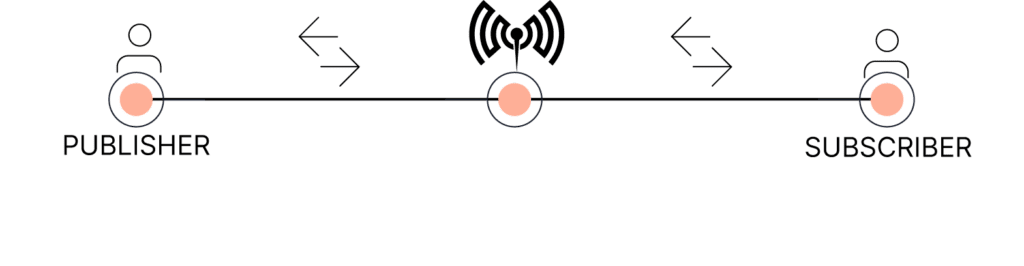
Mosquitto MQTT usually refers to Eclipse Mosquitto, an open-source message broker which implements the MQTT protocol. It is located between MQTT clients and receives published messages, routing them to subscribers that match the relevant topic. In practice, Mosquitto acts as the broker component in an MQTT architecture. Clients such as sensors, gateways, backend services, dashboards, and applications connect to it. Topics define where messages belong and which subscribers receive them.
When is Mosquitto MQTT the Right Broker Choice?
Mosquitto MQTT is the right broker choice when your team needs a lean, proven MQTT broker with a clear operating scope. It fits best when the system architecture, traffic pattern, and security requirements are known before the setup grows.
- You need a lightweight broker for development, testing, edge gateways, or controlled IoT deployments, where a basic Mosquitto Installation validates the setup.
- Your MQTT clients, topics, QoS behavior, and session handling can be tested before production rollout.
- Your client count, message rate, payload size, and traffic peaks are predictable enough for capacity planning.
- Your team can define topic naming rules, client ID patterns, authentication, and access control early.
- Your deployment does not yet require clustering, central multi-broker management, enterprise authentication, audit trails, or formal support.
Once those requirements become relevant, Mosquitto can still remain the broker foundation. The operating model around it needs to grow.
When Does Mosquitto MQTT Become Part of the Production Infrastructure?
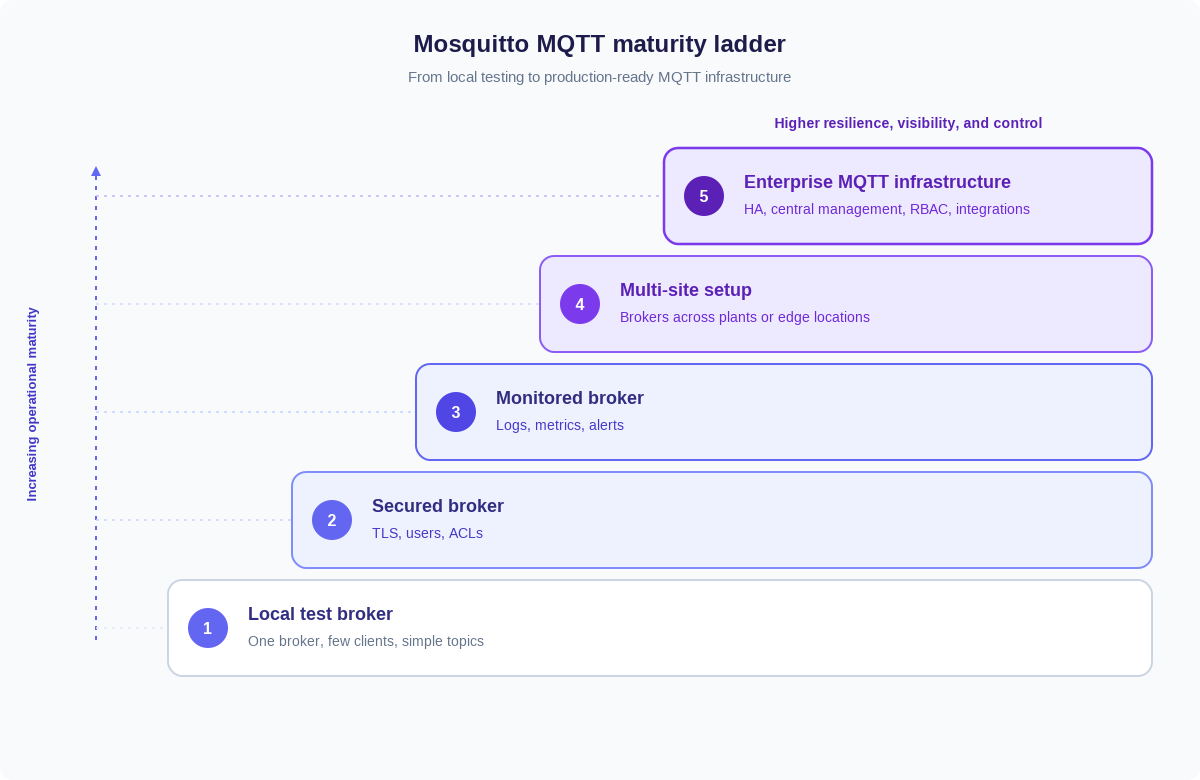
Mosquitto MQTT becomes part of the production infrastructure when the broker transfers operational data across devices, teams, sites, and downstream systems. At that point, the setup needs more than broker configuration. It needs security workflows, visibility, routing rules, failover planning, and ownership.
A production-ready Mosquitto setup typically adds these layers:
- Security: TLS encryption, Mosquitto authentication and authorization, ACLs, certificate handling, permission reviews, and repeatable access workflows.
- Monitoring: Logs, metrics, alerts, connection tracking, client churn, queue growth, publish rates, latency, authentication failures, and resource usage.
- Multi-site routing: Mosquitto Bridge setups help route selected topics between brokers. Teams also need namespace ownership, failover behavior, and clear responsibilities for each plant, edge location, or cloud environment.
- Enterprise operations: Clustering, high availability, central management, RBAC, audit trails, integrations, and professional support.
At this point Mosquitto shifts from a technical component to part of an operational data layer. The broker still handles MQTT messaging, but production success depends on the architecture and operating model around it.
How Does Mosquitto MQTT Work in Practice?
Mosquitto MQTT acts as a broker that receives MQTT packets from connected clients, verifies their connection and access rules, and routes each message to the matching subscribers. The broker does not need to understand the payload. It uses MQTT topics, subscriptions, QoS settings, retained messages, and session state to reliably move data through the system.
Mosquitto Runs as the Broker Process
In an active setup, Mosquitto is the server-side component. Devices, gateways, applications, dashboards, and backend services connect to it as MQTT clients.
The broker listens on configured ports, typically through listeners defined in the mosquitto.conf file. While port 1883 suffices for unencrypted MQTT in isolated test environments, production deployments typically rely on port 8883 for TLS-encrypted traffic, alongside strict authentication and topic-level access control.
Clients Publish and Subscribe Through Topics
Every MQTT client either publishes messages, subscribes to topics, or does both. When Mosquitto receives a published message, it checks which active subscriptions match the topic.
A practical Mosquitto example follows this publish/subscribe flow:
- A sensor publishes a temperature value to
factory/line1/machine3/temperature. - The Mosquitto Broker receives the message on the configured listener.
- The broker checks authentication, authorization, and topic permissions.
- Subscribed systems receive the message if their topic filter matches.
- A dashboard, database connector, SCADA system, or analytics service processes the data downstream.
This topic-based routing makes MQTT different from point-to-point integrations. A publisher does not need to know which systems consume the data. The broker separates data producers from data consumers.
Topics, Filters, and Wildcards Decide Where Messages Go
Mosquitto treats MQTT topics as hierarchical strings separated by slashes. A topic such as factory/line1/machine3/temperature creates a clear structure for site, line, asset, and signal.
Subscribers can listen to one exact topic or to a broader topic pattern:
factory/line1/machine3/temperature: Receives only this one temperature stream.factory/line1/+/temperature: Receives temperature data from all machines on line 1.factory/#: Receives all MQTT messages below the factory namespace.
In production, topic design becomes an architecture decision. A clean namespace helps teams control access rights, route data between sites, and connect downstream systems without custom mappings for every data source.
QoS, Retained Messages, and Sessions Control Delivery Behavior
Mosquitto also controls MQTT delivery behavior. Quality of Service (QoS) controls how strongly the broker and client try to deliver a message. Retained messages enable Mosquitto to store the latest value on a topic. This allows new subscribers to receive the current state immediately. Durable sessions allow subscriptions and queued QoS 1 or QoS 2 messages to survive a client disconnect.
| QoS level | Delivery | Broker behavior |
|---|---|---|
| QoS 0 | At most once | The message is sent once, with no acknowledgement. |
| QoS 1 | At least once | Delivery is acknowledged. Duplicates are possible. |
| QoS 2 | Exactly once | Client and broker complete a four-step handshake so the message arrives once. |
These settings decide how the broker behaves during unstable networks, device restarts, or temporary outages. For example, high-frequency telemetry often uses lower overhead, while alarms, status updates, or critical state changes need stronger delivery guarantees and clear duplicate-handling logic.
Configuration Files Define How the Broker Behaves
Mosquitto is controlled through configuration, not through application code inside the broker. The configuration defines listeners, persistence, logging, password files, ACLs, TLS files, bridges, plugins, and other broker behavior.
In small setups, a single configuration file may be enough. In production, configuration becomes operational work. Teams need version control, review processes, environment separation, restart planning, and ownership for every broker change.
Broker Metrics Show Whether the Setup is Healthy
Mosquitto exposes broker state through $SYS topics, managed by configuration and build options. These topics can include values such as connection counts, message rates, byte rates, dropped publications, and memory use.
That data helps teams understand whether the broker is merely operational or performing well. Rising connection churn, growing queues, increased dropped publishes, or unusual traffic spikes often reveal problems before users notice missing data.
How Cedalo Expands the Broker Layer
Open-source Mosquitto provides teams with a lean, proven broker core. A production MQTT Broker needs more around that core when uptime, security, auditability, and multi-broker operations matter. Cedalo builds on Eclipse Mosquitto and adds the enterprise layer around it: clustering, high availability, central management, RBAC, audit trails, monitoring, integrations, and direct expert support. This keeps teams close to the broker they already know while adding the operating model required for business-critical IoT infrastructure.
Which Mosquitto MQTT Settings Create Production Risk?
Mosquitto MQTT setups usually fail in production because small test-stage settings stay unchanged as the system grows. Client IDs, session policies, QoS levels, retained messages, and topic permissions need clear rules before the broker handles real operational data.
The highest-risk settings are:
- Client IDs: Duplicate client IDs can trigger reconnect loops because Mosquitto replaces the existing session when another client connects with the same ID. Use clear naming patterns for devices, gateways, services, and environments.
- Session policy: Persistent sessions help clients recover after disconnects, but they also create broker-side queues. Without expiry rules and queue limits, disconnected clients can leave growing state behind.
- QoS policy: Higher QoS levels add delivery guarantees, but they also increase traffic and processing overhead. Use QoS 1 or QoS 2 only where the data type, subscriber logic, and duplicate handling justify it.
- Retained message ownership: Retained messages help new subscribers receive the latest known state. They become risky when old values stay on topics without ownership, cleanup rules, or clear update logic.
- Topic and ACL model: Topic names directly affect access control, routing, and monitoring. A messy namespace makes ACLs hard to review and increases the risk of clients receiving or publishing data outside their intended scope.
These settings decide whether Mosquitto remains predictable under real load. In production, each one needs an owner, a review process, and monitoring signals that show when broker behavior drifts from the expected state.
What Does a Production-Ready Mosquitto MQTT Architecture Need?
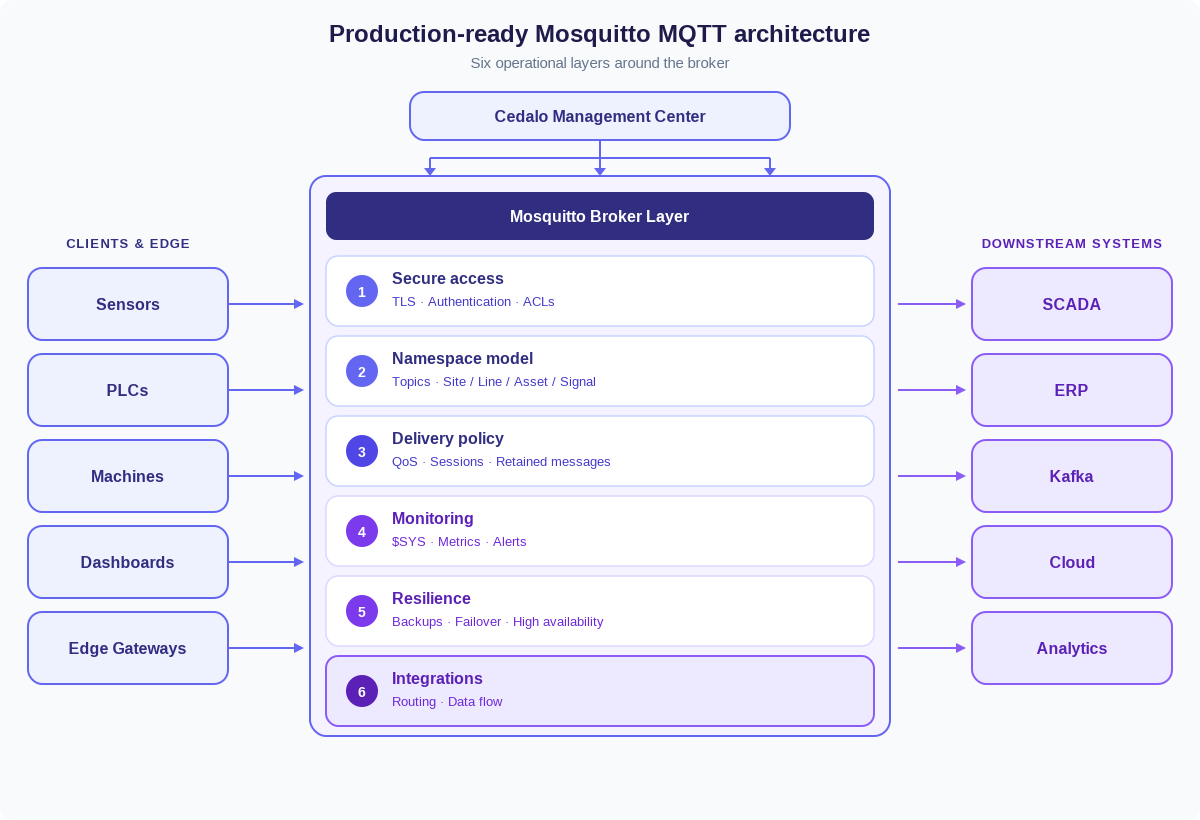
A production-ready Mosquitto MQTT architecture needs clear layers around the broker: secure client access, predictable topic structures, monitored broker behavior, resilient deployment patterns, and controlled integration into downstream systems.
The broker remains as the routing core. The architecture around it decides whether MQTT traffic stays reliable when devices reconnect, sites grow, teams change configurations, or backend systems consume the same data stream.
A practical production setup includes:
- Secure access layer: TLS-secured listeners, client authentication, ACLs, certificate handling, and repeatable permission reviews.
- Topic and namespace model: A clear structure for sites, lines, assets, signals, and environments so teams can route, monitor, and protect MQTT data consistently.
- Session and delivery policy: Rules for persistent sessions, QoS levels, retained messages, queue limits, expiry behavior, and duplicate handling.
- Monitoring layer: Metrics, logs, alerts, client connection status, queue growth, traffic patterns, authentication failures, and resource usage.
- Resilience layer: Broker restart planning, backup strategy, failover behavior, clustering, and high availability where MQTT data supports critical operations.
- Integration layer: Connections to analytics, Kafka, databases, and cloud platforms so MQTT data reaches the systems that need it, including SCADA and ERP consumers.
This architecture turns Mosquitto from a single broker into a controlled data layer. Teams gain a clearer operating model, fewer blind spots, and a stronger basis for scaling MQTT across industrial and large-scale IoT environments.
Why Your Mosquitto MQTT Architecture Depends on the Broker Layer
Devices, gateways, and applications appear stable in controlled tests. The real difference is only visible at the broker layer: this is where client access, message routing, sessions, delivery behavior, security, monitoring, and integrations meet.
Teams that design this layer well can scale from local Mosquitto setups to production MQTT infrastructure with fewer operational blind spots. Teams that leave broker operations unmanaged often face reconnect loops, unclear topic ownership, manual security reviews, missing visibility, and fragile multi-site routing.
Your advantages with Cedalo:
- You keep the Mosquitto foundation your engineers know: Cedalo builds on Eclipse Mosquitto, so teams can extend an existing broker skill set instead of moving to an unfamiliar MQTT stack.
- You reduce downtime risk in production MQTT environments: Clustering and high availability help keep MQTT infrastructure available when broker nodes, sites, or network paths create operational pressure.
- You gain one control layer for broker operations: The Cedalo Management Center gives teams a central place for broker management, monitoring, configuration, and troubleshooting across MQTT environments.
- You strengthen security and traceability: RBAC, TLS, audit trails, and enterprise authentication patterns help teams control access and document broker activity.
- You connect MQTT data to enterprise systems: Cedalo supports integrations with Kafka, databases, and cloud platforms, so MQTT data can move into operational and analytics workflows.
Run Mosquitto MQTT in Production with Cedalo
Add clustering, security, monitoring, and central management to the Mosquitto broker foundation your engineers already know.
Mosquitto MQTT: Frequently Asked Questions
Can Mosquitto MQTT Run in Industrial IoT Environments?
Mosquitto MQTT can run in industrial IoT environments when the deployment has clear rules for security, topics, sessions, monitoring, and availability. Edge gateways, machine data flows, and OT-to-IT communication are common use cases, but larger environments need a stronger operating model around the broker.
What Is the Difference Between Mosquitto MQTT and a Managed MQTT Platform?
Mosquitto MQTT provides the broker core that receives, routes, and delivers MQTT messages. A managed or enterprise MQTT platform adds the operational layer around that broker, including clustering, high availability, central management, security workflows, audit trails, integrations, and support.
Does Mosquitto MQTT Support Clustering?
Open-source Mosquitto is commonly used as a single broker or in bridge-based broker setups. Teams that need broker clustering, automated failover, and central management usually move to an enterprise Mosquitto-based platform.
When Should You Move From Open-Source Mosquitto to Cedalo?
You should consider Cedalo when Mosquitto becomes part of critical infrastructure and your team needs high availability, central broker management, enterprise authentication, RBAC, audit trails, and support. Cedalo keeps the Eclipse Mosquitto foundation while adding the operational layer required for production MQTT environments.
How Does Cedalo Help Teams Already Using Mosquitto MQTT?
Cedalo helps Mosquitto users extend their existing broker setup into a production-ready MQTT infrastructure. Teams can keep the Mosquitto technology they know and add clustering, Management Center, monitoring, security controls, integrations, and expert support.